
Zahid Shanavas v. State of Kerala, 2026
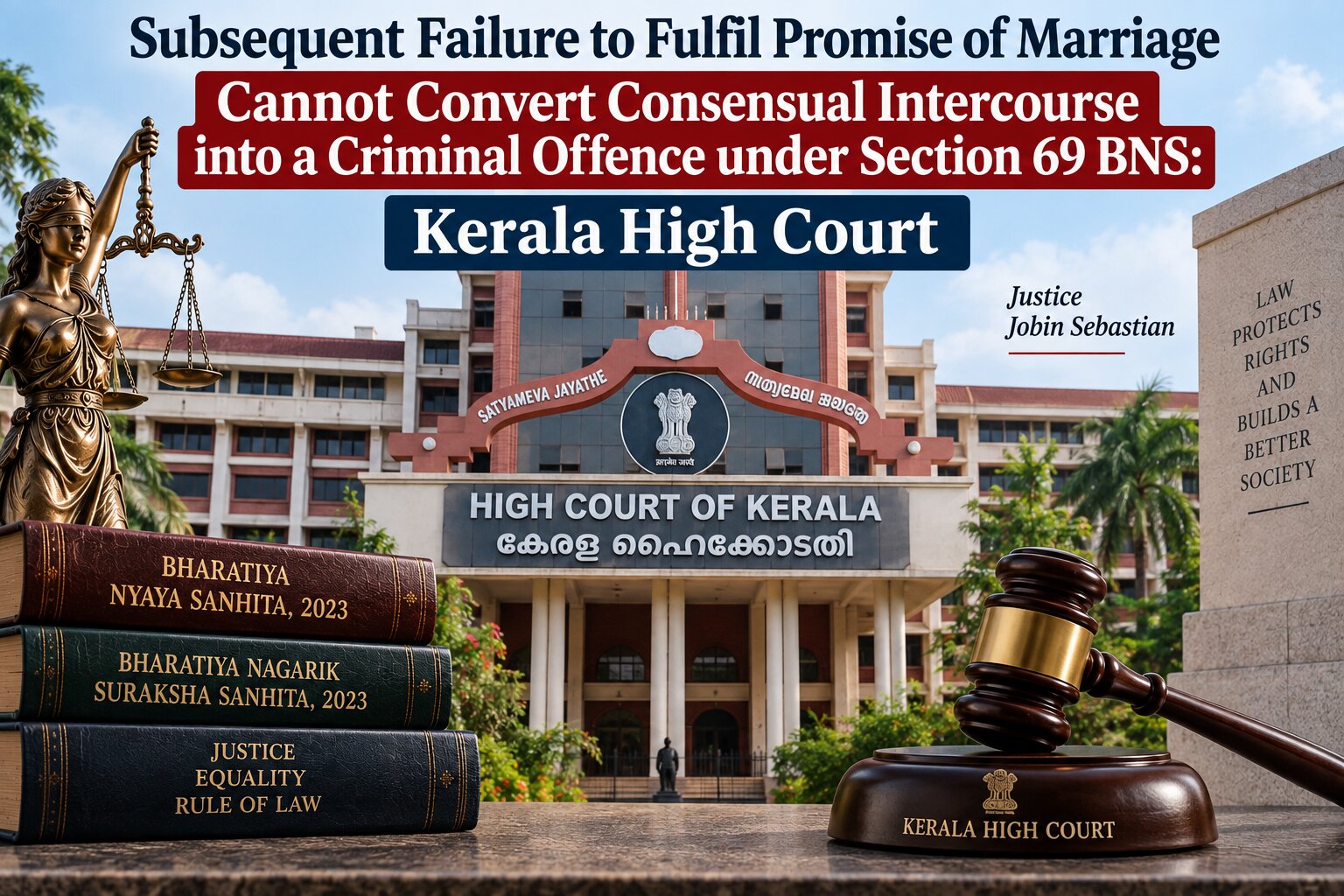
A subsequent failure to marry does not by itself make consensual sexual intercourse an offence under Section 69 BNS.
Judgement Details
Court
Kerala High Court
Date of Decision
10 September 2026
Judges
Justice Jobin Sebastian
Citation
Acts / Provisions
Facts of the Case
-
The prosecution case arose from a relationship between the petitioner and the de facto complainant, during which they allegedly had sexual intercourse at different places.
-
According to the First Information Statement (FIS), the relationship commenced in February 2026 and the petitioner allegedly made a promise of marriage.
-
The complainant subsequently became pregnant.
-
It was alleged that after learning about the pregnancy, the petitioner asked the complainant to abort the child.
-
The petitioner argued that the FIS itself disclosed that the sexual relationship was consensual.
-
It was also pointed out that when the relationship allegedly commenced, the complainant was still legally married to another person and her marriage had not yet been dissolved.
-
The complainant obtained a divorce in March 2026 and subsequently became engaged to the petitioner on 11 March 2026.
-
The FIS alleged that the parties had sexual intercourse repeatedly and at different locations, including the houses of the petitioner and the complainant.
-
The petitioner approached the High Court under Section 528 BNSS, seeking quashing of the criminal proceedings.
-
The High Court examined whether the allegations in the FIS, taken at their face value, disclosed the essential ingredients of Section 69 BNS and Section 316(2) BNS.
Issues
-
Whether the allegations in the FIS prima facie establish that the petitioner obtained the complainant's consent for sexual intercourse through a false promise of marriage within the meaning of Section 69 BNS?
-
Whether a subsequent failure to fulfil a promise of marriage can retrospectively transform otherwise consensual sexual intercourse into an offence under Section 69 BNS?
-
Whether the alleged continuing sexual relationship between the parties and the subsequent events establish a direct nexus between the alleged promise of marriage and the complainant's consent?
-
Whether the allegation that the petitioner asked the pregnant complainant to abort the child, coupled merely with the use of the expression “cheated,” constitutes an offence under Section 316(2) BNS?
-
Whether the High Court could quash the proceedings under Section 528 BNSS at the threshold without conducting a detailed appreciation of evidence?
Judgement
-
The Kerala High Court allowed the criminal miscellaneous case and quashed the FIR and all further proceedings against the petitioner.
-
The Court reiterated that while exercising jurisdiction under Section 528 BNSS, the High Court can examine whether the allegations, if accepted on their face, satisfy the ingredients of the alleged offences.
-
However, the High Court cannot conduct a mini-trial, meticulously assess evidence, or conclusively determine disputed questions of fact at the stage of considering a quashing petition.
-
The Court found that the FIS did not specifically allege that the petitioner knew about the complainant's pending divorce proceedings or that his alleged promise to marry was made with knowledge that the existing marriage had not been dissolved.
-
The allegations also did not provide the necessary factual foundation to establish that the promise of marriage was false from its very inception.
-
The Court held that the mere existence of a promise to marry is insufficient to attract Section 69 BNS unless there is material showing that the promise was false when it was made and that it had a direct nexus with the complainant's consent to the sexual act.
-
The Court distinguished between a false promise from the beginning and a subsequent failure to fulfil a genuine promise.
-
It held that a subsequent failure to marry cannot, by itself, retrospectively make consensual sexual intercourse criminal.
-
The repeated nature of the relationship and the fact that sexual intercourse allegedly occurred at different locations were relevant circumstances indicating a continuing relationship between consenting adults.
-
The complainant's subsequent divorce and later engagement with the petitioner could not, by themselves, establish that her initial consent had been obtained through deception.
-
Relying on the Supreme Court's decision in Mahesh Damu Khare v. State of Maharashtra, the Court emphasised the requirement of a direct nexus between the alleged promise and the sexual relationship.
-
The Court separately considered Section 316(2) BNS and held that merely describing the petitioner's conduct as having “cheated” the complainant does not establish the statutory ingredients of the offence.
-
Since the factual allegations did not disclose the essential ingredients of the offences alleged, continuation of the criminal proceedings was held to be unjustified.
Held
-
For Section 69 BNS to apply on the basis of a promise to marry, there must be material showing that the promise was false from its inception.
-
There must also be a direct nexus between the false promise and the woman's consent to the sexual act.
-
A genuine promise that is subsequently not fulfilled is legally distinguishable from a promise made without any intention of fulfilling it from the outset.
-
A continuing consensual relationship may be an important circumstance while determining whether the alleged promise actually vitiated consent.
-
The mere use of the word “cheated” in an FIS does not automatically establish the offence of cheating; the underlying facts must satisfy the statutory ingredients.
-
The High Court, while exercising inherent jurisdiction under Section 528 BNSS, may quash proceedings where the allegations themselves fail to disclose the ingredients of the alleged offence.
-
The High Court must nevertheless avoid appreciating evidence or conducting a mini-trial at the quashing stage.
Analysis
-
The judgment reinforces an important distinction under Section 69 BNS between deception existing at the inception of the relationship and a promise that subsequently remains unfulfilled.
-
Criminal liability cannot be imposed merely because a relationship involving a promise of marriage ultimately breaks down. The prosecution must establish the mental element existing when the promise was made.
-
The requirement of a direct causal connection between the promise and consent prevents every failed romantic relationship from automatically becoming a criminal prosecution under Section 69 BNS.
-
The Court's reliance on the continuing nature of the relationship is significant because repeated consensual interactions may make it difficult, at the threshold stage, to accept an allegation that the entire sexual relationship was induced solely by one false promise.
-
At the same time, the judgment does not establish that a prolonged relationship can never fall within Section 69 BNS. The decisive question remains whether the promise was false from inception and whether it directly induced the sexual relationship.
-
The ruling also demonstrates the importance of specific factual pleadings in criminal complaints. Simply alleging a promise to marry, followed by pregnancy or refusal to marry, may not be enough unless the complaint explains the circumstances demonstrating initial deception.
-
On the allegation under Section 316(2) BNS, the Court applied the established principle that legal conclusions or labels in a complaint cannot substitute for factual allegations satisfying the statutory ingredients.
-
Procedurally, the judgment maintains the narrow but important role of the High Court's inherent jurisdiction: it can prevent prosecution where the complaint itself does not disclose an offence, while leaving genuine factual disputes for the trial court.
-
The decision therefore provides guidance on the application of Section 69 BNS in consensual relationship cases, particularly where the alleged promise of marriage is followed by a later refusal to marry.