Allahabad High Court Questions Judicial Workload of Administrative Officers, Says Court Sittings Cannot Depend on SDM's Convenience
Lexpedia News · 4 September 2026 · 16 min read
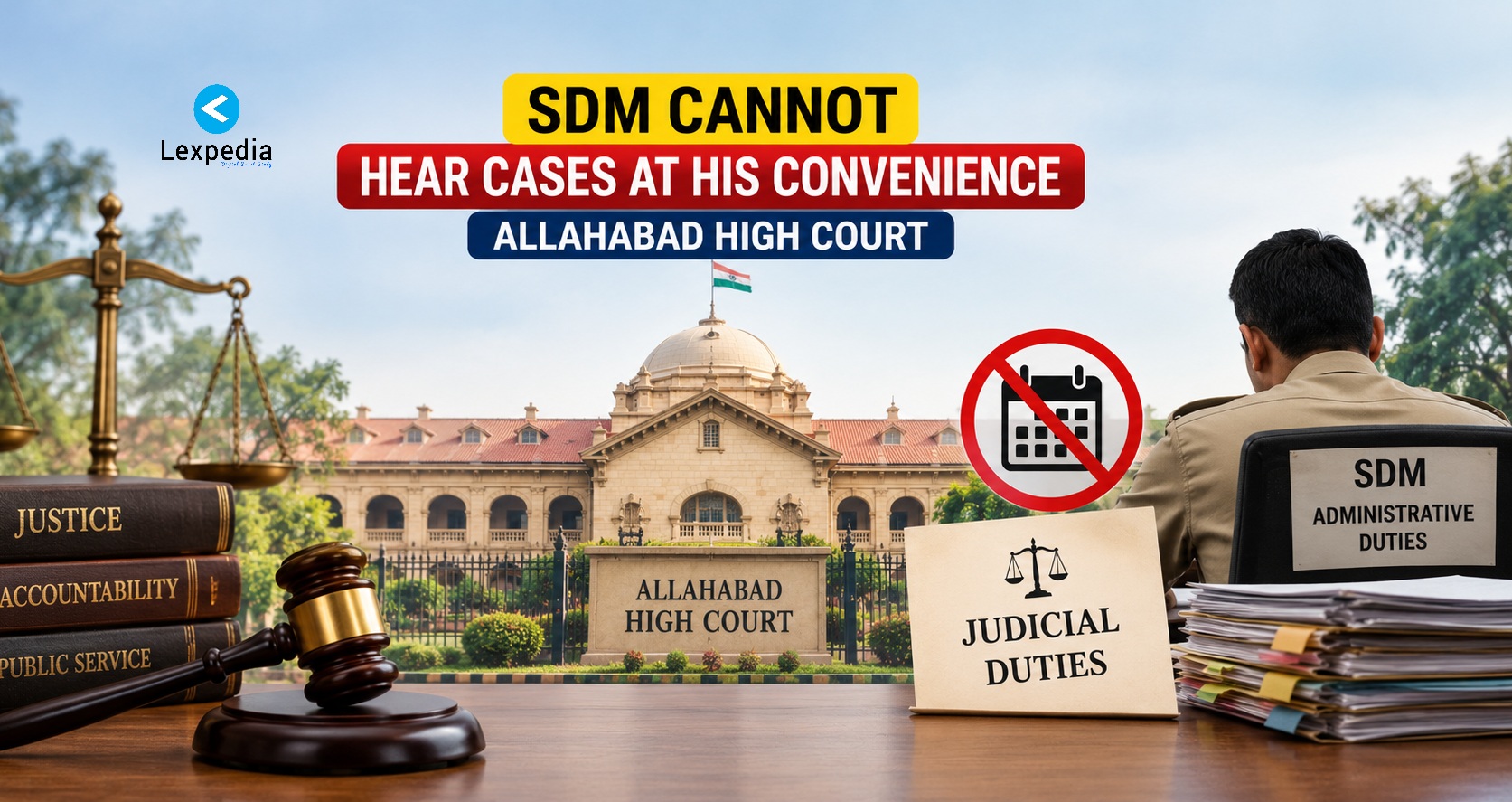
Bench directs Kanpur Nagar SDM to hold three effective hearings every week in senior citizens' maintenance case; asks State to consider entrusting such matters to trained judicial officers
Prayagraj/Lucknow: The Allahabad High Court has emphasised that judicial work must follow a disciplined and predetermined schedule and cannot be conducted according to the convenience of an officer who is simultaneously handling administrative responsibilities.
A Division Bench comprising Justice J.J. Munir and Justice Indrajeet Shukla made the observations while dealing with a petition concerning prolonged proceedings before the Sub-Divisional Magistrate (SDM), Sadar, Kanpur Nagar, who was functioning as a Maintenance Tribunal under the Maintenance and Welfare of Parents and Senior Citizens Act, 2007.
In its August 21, 2026 order in Amar Singh Yadav v. State of U.P. and Others, Writ-C No. 30243 of 2026, the Court said that if judicial functions are assigned to an administrative officer, the officer is required to complete judicial work before taking up administrative duties.
Case arose from delay before Maintenance Tribunal
The proceedings before the High Court arose from a complaint that a matter under the Maintenance and Welfare of Parents and Senior Citizens Act, 2007 had remained pending before the SDM, Sadar, Kanpur Nagar, without effective progress.
The High Court examined a report submitted by the SDM explaining the status of the proceedings.
According to the report reproduced in the High Court's order, no hearing could take place between July 1 and July 21, 2026 because the SDM was occupied with administrative work. A hearing was subsequently held on July 22, when the respondents filed their written response. The matter was then listed on July 29, and further proceedings took place on August 19, according to the report.
The explanation did not satisfy the High Court.
'Judicial work has a certain discipline'
The Bench stressed that judicial work requires discipline, with the schedule of court sittings being one of its most fundamental requirements.
The Court observed that judicial proceedings cannot be haphazard or dependent upon the convenience of the presiding officer.
Importantly, the observation was not limited to professionally trained judges. The Bench said that the requirement of adherence to a schedule applies to a court whether presided over by a Judge or by a lay/administrative presiding officer.
The Court therefore made clear that administrative responsibilities cannot simply result in judicial proceedings being put on hold.
SDM told to prioritise judicial work
The High Court specifically held that where judicial functions are conferred upon an administrative officer, including an SDM functioning as a Maintenance Tribunal, the officer would be obliged to dispose of judicial work first before taking up administrative duties.
The Court's direction was therefore not merely advisory in the context of the pending case.
It ordered that proceedings before the SDM, Sadar, Kanpur Nagar, acting as the Presiding Officer of the Maintenance Tribunal, should now proceed expeditiously.
The SDM was directed to fix three effective dates of hearing every week and pass the necessary orders.
The matter was adjourned to September 15, 2026, by which date the SDM has been directed to submit a fresh report regarding the status of the proceedings.
The Registrar (Compliance) was also directed to communicate the order to the Principal Secretary, Social Welfare Department, Government of Uttar Pradesh, as well as the concerned SDM through the respective Chief Judicial Magistrates.
High Court questions policy of assigning judicial functions to administrative officers
The more significant aspect of the order concerns the Bench's observations about the broader institutional arrangement.
The Court said it had repeatedly emphasised that entrusting judicial duties to administrative officers is not a good idea. At the same time, the Bench expressly acknowledged that the issue falls within the policy-making domain of the State, because the existing arrangement flows from statutory provisions.
The Bench said the State should consider whether such matters ought instead to be entrusted to trained and professional judges who are not burdened with administrative responsibilities and have a regular schedule devoted entirely to judicial work.
Thus, the order should not be read as an immediate direction abolishing the existing system or removing SDMs from Maintenance Tribunals. Rather, the Court has flagged the structural problem created when an officer has to balance judicial proceedings with administrative assignments.
What does the law currently provide?
The statutory framework is important to understand the Court's observations.
Under Section 7 of the Maintenance and Welfare of Parents and Senior Citizens Act, 2007, the State Government is required to constitute one or more Maintenance Tribunals for each sub-division.
Section 7(2) specifically provides that the Tribunal shall be presided over by an officer not below the rank of Sub-Divisional Officer.
Therefore, the involvement of an SDM in the present case was not an informal or unauthorised assignment. It forms part of the statutory structure created for adjudicating maintenance applications under the Act.
The Uttar Pradesh Maintenance and Welfare of Parents and Senior Citizens Rules, 2014 also define the term "Presiding Officer" with reference to an officer appointed to preside over a Maintenance Tribunal under Section 7 of the Act. The Rules provide for Maintenance Tribunals in each sub-division.
Maintenance Tribunal has adjudicatory responsibilities
The 2007 Act gives Maintenance Tribunals a specific adjudicatory role in proceedings relating to maintenance of parents and senior citizens.
Section 7 provides for their constitution, while Sections 8 and 9 deal with the procedure for inquiry and orders for maintenance. The Act also provides for an Appellate Tribunal, headed by an officer not below the rank of District Magistrate, for appeals against orders of the Maintenance Tribunal.
Consequently, although an SDM is fundamentally an administrative officer, when exercising powers as the Presiding Officer of a Maintenance Tribunal, the officer is performing a statutory adjudicatory function.
It was this overlap between administrative responsibilities and judicial/tribunal work that came into sharp focus before the High Court.
No current reassignment of SDM established by the order
The August 21 order does not direct that the Kanpur Nagar SDM be replaced by a judicial officer, nor does it direct the State Government to immediately alter the existing statutory arrangement.
Similarly, the latest publicly available Allahabad High Court listings checked for this report show that the High Court continues to publish its regular constitution of benches and supplementary bench assignments; those listings do not establish any reassignment arising from the August 21 order.
The distinction is significant: the Bench's comments about the desirability of having trained professional judges are a broader policy observation, while the operative direction in this particular case is that the existing SDM-led Maintenance Tribunal must proceed with the matter expeditiously.
Background: Why SDMs perform such functions
The arrangement exists because the 2007 Act deliberately places Maintenance Tribunals at the sub-divisional level and requires them to be presided over by an officer at least of SDO rank.
The legislative design seeks to provide senior citizens and parents with a relatively accessible mechanism for seeking maintenance without having to approach the regular civil court system for every dispute.
The statutory framework therefore combines administrative accessibility with adjudicatory powers.
The difficulty highlighted by the Allahabad High Court is that an officer performing both roles may face competing demands on time. If administrative assignments prevent regular tribunal sittings, cases may remain pending despite the statutory objective of providing an accessible and expeditious remedy.
High Court's focus is on timely justice
The order consequently places emphasis on a basic principle applicable to adjudicatory bodies: a judicial or quasi-judicial proceeding cannot be treated as an activity that can be taken up only when the presiding officer becomes available after administrative work.
For the litigant, the distinction between an administrative and judicial assignment does not eliminate the need for a predictable hearing schedule.
In the present case, the High Court has therefore prescribed a concrete mechanism—three effective hearing dates every week—rather than merely asking the SDM to dispose of the case "expeditiously."
Broader significance of the order
The order raises an institutional question extending beyond the individual senior-citizen dispute: whether officers who are simultaneously responsible for substantial administrative functions should continue to discharge adjudicatory responsibilities that require regular court sittings and dedicated judicial time.
The High Court has not itself resolved that policy question. Instead, it has indicated that the State should consider whether such responsibilities would be better handled by trained professional judges whose principal responsibility is judicial work.
For now, however, the statutory framework remains in operation, and the SDM concerned remains responsible for proceeding with the case in accordance with the High Court's directions.
The matter is next scheduled to come before the High Court on September 15, 2026, when the SDM is required to report on the progress of the proceedings.
Case: Amar Singh Yadav v. State of U.P. and Others
Writ Petition: Writ-C No. 30243 of 2026
Bench: Justice J.J. Munir and Justice Indrajeet Shukla
Order Date: August 21, 2026
Next Date: September 15, 2026
Counsel for Petitioner: Nikhil Pandey
Respondents: State of Uttar Pradesh and others.
प्रशासनिक अधिकारियों के न्यायिक कार्य पर इलाहाबाद हाईकोर्ट की अहम टिप्पणी, कहा- कोर्ट की कार्यवाही अधिकारी की सुविधा पर निर्भर नहीं हो सकती
वरिष्ठ नागरिकों के भरण-पोषण मामले में कानपुर नगर SDM को हर सप्ताह तीन प्रभावी सुनवाई करने का निर्देश; ऐसे मामलों को प्रशिक्षित न्यायिक अधिकारियों को सौंपने पर राज्य से विचार करने को कहा
प्रयागराज/लखनऊ: इलाहाबाद हाईकोर्ट ने कहा है कि न्यायिक कार्य एक निश्चित और अनुशासित समय-सारणी के अनुसार होना चाहिए और किसी ऐसे अधिकारी की सुविधा पर निर्भर नहीं रह सकता, जो एक साथ महत्वपूर्ण प्रशासनिक जिम्मेदारियां भी संभाल रहा हो।
न्यायमूर्ति जे.जे. मुनीर और न्यायमूर्ति इंद्रजीत शुक्ला की खंडपीठ ने यह टिप्पणी एक ऐसे मामले की सुनवाई के दौरान की, जिसमें कानपुर नगर के सदर क्षेत्र के उप-जिलाधिकारी (SDM) माता-पिता एवं वरिष्ठ नागरिकों का भरण-पोषण एवं कल्याण अधिनियम, 2007 के तहत गठित Maintenance Tribunal के पीठासीन अधिकारी के रूप में कार्य कर रहे थे।
21 अगस्त 2026 के आदेश में, Amar Singh Yadav v. State of U.P. and Others, Writ-C No. 30243 of 2026 में हाईकोर्ट ने कहा कि यदि किसी प्रशासनिक अधिकारी को न्यायिक कार्य सौंपा गया है, तो उसे प्रशासनिक कार्यों में जाने से पहले अपना न्यायिक कार्य निपटाना होगा।
Maintenance Tribunal में मामले की देरी से शुरू हुआ विवाद
हाईकोर्ट के समक्ष मामला एक ऐसे आवेदन से संबंधित था, जो Maintenance and Welfare of Parents and Senior Citizens Act, 2007 के तहत दायर किया गया था। आरोप था कि यह मामला SDM, सदर, कानपुर नगर के समक्ष लंबे समय से लंबित था और उसमें प्रभावी प्रगति नहीं हो रही थी।
हाईकोर्ट ने SDM द्वारा दाखिल की गई रिपोर्ट का परीक्षण किया।
हाईकोर्ट के आदेश में दर्ज रिपोर्ट के अनुसार, 1 जुलाई से 21 जुलाई 2026 के बीच सुनवाई नहीं हो सकी, क्योंकि SDM प्रशासनिक कार्यों में व्यस्त थे। इसके बाद 22 जुलाई को सुनवाई हुई, जिसमें प्रतिवादियों ने अपना जवाब दाखिल किया। 29 जुलाई को भी कार्यवाही हुई और 19 अगस्त को मामले की सुनवाई हुई, जैसा कि SDM की रिपोर्ट में बताया गया।
इस स्पष्टीकरण से हाईकोर्ट संतुष्ट नहीं हुआ।
'न्यायिक कार्य में एक निश्चित अनुशासन होता है'
खंडपीठ ने स्पष्ट किया कि न्यायिक कार्य के लिए अनुशासन आवश्यक है और इसमें सबसे महत्वपूर्ण पहलू अदालत के बैठने का निर्धारित समय है।
कोर्ट ने कहा कि न्यायिक कार्यवाही अनियमित तरीके से या पीठासीन अधिकारी की सुविधा के अनुसार नहीं चल सकती।
महत्वपूर्ण रूप से, हाईकोर्ट ने कहा कि यह आवश्यकता केवल नियमित न्यायाधीशों की अदालतों तक सीमित नहीं है। अदालत चाहे किसी न्यायाधीश की अध्यक्षता में हो या किसी प्रशासनिक/अन्य पीठासीन अधिकारी की, उसे निर्धारित सुनवाई कार्यक्रम का पालन करना होगा।
इसका अर्थ है कि प्रशासनिक जिम्मेदारियों के कारण न्यायिक कार्य को अनिश्चित समय तक टाला नहीं जा सकता।
SDM को न्यायिक कार्य को प्राथमिकता देने का निर्देश
हाईकोर्ट ने स्पष्ट रूप से कहा कि जब किसी प्रशासनिक अधिकारी को न्यायिक कार्य सौंपा जाता है, जिसमें वरिष्ठ नागरिकों के कानून के तहत Maintenance Tribunal के रूप में कार्य करने वाला SDM भी शामिल है, तो अधिकारी को प्रशासनिक कार्य शुरू करने से पहले अपना न्यायिक कार्य निपटाना होगा।
इस मामले में कोर्ट ने केवल सामान्य टिप्पणी नहीं की, बल्कि ठोस दिशा-निर्देश भी दिए।
हाईकोर्ट ने SDM, सदर, कानपुर नगर, जो Maintenance Tribunal के पीठासीन अधिकारी के रूप में कार्य कर रहे हैं, को मामले की कार्यवाही तेजी से आगे बढ़ाने का निर्देश दिया।
SDM को निर्देश दिया गया कि हर सप्ताह तीन प्रभावी सुनवाई की तारीखें निर्धारित की जाएं और आवश्यक आदेश पारित किए जाएं।
मामले को 15 सितंबर 2026 के लिए स्थगित किया गया है। उस तारीख तक SDM को मामले की प्रगति के संबंध में हाईकोर्ट के समक्ष नई रिपोर्ट प्रस्तुत करनी होगी।
रजिस्ट्रार (Compliance) को यह आदेश उत्तर प्रदेश सरकार के समाज कल्याण विभाग के Principal Secretary तथा संबंधित SDM तक संबंधित मुख्य न्यायिक मजिस्ट्रेटों के माध्यम से 24 घंटे के भीतर पहुंचाने का निर्देश भी दिया गया।
प्रशासनिक अधिकारियों को न्यायिक कार्य देने की नीति पर सवाल
आदेश का सबसे महत्वपूर्ण पहलू प्रशासनिक अधिकारियों को न्यायिक कार्य सौंपने की व्यापक संस्थागत व्यवस्था पर हाईकोर्ट की टिप्पणी है।
कोर्ट ने कहा कि वह पहले भी इस बात पर जोर देता रहा है कि प्रशासनिक अधिकारियों को न्यायिक कार्य सौंपना अच्छा विचार नहीं है। हालांकि, खंडपीठ ने साथ ही यह भी स्पष्ट किया कि यह विषय राज्य की नीति-निर्माण की सीमा में आता है, क्योंकि वर्तमान व्यवस्था कानून और वैधानिक प्रावधानों से जुड़ी हुई है।
हाईकोर्ट ने कहा कि राज्य को इस बात पर विचार करना चाहिए कि ऐसे मामलों को प्रशिक्षित और पेशेवर न्यायाधीशों को सौंपा जाए, जो प्रशासनिक जिम्मेदारियों से मुक्त हों और जिनकी नियमित समय-सारणी पूरी तरह न्यायिक कार्य के लिए समर्पित हो।
इसलिए इस आदेश को यह मानना सही नहीं होगा कि हाईकोर्ट ने तत्काल प्रभाव से SDMs को Maintenance Tribunals से हटाने या उनकी जगह न्यायिक अधिकारियों की नियुक्ति का आदेश दे दिया है।
इसके बजाय, कोर्ट ने प्रशासनिक और न्यायिक जिम्मेदारियों के एक साथ होने से उत्पन्न संरचनात्मक समस्या को रेखांकित किया है।
वर्तमान कानून क्या कहता है?
इस मामले को समझने के लिए मौजूदा वैधानिक व्यवस्था महत्वपूर्ण है।
Maintenance and Welfare of Parents and Senior Citizens Act, 2007 की Section 7 के तहत राज्य सरकार को प्रत्येक उपखंड के लिए एक या अधिक Maintenance Tribunals गठित करने होते हैं।
Section 7(2) में स्पष्ट रूप से कहा गया है कि Tribunal की अध्यक्षता ऐसे अधिकारी द्वारा की जाएगी, जो Sub-Divisional Officer के पद से नीचे के रैंक का न हो।
इसलिए वर्तमान मामले में SDM का Maintenance Tribunal के रूप में कार्य करना अनौपचारिक या बिना कानूनी आधार का प्रशासनिक असाइनमेंट नहीं था। यह 2007 के कानून में बनाई गई वैधानिक व्यवस्था का हिस्सा है।
इसी प्रकार, Uttar Pradesh Maintenance and Welfare of Parents and Senior Citizens Rules, 2014 में "Presiding Officer" की परिभाषा Maintenance Tribunal के लिए Section 7 के तहत नियुक्त अधिकारी के संदर्भ में की गई है। नियमों में प्रत्येक उपखंड में Maintenance Tribunal की व्यवस्था भी की गई है।
Maintenance Tribunal का कार्य केवल प्रशासनिक नहीं
2007 का कानून Maintenance Tribunal को माता-पिता और वरिष्ठ नागरिकों के भरण-पोषण से संबंधित मामलों में निर्णय लेने की जिम्मेदारी देता है।
Act की Section 7 Tribunal के गठन से संबंधित है, जबकि Sections 8 और 9 क्रमशः जांच की प्रक्रिया और भरण-पोषण के आदेश से संबंधित हैं। कानून में Tribunal के आदेशों के खिलाफ अपील के लिए Appellate Tribunal का भी प्रावधान है, जिसकी अध्यक्षता District Magistrate से नीचे रैंक के अधिकारी द्वारा नहीं की जा सकती।
इस प्रकार, भले ही SDM मूल रूप से एक प्रशासनिक अधिकारी हो, लेकिन जब वह Maintenance Tribunal के पीठासीन अधिकारी के रूप में कार्य करता है, तब वह वैधानिक न्यायिक/अर्ध-न्यायिक कार्य करता है।
इसी प्रशासनिक जिम्मेदारियों और न्यायिक कार्य के बीच टकराव पर इस मामले में हाईकोर्ट का ध्यान गया।
SDM के पुनर्नियुक्ति या तबादले का कोई आधिकारिक आदेश सामने नहीं
21 अगस्त के हाईकोर्ट के आदेश में यह निर्देश नहीं दिया गया कि कानपुर नगर के SDM को Maintenance Tribunal के पद से हटाकर किसी न्यायिक अधिकारी को नियुक्त किया जाए। न ही आदेश में राज्य सरकार को मौजूदा वैधानिक व्यवस्था को तत्काल बदलने का निर्देश दिया गया है।
इसी तरह, इस रिपोर्ट के लिए जांचे गए इलाहाबाद हाईकोर्ट के नवीनतम सार्वजनिक Bench Constitution और Supplementary Bench Assignment रिकॉर्ड में भी ऐसा कोई आदेश नहीं मिला, जिससे 21 अगस्त के आदेश के कारण संबंधित SDM के किसी पुनर्नियोजन की पुष्टि होती हो।
यह अंतर महत्वपूर्ण है। प्रशिक्षित न्यायिक अधिकारियों को ऐसे कार्य सौंपे जाने चाहिए, यह हाईकोर्ट की व्यापक नीति संबंधी टिप्पणी है; जबकि इस मामले में लागू किया गया आदेश यह है कि मौजूदा SDM-led Maintenance Tribunal को ही मामले की सुनवाई तेजी से करनी है।
SDMs को ऐसे कार्य क्यों मिलते हैं?
यह व्यवस्था इसलिए अस्तित्व में है क्योंकि 2007 के कानून ने Maintenance Tribunals को उपखंड स्तर पर स्थापित करने और उनकी अध्यक्षता कम से कम SDO रैंक के अधिकारी से कराने की व्यवस्था की है।
इसका उद्देश्य वरिष्ठ नागरिकों और माता-पिता को भरण-पोषण के लिए एक ऐसा तंत्र उपलब्ध कराना है, जो स्थानीय और अपेक्षाकृत आसानी से सुलभ हो तथा प्रत्येक मामले के लिए उन्हें नियमित दीवानी अदालत की लंबी प्रक्रिया में जाने की आवश्यकता न पड़े।
इस प्रकार कानून में प्रशासनिक पहुंच और निर्णयात्मक अधिकार, दोनों को एक व्यवस्था में जोड़ा गया है।
हाईकोर्ट की चिंता यह है कि जब एक ही अधिकारी को प्रशासनिक और न्यायिक दोनों जिम्मेदारियां निभानी पड़ती हैं, तो उसके समय पर दबाव पड़ सकता है। यदि प्रशासनिक कार्यों के कारण Tribunal की नियमित सुनवाई प्रभावित होती है, तो वरिष्ठ नागरिकों के लिए बनाए गए त्वरित और सुलभ कानूनी उपाय का उद्देश्य कमजोर हो सकता है।
हाईकोर्ट का मुख्य जोर समय पर न्याय देने पर
इस आदेश में मूल रूप से एक महत्वपूर्ण सिद्धांत पर जोर दिया गया है—न्यायिक या अर्ध-न्यायिक कार्य ऐसा काम नहीं हो सकता, जिसे प्रशासनिक कार्यों से समय मिलने पर ही किया जाए।
किसी अधिकारी के पास प्रशासनिक जिम्मेदारियां होने के बावजूद, यदि वह न्यायिक/अर्ध-न्यायिक भूमिका में बैठ रहा है, तो पक्षकारों के लिए निश्चित और पूर्वानुमेय सुनवाई व्यवस्था आवश्यक है।
इसीलिए हाईकोर्ट ने केवल यह कहकर मामला समाप्त नहीं किया कि SDM को इसे "जल्द" निपटाना चाहिए। कोर्ट ने एक ठोस व्यवस्था बनाते हुए हर सप्ताह तीन प्रभावी सुनवाई करने का निर्देश दिया है।
आदेश का व्यापक महत्व
यह आदेश एक व्यक्तिगत वरिष्ठ नागरिक मामले से आगे बढ़कर एक महत्वपूर्ण संस्थागत सवाल उठाता है:
क्या ऐसे अधिकारियों को, जो पहले से महत्वपूर्ण प्रशासनिक जिम्मेदारियां निभा रहे हैं, ऐसे न्यायिक या अर्ध-न्यायिक कार्य भी सौंपे जाने चाहिए जिनके लिए नियमित सुनवाई और समर्पित समय की आवश्यकता होती है?
हाईकोर्ट ने इस नीति संबंधी प्रश्न का अंतिम समाधान स्वयं नहीं किया है। इसके बजाय उसने राज्य को इस बात पर विचार करने का संकेत दिया है कि ऐसे कार्य प्रशिक्षित पेशेवर न्यायाधीशों को सौंपना अधिक प्रभावी हो सकता है, जिनका मुख्य दायित्व न्यायिक कार्य हो।
फिलहाल, हालांकि, मौजूदा वैधानिक व्यवस्था लागू है और संबंधित SDM को हाईकोर्ट के निर्देशों के अनुसार मामले की सुनवाई आगे बढ़ानी होगी।
मामला 15 सितंबर 2026 को फिर हाईकोर्ट के समक्ष आएगा। उस दिन SDM को कार्यवाही की प्रगति के संबंध में रिपोर्ट प्रस्तुत करनी होगी।
मामले की मुख्य जानकारी
मामला: Amar Singh Yadav v. State of U.P. and Others
रिट याचिका: Writ-C No. 30243 of 2026
पीठ: न्यायमूर्ति जे.जे. मुनीर और न्यायमूर्ति इंद्रजीत शुक्ला
आदेश की तारीख: 21 अगस्त 2026
अगली तारीख: 15 सितंबर 2026
याचिकाकर्ता के अधिवक्ता: निखिल पांडे
प्रतिवादी: उत्तर प्रदेश राज्य एवं अन्य।