Supreme Court Modifies Mandatory Legal Practice Rule for Civil Judge Entry: Practice Cut to 1 Year with Mandatory Training and Clerkship
Lexpedia News · 21 August 2026 · 5 min read
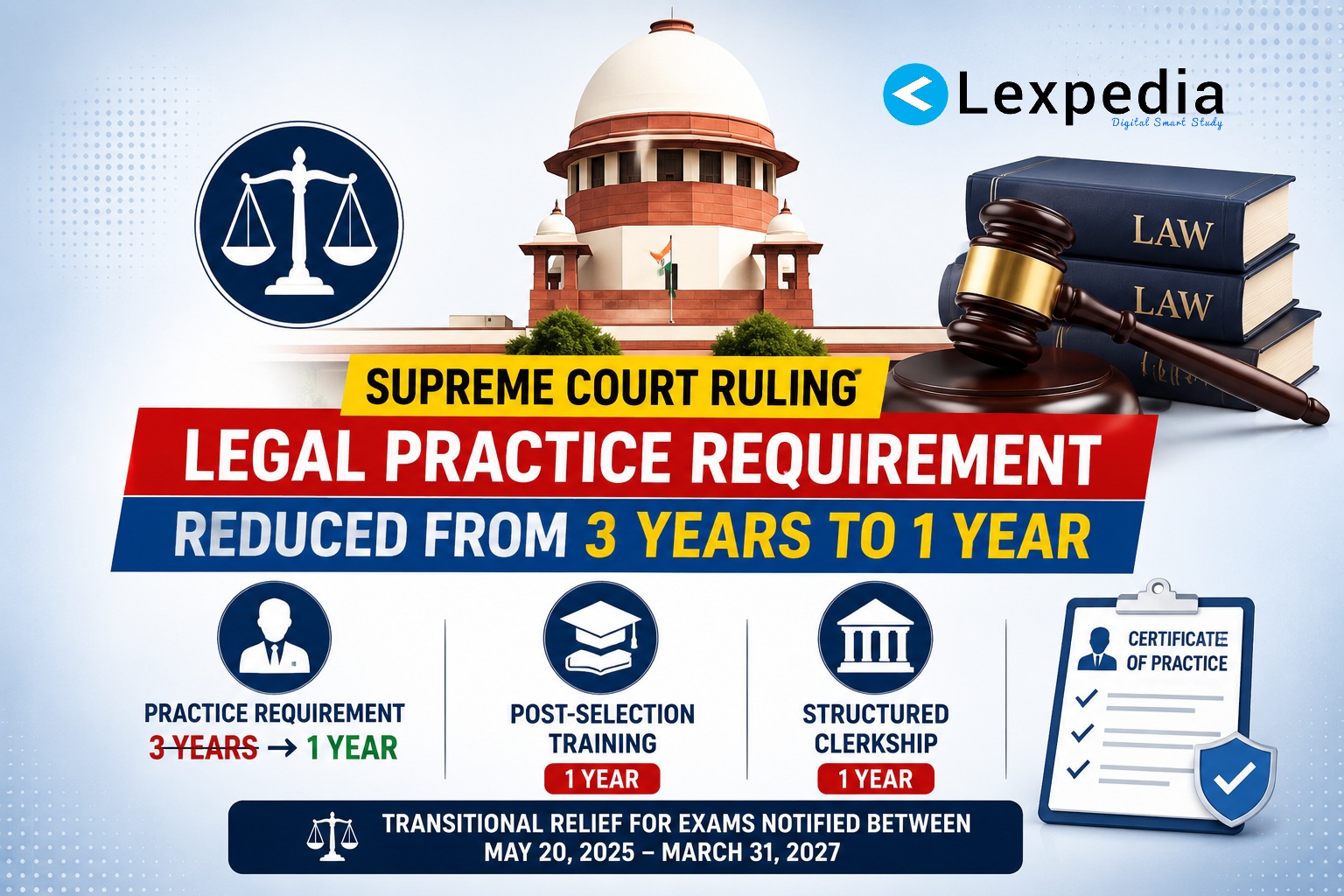
In a landmark ruling, a three-judge Bench of the Supreme Court of India modified its earlier May 2025 decision, reducing the mandatory legal practice requirement for candidates appearing for entry-level judicial service examinations—Civil Judge (Junior Division)—from three years to one year.
The judgment was delivered by a 2:1 majority, with Chief Justice of India Surya Kant and Justice Augustine George Masih forming the majority, while Justice K. Vinod Chandran issued a dissenting opinion.
Key Highlights of the Supreme Court Ruling
-
Practice Requirement Reduced: The prior practice at the Bar required to take the entry-level judicial service exam has been reduced from three years to one year for recruitment notifications issued on or after April 1, 2027.
-
Transitional Exemption (May 20, 2025 – March 31, 2027): For examinations notified during this transitional window, all fresh law graduates remain eligible to apply without proving prior Bar practice. They will be deemed to have completed one year of active practice.
-
Post-Selection Training & Clerkship Model: Selected candidates will not immediately assume regular bench duties. Instead, they will undergo:
-
1 Year of Training at the respective State Judicial Academy as Trainee Judicial Officers.
-
1 Year of Structured Clerkship, spent under the supervision of a Principal District Judge or Higher Judicial Service Officer (first 6 months) and sitting High Court Judges (remaining 6 months).
-
-
Verification of Practice: For post-2027 recruitments, active practice must be established via a Certificate of Practice verifying participation in effective court proceedings.
Reasoning Behind the Relief
Pronouncing the majority verdict, Chief Justice Surya Kant clarified that the Court found no reason to overturn the core principle that aspiring judges require courtroom exposure. However, the bench recognized that the abrupt restoration of the three-year rule in May 2025 without a transition period had created immense hardship for law graduates and young advocates who had structured their careers under the prior rules.
The Court observed that prior experience criteria must maintain a reasonable nexus to its objective and avoid creating disproportionate barriers for young lawyers, particularly impacting women candidates and aspirants from marginalized backgrounds.
Dissenting Opinion
Justice K. Vinod Chandran dissented from the majority view, stating that there was no valid ground to review or alter the May 2025 judgment. He maintained that a full three-year Bar experience remains essential before an individual assumes judicial functions to handle litigation complexly and independently.
Future Outlook
The Supreme Court noted that this revised structure—combining 1 year of Bar practice, 1 year of Judicial Academy training, and 1 year of judicial clerkship—will run as an institutional framework. The apex court will review the scheme after three years based on assessment reports detailing the quality of recruitment and performance indicators.
सुप्रीम कोर्ट ने सिविल जज प्रवेश परीक्षा के लिए अनिवार्य लीगल प्रैक्टिस की अवधि 3 साल से घटाकर 1 साल की: चयनित उम्मीदवारों को 1 साल की ट्रेनिंग और 1 साल की क्लर्कशिप करनी होगी
एक ऐतिहासिक फैसले में, भारत के सर्वोच्च न्यायालय की तीन न्यायाधीशों की पीठ ने अपने मई 2025 के फैसले को संशोधित करते हुए प्रवेश स्तर की न्यायिक सेवा परीक्षा—सिविल जज (जूनियर डिविजन)—में शामिल होने वाले उम्मीदवारों के लिए अनिवार्य वकालत अनुभव (लीगल प्रैक्टिस) को तीन साल से घटाकर एक साल कर दिया है।
यह फैसला 2:1 के बहुमत से सुनाया गया, जिसमें भारत के मुख्य न्यायाधीश सूर्यकांत और न्यायमूर्ति ऑगस्टीन जॉर्ज मसीह बहुमत में रहे, जबकि न्यायमूर्ति के. विनोद चंद्रन ने अपनी असहमति (डिसेंट) दर्ज की।
सुप्रीम कोर्ट के फैसले के मुख्य बिंदु
-
प्रैक्टिस की अवधि में कटौती: 1 अप्रैल 2027 को या उसके बाद जारी होने वाली भर्ती अधिसूचनाओं के लिए न्यायिक परीक्षा में बैठने हेतु आवश्यक न्यूनतम वकालत अनुभव को तीन वर्ष से घटाकर एक वर्ष कर दिया गया है।
-
संक्रमणकालीन छूट (20 मई 2025 से 31 मार्च 2027): इस अवधि के दौरान अधिसूचित होने वाली परीक्षाओं में सभी नए लॉ ग्रेजुएट्स बिना वकालत का अनुभव दिखाए भी आवेदन करने के पात्र होंगे। उन्हें आवेदन पत्र के उद्देश्य से एक वर्ष की सक्रिय प्रैक्टिस पूर्ण मानी जाएगी।
-
चयन के बाद ट्रेनिंग और क्लर्कशिप: चुने गए उम्मीदवार सीधे तौर पर जज के रूप में पीठ पर नहीं बैठेंगे। इसके बजाय उन्हें निम्नलिखित प्रक्रियाओं से गुजरना होगा:
-
संबंधित राज्य न्यायिक अकादमी में प्रशिक्षु न्यायिक अधिकारी (ट्रेनी ज्यूडिशियल ऑफिसर) के रूप में 1 वर्ष का प्रशिक्षण।
-
1 वर्ष की संरचित क्लर्कशिप, जिसमें पहले 6 महीने प्रधान जिला न्यायाधीश या उच्चतर न्यायिक सेवा अधिकारी के अधीन और शेष 6 महीने उच्च न्यायालय के न्यायाधीशों की देखरेख में व्यतीत होंगे।
-
-
प्रैक्टिस का सत्यापन: 2027 के बाद की भर्तियों के लिए, उम्मीदवार की सक्रिय प्रैक्टिस को प्रैक्टिस प्रमाण पत्र (सर्टिफिकेट ऑफ प्रैक्टिस) के माध्यम से सत्यापित किया जाएगा।
राहत देने के पीछे का कारण
बहुमत का फैसला सुनाते हुए मुख्य न्यायाधीश सूर्यकांत ने स्पष्ट किया कि अदालत को इस मूल सिद्धांत से हटने का कोई कारण नहीं दिखा कि भावी जजों के पास अदालती कार्यवाही का अनुभव होना चाहिए। हालांकि, पीठ ने स्वीकार किया कि बिना किसी अंतरिम व्यवस्था के मई 2025 में अचानक 3 साल का नियम लागू करने से उन नए कानून स्नातकों और युवा वकीलों को भारी कठिनाई हुई थी, जिन्होंने पुरानी व्यवस्था के आधार पर अपने करियर की योजना बनाई थी।
अदालत ने टिप्पणी की कि पूर्व अनुभव की शर्त का उद्देश्य से तार्किक संबंध होना चाहिए और यह युवा अधिवक्ताओं, विशेष रूप से महिला उम्मीदवारों पर अनुचित बोझ नहीं डालनी चाहिए।
असहमत न्यायधीश का रुख
न्यायमूर्ति के. विनोद चंद्रन ने बहुमत के विचार से असहमति व्यक्त करते हुए कहा कि मई 2025 के फैसले की समीक्षा करने का कोई वैध आधार नहीं था। उनका मानना था कि न्यायिक जिम्मेदारियों को स्वतंत्र रूप से संभालने से पहले 3 वर्ष का वकालत अनुभव बेहद आवश्यक है।
आगे की राह
सुप्रीम कोर्ट ने स्पष्ट किया कि 1 वर्ष का वकालत अनुभव, 1 वर्ष की अकादमी ट्रेनिंग, और 1 वर्ष की ज्यूडिशियल क्लर्कशिप का यह नया मॉडल अगले तीन वर्षों तक लागू रहेगा, जिसके बाद इसकी समीक्षा की जाएगी।