Supreme Court Releases Draft AI Regulations for Courts: Human Judges to Remain Supreme, AI-Based Decision-Making Prohibited
Lexpedia News · 5 June 2026 · 7 min read
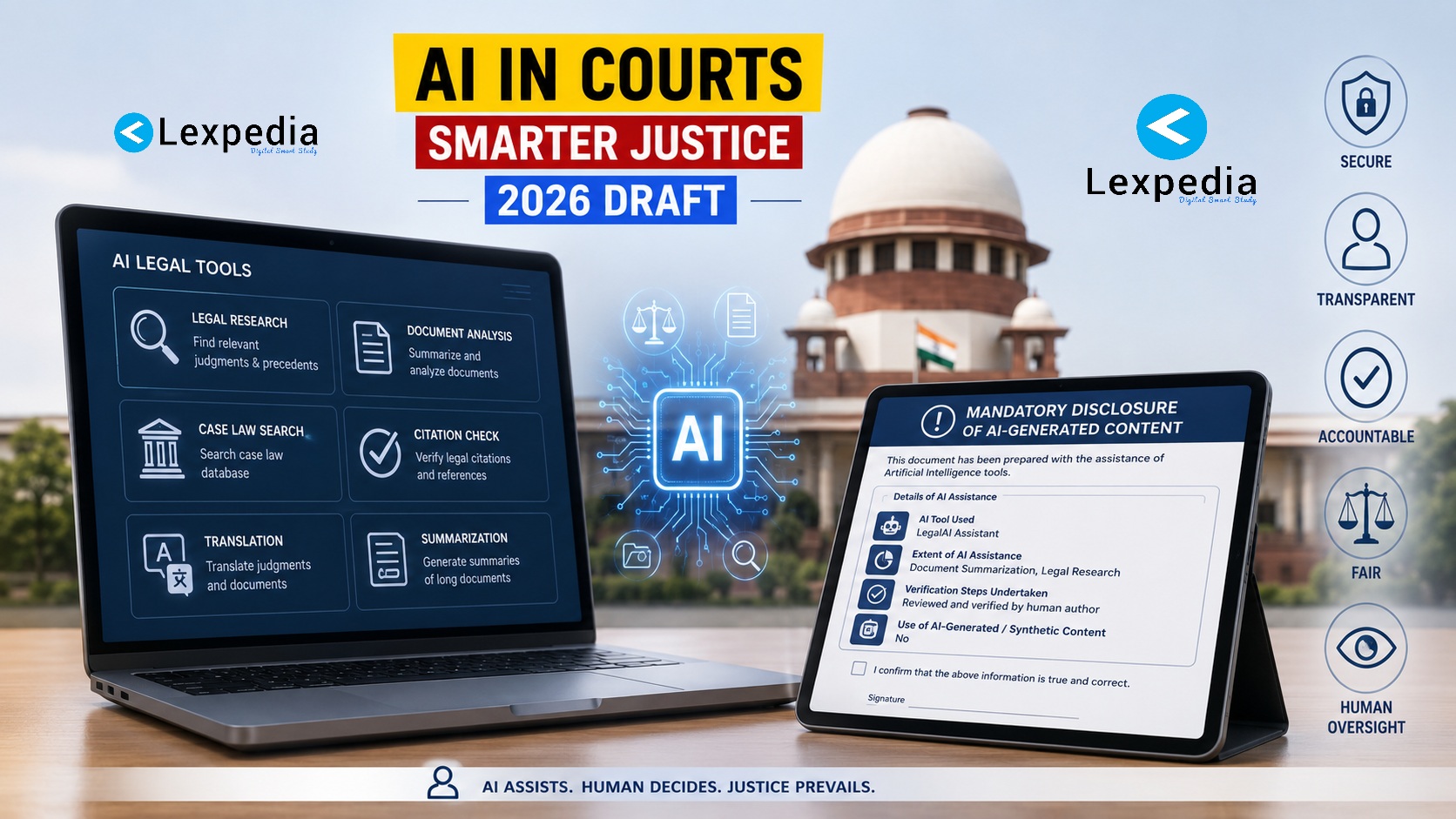
In a landmark step towards regulating the use of Artificial Intelligence (AI) within India's judicial system, the Supreme Court of India has released a comprehensive draft titled "Regulations for Use of Artificial Intelligence in Courts, 2026" and invited comments from stakeholders and the general public.
The draft framework seeks to establish a uniform national policy governing the adoption, deployment, oversight and regulation of AI tools across the Supreme Court, High Courts, subordinate courts, tribunals and statutory commissions performing adjudicatory functions. The Supreme Court's AI Committee has prepared the draft after extensive deliberations and consultations, emphasizing that AI must operate within a framework rooted in judicial independence, human primacy, transparency, accountability and data protection.
Public Consultation Invited
The Supreme Court has published the draft regulations and invited suggestions from all stakeholders, including judges, lawyers, academics, technology experts, institutions and members of the public. Comments may be submitted to the AI Committee by 20 June 2026.
The move represents one of the most detailed judicial AI governance frameworks proposed anywhere in the world and reflects India's attempt to balance technological innovation with constitutional safeguards.
Human Judges Will Always Have the Final Say
At the heart of the draft regulations is a fundamental principle: AI can assist but can never replace judges.
The regulations explicitly state that AI systems must remain strictly subordinate to human judgment and judicial authority. Every AI tool deployed in courts must function only in an assistive capacity, while the ultimate authority to determine questions of law, facts and justice shall remain exclusively with judicial officers.
The draft also makes it clear that no judge or court official can evade responsibility by blaming an AI-generated error, a "black-box" system, or an AI hallucination. Accountability for decisions will continue to rest with the human decision-maker.
Supreme Court Rejects AI-Based Judicial Decision-Making
One of the most significant features of the draft is its categorical prohibition on AI-driven adjudication.
The regulations expressly prohibit:
- AI-generated judgments or orders without human determination;
- Algorithmic decision-making in judicial matters;
- AI-based sentencing;
- Risk-scoring systems for bail or criminal justice decisions;
- Predictive profiling of litigants, witnesses or accused persons;
- AI tools that attempt to predict future behaviour or criminal conduct;
- AI-based assessment of witness credibility.
This means Indian courts will not be permitted to adopt controversial AI systems used in some jurisdictions that evaluate recidivism risks or recommend bail outcomes.
The draft firmly establishes that all adjudicatory decisions must remain under meaningful human control through a mandatory "Human-in-the-Loop" mechanism.
AI Allowed for Administrative and Assistive Functions
While judicial decision-making remains off-limits, the regulations encourage responsible AI adoption in various court functions.
The draft permits AI tools for:
- Case management and docket administration;
- Automated defect detection in filings;
- Cause list preparation;
- Hearing scheduling;
- Automated transcription of court proceedings;
- Translation of judgments and legal documents;
- Legal research and precedent retrieval;
- Citation verification;
- Document summarisation;
- Litigant assistance chatbots;
- Accessibility services for persons with disabilities;
- Fraud detection in administrative processes;
- Anonymisation of judgments and court records;
- Court performance analytics and backlog management.
However, nearly all such uses remain subject to human supervision and verification.
Strong Focus on Transparency and Explainability
The proposed regulations require AI systems used in courts to be transparent and explainable.
Judicial officers, litigants and affected parties must be capable of understanding how an AI system arrived at a particular recommendation or output. Systems that operate as opaque "black boxes" will face heightened scrutiny, particularly in situations affecting personal liberty or legal rights.
The draft recognises the growing concern around AI hallucinations and explicitly defines them as outputs that appear plausible but are factually incorrect, fabricated or misleading.
Courts using AI systems will be required to continuously monitor, audit and evaluate such risks.
Mandatory Disclosure of AI-Generated Content
The regulations introduce a major compliance obligation for lawyers and litigants.
Whenever AI is used to prepare pleadings, documents, evidence or submissions, the AI-assisted nature of the material must be disclosed to the court through a prescribed declaration.
Parties may also be required to reveal:
- The AI system used;
- The extent of AI assistance;
- Verification steps undertaken;
- Whether synthetic or AI-generated information has been relied upon.
The draft further provides that if AI-generated material is later found to be false, fabricated or misleading, the person submitting it will remain fully responsible and cannot rely on the AI system as a defence.
Creation of a National AI Governance Structure for Judiciary
To regulate AI adoption across courts, the draft proposes an extensive institutional framework.
Apex Body at Supreme Court
A permanent national-level Apex Body is proposed to oversee AI governance within the judiciary.
The body would include:
- Supreme Court judges;
- Chief Justices of High Courts;
- High Court judges;
- Technology experts;
- Cybersecurity specialists;
- Finance experts;
- Representatives from MeitY;
- Senior advocates with expertise in technology law;
- Academic experts.
The Apex Body would establish standards, approve AI systems, issue guidelines and coordinate AI governance across the country.
AI Committees in Every High Court
Each High Court and the Supreme Court would establish dedicated AI Committees responsible for:
- Approving AI tools;
- Monitoring compliance;
- Conducting impact assessments;
- Investigating AI incidents;
- Supervising audits;
- Preparing annual reports on AI adoption.
Dedicated AI Secretariats would support these committees with technical and administrative expertise.
Annual Audits and AI Incident Reporting
The draft proposes strict monitoring mechanisms.
Every AI system deployed in courts must undergo:
- Technical audits;
- Legal audits;
- Ethical audits;
- Cybersecurity reviews.
These audits must be conducted at least once every year.
Courts will also maintain an AI Incident Database documenting malfunctions, biases, data breaches and harmful outputs.
Any AI-related error with potential legal consequences must be reported immediately to the AI Secretariat for remedial action.
Special Protection for Judicial Data
Recognising the sensitivity of court records, the draft introduces stringent data protection safeguards.
Sensitive judicial data cannot be transferred to external systems without prior approval.
The regulations require:
- Data minimisation;
- Privacy-by-design architecture;
- Anonymisation wherever feasible;
- Restricted access controls;
- Regular cybersecurity audits;
- Compliance with the Digital Personal Data Protection Act, 2023 and the Information Technology Act, 2000.
Private vendors handling judicial AI systems will also be subject to extensive contractual obligations and oversight.
AI Training for Judges, Lawyers and Court Staff
The regulations envisage large-scale capacity building across the justice system.
Judges, advocates and court staff using AI tools would undergo regular training covering:
- Technical functioning of AI systems;
- AI bias and hallucinations;
- Legal and ethical considerations;
- Cybersecurity;
- Data protection;
- Incident reporting mechanisms.
Training programs are expected to be available across all levels of the judiciary, including district courts.
Encouraging Innovation While Protecting Rights
Interestingly, the draft adopts what it describes as a presumption in favour of "responsible AI adoption."
Rather than treating AI as a threat, the regulations encourage courts to actively explore AI tools that can reduce delays, improve efficiency and expand access to justice.
At the same time, the framework draws clear red lines around judicial independence, fairness, privacy and due process.
Significance of the Draft
The proposed regulations represent India's most comprehensive judicial AI governance initiative to date. They acknowledge both the transformative potential and inherent risks of AI within the justice delivery system.
If implemented, the framework could serve as a model for AI governance in courts globally by combining innovation-friendly policies with robust constitutional safeguards.
Most importantly, the draft sends a clear message: while Artificial Intelligence may become an important assistant in Indian courts, the administration of justice will remain firmly in human hands.
सुप्रीम कोर्ट ने न्यायालयों में AI के उपयोग हेतु मसौदा विनियम जारी किए: न्यायिक निर्णयों में अंतिम अधिकार मानव न्यायाधीशों का ही रहेगा, AI आधारित निर्णय लेने पर रोक
भारत के न्यायिक तंत्र में कृत्रिम बुद्धिमत्ता (Artificial Intelligence - AI) के उपयोग को विनियमित करने की दिशा में एक ऐतिहासिक कदम उठाते हुए, भारत के सर्वोच्च न्यायालय ने "न्यायालयों में कृत्रिम बुद्धिमत्ता के उपयोग हेतु विनियम, 2026" (Regulations for Use of Artificial Intelligence in Courts, 2026) का विस्तृत मसौदा जारी किया है तथा इस पर आम जनता एवं सभी हितधारकों से सुझाव आमंत्रित किए हैं।
यह मसौदा सर्वोच्च न्यायालय, उच्च न्यायालयों, अधीनस्थ न्यायालयों, अधिकरणों (Tribunals) तथा न्यायनिर्णयन संबंधी कार्य करने वाले वैधानिक आयोगों में AI के उपयोग, तैनाती, निगरानी और विनियमन के लिए एक समान राष्ट्रीय नीति स्थापित करने का प्रयास करता है। सर्वोच्च न्यायालय की AI समिति द्वारा तैयार किए गए इस मसौदे का आधार न्यायिक स्वतंत्रता, मानव प्रधानता, पारदर्शिता, जवाबदेही और डेटा संरक्षण जैसे मूलभूत सिद्धांत हैं।
20 जून तक मांगे गए सुझाव
सर्वोच्च न्यायालय ने इस मसौदे को सार्वजनिक परामर्श के लिए जारी करते हुए न्यायाधीशों, अधिवक्ताओं, शिक्षाविदों, तकनीकी विशेषज्ञों, संस्थानों और आम नागरिकों से सुझाव मांगे हैं। इच्छुक व्यक्ति 20 जून 2026 तक अपने सुझाव AI समिति को भेज सकते हैं।
यह पहल न्यायपालिका में AI के उपयोग को लेकर दुनिया के सबसे व्यापक नियामक ढाँचों में से एक मानी जा रही है तथा यह दर्शाती है कि भारत तकनीकी नवाचार और संवैधानिक मूल्यों के बीच संतुलन स्थापित करना चाहता है।
न्यायाधीशों का स्थान कभी नहीं ले सकेगा AI
मसौदा विनियमों का सबसे महत्वपूर्ण सिद्धांत यह है कि AI केवल सहायता प्रदान करेगा, न्यायाधीशों का स्थान नहीं लेगा।
विनियम स्पष्ट रूप से कहते हैं कि न्यायालयी प्रक्रियाओं में AI का उपयोग सदैव मानव निर्णय और न्यायिक अधिकार के अधीन रहेगा। प्रत्येक AI प्रणाली केवल सहायक भूमिका में कार्य करेगी, जबकि कानून, तथ्यों और न्याय से संबंधित अंतिम निर्णय लेने का अधिकार केवल न्यायिक अधिकारियों के पास रहेगा।
मसौदा यह भी स्पष्ट करता है कि कोई न्यायाधीश या न्यायालय अधिकारी AI की त्रुटि, "ब्लैक बॉक्स" प्रणाली या AI की "हैलुसिनेशन" (गलत या काल्पनिक उत्तर) का हवाला देकर अपनी जिम्मेदारी से बच नहीं सकेगा। किसी भी निर्णय की जवाबदेही मानव अधिकारी की ही होगी।
AI आधारित न्यायिक निर्णयों पर स्पष्ट प्रतिबंध
मसौदे की सबसे महत्वपूर्ण विशेषताओं में से एक AI आधारित न्यायनिर्णयन पर पूर्ण प्रतिबंध है।
विनियम निम्नलिखित गतिविधियों को स्पष्ट रूप से प्रतिबंधित करते हैं—
- AI द्वारा स्वतः निर्णय, आदेश या न्यायिक निष्कर्ष देना;
- एल्गोरिदमिक निर्णय-निर्माण (Algorithmic Decision-Making);
- AI आधारित सजा निर्धारण (Sentencing);
- जमानत या आपराधिक मामलों में जोखिम मूल्यांकन (Risk Scoring);
- अभियुक्तों, गवाहों या पक्षकारों की प्रोफाइलिंग;
- भविष्य के व्यवहार या अपराध की संभावना का AI द्वारा पूर्वानुमान;
- गवाहों की विश्वसनीयता का AI द्वारा मूल्यांकन।
इसका अर्थ है कि भारतीय न्यायालय उन विवादास्पद AI प्रणालियों का उपयोग नहीं कर सकेंगे जो कुछ देशों में जमानत या पुनः अपराध करने की संभावना का आकलन करती हैं।
मसौदा स्पष्ट करता है कि सभी न्यायिक निर्णयों में "Human-in-the-Loop" अर्थात् मानव नियंत्रण अनिवार्य रहेगा।
प्रशासनिक और सहायक कार्यों में AI के उपयोग को प्रोत्साहन
हालांकि न्यायिक निर्णयों में AI के उपयोग पर रोक लगाई गई है, लेकिन मसौदा प्रशासनिक और सहायक कार्यों में इसके उपयोग को बढ़ावा देता है।
AI का उपयोग निम्नलिखित कार्यों के लिए किया जा सकेगा—
- केस प्रबंधन (Case Management);
- नई याचिकाओं में त्रुटियों की पहचान;
- कॉज लिस्ट तैयार करना;
- सुनवाई का निर्धारण एवं शेड्यूलिंग;
- न्यायालयीय कार्यवाहियों का स्वचालित ट्रांसक्रिप्शन;
- निर्णयों एवं दस्तावेजों का अनुवाद;
- कानूनी शोध एवं मिसालों (Precedents) की खोज;
- उद्धरणों (Citations) का सत्यापन;
- दस्तावेजों का सार-संक्षेप तैयार करना;
- वादकारियों की सहायता हेतु चैटबॉट;
- दिव्यांग व्यक्तियों हेतु सुगम्यता सेवाएँ;
- प्रशासनिक प्रक्रियाओं में धोखाधड़ी की पहचान;
- निर्णयों एवं रिकॉर्ड का अनामीकरण (Anonymisation);
- लंबित मामलों और न्यायालयी प्रदर्शन का विश्लेषण।
हालांकि इन अधिकांश कार्यों में भी मानव पर्यवेक्षण और सत्यापन आवश्यक होगा।
पारदर्शिता और Explainability पर विशेष जोर
मसौदा विनियमों में यह अनिवार्य किया गया है कि न्यायालयों में उपयोग की जाने वाली AI प्रणालियाँ पारदर्शी और समझने योग्य हों।
न्यायाधीशों, वादकारियों और प्रभावित पक्षों को यह समझने में सक्षम होना चाहिए कि AI ने किसी निष्कर्ष या सुझाव तक कैसे पहुंच बनाई। ऐसे "ब्लैक बॉक्स" AI सिस्टम, जिनकी कार्यप्रणाली समझना संभव नहीं है, विशेष रूप से व्यक्तिगत स्वतंत्रता या कानूनी अधिकारों से जुड़े मामलों में कड़ी जांच के अधीन होंगे।
मसौदा AI "हैलुसिनेशन" को भी परिभाषित करता है और इसे ऐसे उत्तरों के रूप में वर्णित करता है जो देखने में सही प्रतीत हों, लेकिन वास्तव में तथ्यात्मक रूप से गलत, काल्पनिक या भ्रामक हों।
AI द्वारा तैयार सामग्री का खुलासा अनिवार्य
विनियम अधिवक्ताओं और वादकारियों पर एक महत्वपूर्ण दायित्व भी डालते हैं।
यदि किसी याचिका, दस्तावेज, साक्ष्य या अन्य प्रस्तुति की तैयारी में AI का उपयोग किया गया है, तो इसकी जानकारी न्यायालय को निर्धारित घोषणा-पत्र (Declaration) के माध्यम से देनी होगी।
न्यायालय आवश्यकता पड़ने पर निम्नलिखित जानकारी भी मांग सकता है—
- उपयोग किए गए AI सिस्टम का नाम;
- AI की सहायता का स्तर;
- सत्यापन के लिए उठाए गए कदम;
- क्या किसी सिंथेटिक या AI-जनित सामग्री का उपयोग किया गया है।
यदि AI द्वारा तैयार सामग्री बाद में झूठी, मनगढ़ंत या भ्रामक पाई जाती है, तो उसकी पूरी जिम्मेदारी प्रस्तुतकर्ता की होगी और वह AI का हवाला देकर दायित्व से मुक्त नहीं हो सकेगा।
न्यायपालिका के लिए राष्ट्रीय AI शासन ढांचा
AI के उपयोग की निगरानी हेतु मसौदा एक व्यापक संस्थागत संरचना का प्रस्ताव करता है।
सर्वोच्च न्यायालय में Apex Body
मसौदे के अनुसार न्यायपालिका में AI शासन हेतु सर्वोच्च न्यायालय में एक स्थायी राष्ट्रीय स्तर की Apex Body गठित की जाएगी।
इसमें शामिल होंगे—
- सर्वोच्च न्यायालय के न्यायाधीश;
- विभिन्न उच्च न्यायालयों के मुख्य न्यायाधीश;
- उच्च न्यायालयों के न्यायाधीश;
- तकनीकी विशेषज्ञ;
- साइबर सुरक्षा विशेषज्ञ;
- वित्त विशेषज्ञ;
- इलेक्ट्रॉनिक्स एवं सूचना प्रौद्योगिकी मंत्रालय (MeitY) के प्रतिनिधि;
- प्रौद्योगिकी कानून विशेषज्ञ वरिष्ठ अधिवक्ता;
- शैक्षणिक विशेषज्ञ।
यह संस्था AI मानक निर्धारित करेगी, AI प्रणालियों को स्वीकृति देगी तथा पूरे देश में न्यायिक AI शासन का समन्वय करेगी।
प्रत्येक उच्च न्यायालय में AI समिति
प्रत्येक उच्च न्यायालय तथा सर्वोच्च न्यायालय में अलग-अलग AI समितियाँ गठित की जाएंगी।
इन समितियों के कार्य होंगे—
- AI उपकरणों को स्वीकृति देना;
- अनुपालन की निगरानी;
- प्रभाव मूल्यांकन करना;
- AI घटनाओं (Incidents) की जांच करना;
- ऑडिट की निगरानी;
- AI उपयोग पर वार्षिक रिपोर्ट तैयार करना।
इन समितियों की सहायता के लिए विशेष AI सचिवालय भी स्थापित किए जाएंगे।
वार्षिक ऑडिट और AI घटना रिपोर्टिंग
मसौदा AI प्रणालियों की नियमित निगरानी और समीक्षा का प्रावधान करता है।
प्रत्येक AI प्रणाली का—
- तकनीकी ऑडिट;
- कानूनी ऑडिट;
- नैतिक ऑडिट;
- साइबर सुरक्षा ऑडिट
कम-से-कम वर्ष में एक बार किया जाएगा।
इसके अतिरिक्त प्रत्येक न्यायालय AI Incident Database भी बनाएगा, जिसमें तकनीकी त्रुटियों, पक्षपात (Bias), डेटा उल्लंघन तथा अन्य समस्याओं का रिकॉर्ड रखा जाएगा।
न्यायिक डेटा की सुरक्षा को सर्वोच्च प्राथमिकता
न्यायालयी रिकॉर्ड की संवेदनशील प्रकृति को देखते हुए मसौदा कठोर डेटा सुरक्षा उपायों का प्रस्ताव करता है।
संवेदनशील न्यायिक डेटा को बिना पूर्व अनुमति किसी बाहरी प्रणाली को हस्तांतरित नहीं किया जा सकेगा।
इसके लिए निम्नलिखित उपाय अनिवार्य होंगे—
- डेटा न्यूनतमकरण (Data Minimisation);
- Privacy by Design;
- अनामीकरण (Anonymisation);
- सीमित एक्सेस नियंत्रण;
- नियमित साइबर सुरक्षा ऑडिट;
- डिजिटल व्यक्तिगत डेटा संरक्षण अधिनियम, 2023 तथा सूचना प्रौद्योगिकी अधिनियम, 2000 का अनुपालन।
न्यायाधीशों, अधिवक्ताओं और न्यायालय कर्मचारियों को मिलेगा AI प्रशिक्षण
मसौदा न्यायपालिका में व्यापक क्षमता निर्माण (Capacity Building) का भी प्रावधान करता है।
AI का उपयोग करने वाले न्यायाधीशों, अधिवक्ताओं और कर्मचारियों को नियमित प्रशिक्षण दिया जाएगा, जिसमें शामिल होंगे—
- AI की तकनीकी कार्यप्रणाली;
- AI पक्षपात और हैलुसिनेशन की पहचान;
- कानूनी एवं नैतिक पहलू;
- साइबर सुरक्षा;
- डेटा संरक्षण;
- AI घटनाओं की रिपोर्टिंग।
यह प्रशिक्षण जिला न्यायालय स्तर तक उपलब्ध कराया जाएगा।
नवाचार को बढ़ावा, अधिकारों की सुरक्षा बरकरार
दिलचस्प रूप से मसौदा "जिम्मेदार AI अपनाने" (Responsible AI Adoption) के पक्ष में एक सकारात्मक दृष्टिकोण अपनाता है।
विनियम न्यायालयों को ऐसे AI उपकरण अपनाने के लिए प्रोत्साहित करते हैं जो न्याय तक पहुंच को आसान बनाएं, लंबित मामलों को कम करें तथा प्रशासनिक दक्षता बढ़ाएं।
साथ ही, न्यायिक स्वतंत्रता, निष्पक्षता, गोपनीयता और विधिक प्रक्रिया (Due Process) जैसे मूलभूत सिद्धांतों की रक्षा के लिए स्पष्ट सीमाएँ भी निर्धारित की गई हैं।
मसौदे का महत्व
प्रस्तावित विनियम भारतीय न्यायपालिका में AI शासन की दिशा में अब तक की सबसे व्यापक पहल हैं। यह दस्तावेज AI की परिवर्तनकारी क्षमता और उससे जुड़े जोखिमों दोनों को स्वीकार करता है।
यदि यह ढांचा लागू होता है, तो यह विश्वभर की न्यायिक प्रणालियों के लिए एक आदर्श मॉडल बन सकता है, जो तकनीकी नवाचार और संवैधानिक सुरक्षा उपायों के बीच संतुलन स्थापित करता है।
सबसे महत्वपूर्ण बात यह है कि यह मसौदा एक स्पष्ट संदेश देता है— कृत्रिम बुद्धिमत्ता भारतीय न्यायालयों की सहायक बन सकती है, लेकिन न्याय करने का अधिकार और जिम्मेदारी सदैव मानव न्यायाधीशों के पास ही रहेगी