Sonam Wangchuk: The Engineer, Educator, and Voice of a Generation - Full Story
Lexpedia News · 19 August 2026 · 13 min read
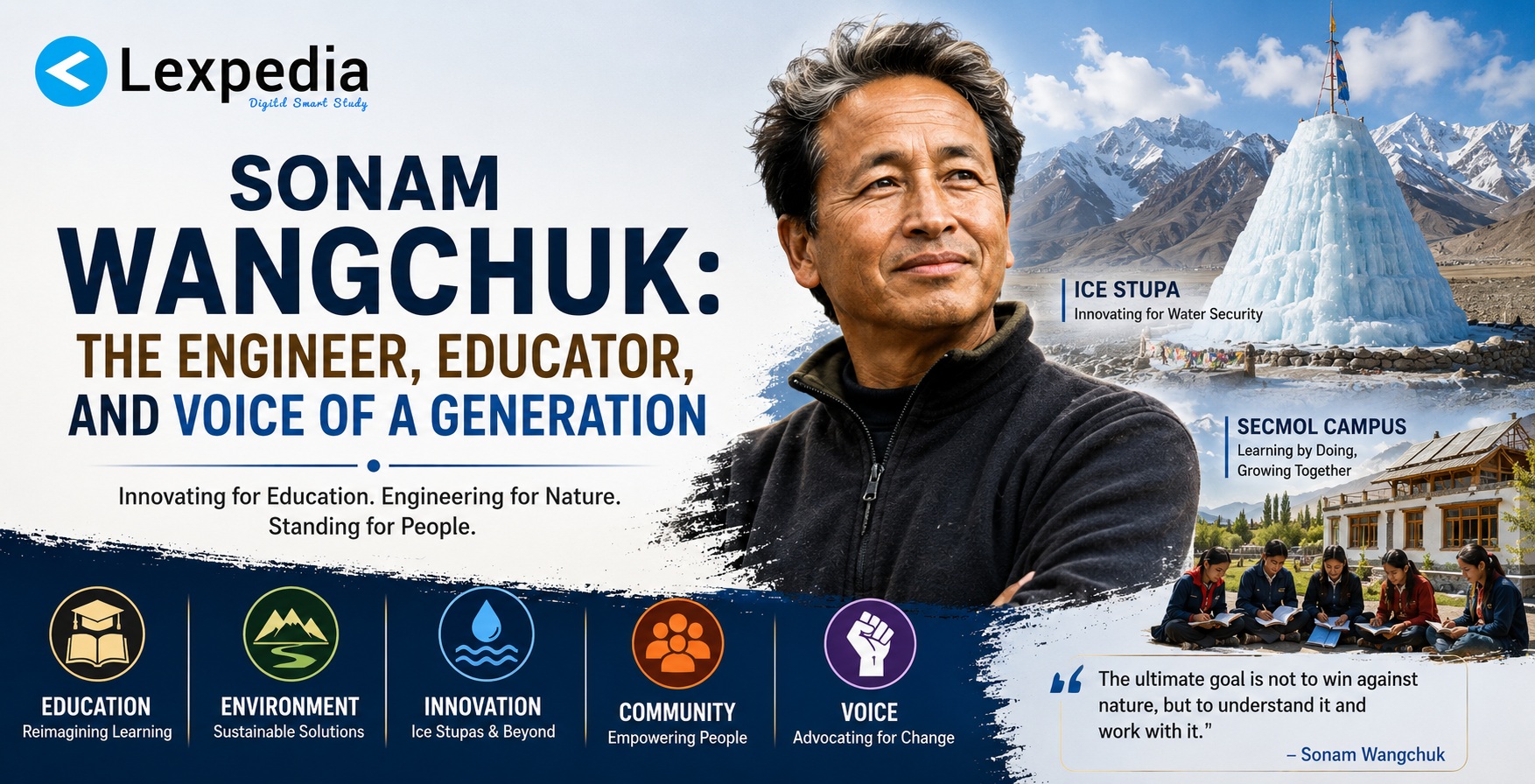
From transforming classrooms in Ladakh to building artificial glaciers, Sonam Wangchuk’s journey represents a distinctive blend of engineering, education, environmental innovation and public activism.
In an era in which education is often measured through examination scores, technological innovation through patents, and leadership through political office, Sonam Wangchuk represents a different model. The Ladakh-born engineer and educator has spent decades attempting to solve problems by starting with the realities of the communities affected by them.
From challenging conventional methods of education to developing the Ice Stupa technique for water conservation, Wangchuk's work has connected engineering with ecology and education with social transformation. His journey has also increasingly moved into public activism, particularly on questions concerning Ladakh, environmental protection and, more recently, examination reforms.
Today, his name is widely associated with SECMOL, Ice Stupas, alternative education, sustainable architecture and Ladakh's environmental concerns. But the story behind that public image begins with an unconventional childhood and an educational experience that profoundly influenced his philosophy.
A Childhood Without a Conventional School
Sonam Wangchuk was born in 1966 in the Ladakh region, in what was then Jammu and Kashmir. His early education did not follow the conventional path.
There was no formal school in his village when he was a young child, and he did not enter a formal school until around the age of nine. His mother initially taught him basic learning in his native language. When he later moved to Srinagar, he encountered a completely different educational environment.
The experience of being educated in a system that did not initially accommodate his linguistic and cultural background would become important to his later thinking.
Rather than viewing struggling students simply as failures, Wangchuk came to question whether the education system itself could sometimes be responsible for producing failure.
That idea would eventually become the foundation of his educational work.
From Mechanical Engineering to Education Reform
Wangchuk studied Mechanical Engineering at the National Institute of Technology Srinagar, then known as Regional Engineering College, completing his B.Tech in 1987. He later studied earthen architecture at the CRATerre School of Architecture in Grenoble, France, developing an interest in sustainable and climate-responsive construction.
But instead of pursuing a conventional engineering career, he returned to Ladakh.
In 1988, Wangchuk became one of the founders of the Students' Educational and Cultural Movement of Ladakh (SECMOL). The organisation sought to address the difficulties faced by Ladakhi students within an examination-centred education system and promote practical, locally relevant learning.
SECMOL became much more than a school.
It developed an educational philosophy built around learning by doing, community participation, local culture, environmental responsibility and practical skills.
The objective was not simply to help students pass examinations but to make education relevant to the lives they would lead.
Operation New Hope and a Different Approach to Education
One of Wangchuk's important educational interventions was Operation New Hope, launched in the 1990s as a collaborative effort involving government departments, communities and civil society.
The initiative sought to improve the quality of government-school education in Ladakh.
The underlying principle was straightforward: educational reform could not be imposed entirely from outside. Teachers, students, parents and communities had to participate in the process.
SECMOL's work consequently became an example of how education reform could be rooted in local circumstances rather than based exclusively on a standardised national model.
The organisation's campus itself reflected this philosophy.
Its buildings incorporated passive solar design, traditional materials and climate-responsive architecture, demonstrating that the physical environment in which education takes place can itself become part of the learning process.
The Engineer Who Looked at Ladakh's Water Problem Differently
Wangchuk's engineering work became internationally recognised through his work on the Ice Stupa.
Ladakh is a high-altitude cold desert where agriculture has traditionally depended heavily on meltwater. Climate change, changing precipitation patterns and retreating glaciers have made the timing and availability of water increasingly unpredictable.
The problem was not necessarily an absolute absence of water.
The problem was timing.
Large quantities of winter water could be unavailable when farmers needed water in spring.
Wangchuk's approach was to store that water in the form of ice and delay its melting until the agricultural season.
What Is an Ice Stupa?
An Ice Stupa is an artificial glacier designed to store winter water in a large, conical structure of ice.
The concept uses a relatively simple physical principle.
Water from higher-altitude streams is brought through pipes to lower locations. During the freezing winter temperatures, water emerging from a vertical pipe freezes into droplets and accumulates into a cone-shaped structure.
The conical shape is important because it reduces the surface area exposed to sunlight relative to the volume of ice.
As spring arrives, the Ice Stupa gradually melts and releases water when farmers need it.
The design was inspired partly by the shape of Buddhist stupas, which are familiar architectural forms in the region.
The first prototype was developed with SECMOL students in the early 2010s. A later Ice Stupa in Phyang became a significant demonstration of the concept. Rolex reports that a 2015 structure reached approximately 20 metres and stored around 1.5 million litres of water, providing water for newly planted trees.
The significance of the innovation was not simply its physical design.
It was its simplicity.
The system could operate without conventional electricity-intensive refrigeration. Gravity and naturally occurring winter temperatures did much of the work.
It was therefore an example of technology designed around the environment rather than technology attempting to overcome it.
Recognition on the International Stage
The Ice Stupa project brought Wangchuk international recognition.
In 2016, he received a Rolex Award for Enterprise for his work on artificial glaciers and water conservation in Ladakh. Rolex described the project as an effort to use artificial glaciers to provide water to farmers during the dry season.
The recognition helped bring wider international attention to an innovation developed for a very specific Himalayan problem.
Wangchuk subsequently received numerous other honours, including the Ramon Magsaysay Award in 2018, widely regarded as one of Asia's most prestigious awards for public leadership and social change.
His recognition illustrates an important feature of his career: many of his innovations have been developed not in conventional laboratories but in response to problems experienced by local communities.
Beyond Ice: Sustainable Architecture
Wangchuk's work has never been limited to water conservation.
His engineering and architectural interests have included passive solar buildings, natural construction techniques, renewable energy and sustainable living.
The SECMOL campus itself demonstrates this approach.
In an environment where winter temperatures can become extremely severe, the campus uses passive solar principles and locally appropriate materials to reduce dependence on conventional heating systems. SECMOL's work has also included courses and workshops dealing with earth construction, solar design and ecological building.
The underlying philosophy is consistent:
Technology should respond to geography, climate and culture.
For Wangchuk, sustainability is therefore not merely a question of adopting the latest technology. It is about identifying the simplest solution that works within the ecological limits of a particular place.
From SECMOL to HIAL
Wangchuk later extended his educational vision through the Himalayan Institute of Alternatives, Ladakh (HIAL).
HIAL represents his attempt to create an alternative model of higher education—one in which students learn through real-world problems rather than relying entirely on classroom instruction.
The concept is especially significant for a region such as Ladakh, where conventional educational models can sometimes prepare students for careers elsewhere rather than equip them to address the challenges of their own communities.
The philosophy behind alternative education is therefore closely linked with local employment, entrepreneurship, sustainability and community development.
SECMOL's own website notes that Wangchuk is no longer involved with the organisation full-time and is now associated with HIAL.
The Teacher Who Challenged the Meaning of ‘Failure’
Perhaps Wangchuk's most enduring contribution is philosophical rather than technological.
He challenged the assumption that a student who performs poorly in examinations is necessarily a failure.
His experience led him to ask a more fundamental question:
What if the system is failing the student?
This idea became central to SECMOL's approach.
Instead of judging students exclusively through conventional academic performance, the institution emphasised practical ability, creativity, responsibility and problem-solving.
The approach has resonated particularly strongly because it challenges one of the most persistent assumptions in modern education—that academic examination performance is an adequate measure of intelligence or potential.
Why His Story Became Widely Known Through ‘3 Idiots’
Wangchuk's national popularity expanded dramatically after the release of the 2009 Hindi film 3 Idiots.
The character Phunsukh Wangdu, portrayed by Aamir Khan, became popularly associated with Wangchuk.
The comparison has often been repeated in popular culture, although the exact extent of Wangchuk's connection to the fictional character has been the subject of debate. Recent reporting has again highlighted that the widely repeated claim that Wangchuk directly inspired the character should be treated cautiously; actor Aamir Khan reportedly described that belief as a misconception in July 2026.
Regardless of the cinematic connection, Wangchuk's actual work stands independently.
His educational institutions, Ice Stupas and sustainable-development projects predate and extend far beyond the film's popularity.
From Educator to Environmental Advocate
Wangchuk's public role gradually expanded beyond education.
As concerns over climate change, glacier retreat, water scarcity and unsustainable development grew in Ladakh, he increasingly became an advocate for environmental protection.
His argument has consistently been that development in fragile mountain regions cannot simply replicate models designed for plains or metropolitan areas.
Ladakh's ecological limits demand a different approach.
For Wangchuk, the Himalayan environment is not merely a backdrop to development—it is a fundamental constraint that development policy must respect.
The Ladakh Question
Wangchuk has also become an important public voice on the political and constitutional future of Ladakh.
After Ladakh became a Union Territory in 2019, he increasingly advocated for constitutional and institutional safeguards relating to the region, alongside demands concerning environmental protection and local representation. His activism has included hunger strikes and public campaigns.
His political advocacy has also attracted criticism and debate.
Supporters view him as a prominent voice for Ladakh's ecological and democratic concerns, while critics have questioned aspects of his political positions and methods. A balanced assessment therefore requires distinguishing his widely documented educational and engineering contributions from the more contested aspects of his recent activism.
The 2026 Protest and a New National Role
In 2026, Wangchuk's public profile entered another phase when he joined a protest in Delhi connected with demands for examination reform and accountability over alleged irregularities in competitive examinations.
Reports said he began an indefinite hunger strike at Jantar Mantar on June 28, 2026, alongside the Cockroach Janta Party's protest. Among the demands reported were calls for the resignation of then Union Education Minister Dharmendra Pradhan, alongside broader concerns about examination irregularities and student issues.
The protest subsequently became a major national story.
By July, reports said that Wangchuk had been moved to hospital following concerns over his health after weeks of fasting.
This phase of his public life is important because it represents a shift in the way he is perceived.
For decades, Wangchuk was primarily known as an engineer, educator and environmental innovator from Ladakh.
In recent years, he has increasingly become a national political and civic voice.
A Career Built Around Local Problems
What connects the different phases of Wangchuk's career is a common method.
He begins with a local problem.
Students are failing examinations → question the education system.
Farmers lack water in spring → rethink how winter water can be stored.
Buildings consume excessive energy → adapt architecture to the climate.
Fragile mountain ecosystems face development pressure → demand locally appropriate environmental policy.
This approach is what makes his work distinctive.
Rather than importing a universal solution, he has repeatedly attempted to create context-specific solutions.
Why Sonam Wangchuk Matters to a Generation
Wangchuk's relevance extends beyond Ladakh.
For students, he represents a challenge to the idea that marks are the ultimate measure of ability.
For engineers, he represents the possibility of designing technology that is simple, inexpensive and environmentally compatible.
For environmentalists, the Ice Stupa represents an example of climate adaptation using locally available resources.
For educators, SECMOL represents an experiment in community-driven and experiential learning.
And for young citizens involved in public affairs, his recent activism represents the transition of an educator and innovator into a more visible voice of civic dissent.
His career also raises difficult questions.
Can alternative education models be scaled nationally?
Can technological solutions developed for one ecosystem work elsewhere?
How should environmental protection be balanced with economic development?
And how far should an educator and engineer enter political advocacy?
These questions ensure that Wangchuk's story is not merely one of achievement but also one of continuing debate.
The Larger Legacy
The most enduring part of Sonam Wangchuk's legacy may ultimately be neither the Ice Stupa nor any individual institution.
It may be the idea that problems should be understood from the ground up.
A mountain community does not necessarily need the same solution as a metropolitan city.
A student who fails an examination may not be incapable of learning.
A water shortage does not always require a massive infrastructure project.
A building in a cold desert does not have to consume enormous quantities of energy to remain habitable.
These ideas appear simple, but they require a willingness to question established systems.
That willingness has defined Wangchuk's career.
Sonam Wangchuk: Key Milestones
| Year | Milestone |
|---|---|
| 1966 | Born in Ladakh |
| 1987 | Completed B.Tech in Mechanical Engineering from NIT Srinagar |
| 1988 | Co-founded SECMOL |
| 1990s | Worked on education reform and Operation New Hope |
| 2013–14 | Developed early Ice Stupa prototypes |
| 2015 | Major Ice Stupa demonstration in Ladakh |
| 2016 | Received Rolex Award for Enterprise |
| 2017 | Received Global Award for Sustainable Architecture |
| 2018 | Received Ramon Magsaysay Award |
| 2019 onward | Became increasingly active on Ladakh's environmental and constitutional concerns |
| 2026 | Joined Delhi protest movement and undertook an extended hunger strike over examination reforms and other demands |
The timeline is based on institutional and contemporary reporting, with some dates and descriptions cross-checked against SECMOL and Rolex materials.
Conclusion: More Than the ‘Real-Life Phunsukh Wangdu’
For many Indians, Sonam Wangchuk first became familiar as the supposed inspiration behind a fictional character in a popular film.
But the real story is considerably more substantial.
He is an engineer who turned to education, an educator who became an environmental innovator, an innovator who became an advocate, and an advocate who increasingly entered national public debate.
His Ice Stupas demonstrate how engineering can respond to ecological realities. SECMOL demonstrates how education can be redesigned around local needs. HIAL reflects an effort to rethink higher education. And his recent activism demonstrates how professional expertise can evolve into civic engagement.
Whether one agrees with all of his political positions or methods is a separate question.
What is difficult to dispute is the distinctive trajectory of his life: from a child who experienced the limitations of a conventional education system to an engineer who questioned conventional solutions, and ultimately to a public figure challenging institutions to listen to communities more closely.
That is why Sonam Wangchuk's story continues to resonate with a generation searching for a different relationship between education, technology, environment and society.