Reservation in India: History, Caste, Economic Justice, Agitations and the Road Ahead
Lexpedia News · 2 September 2026 · 24 min read
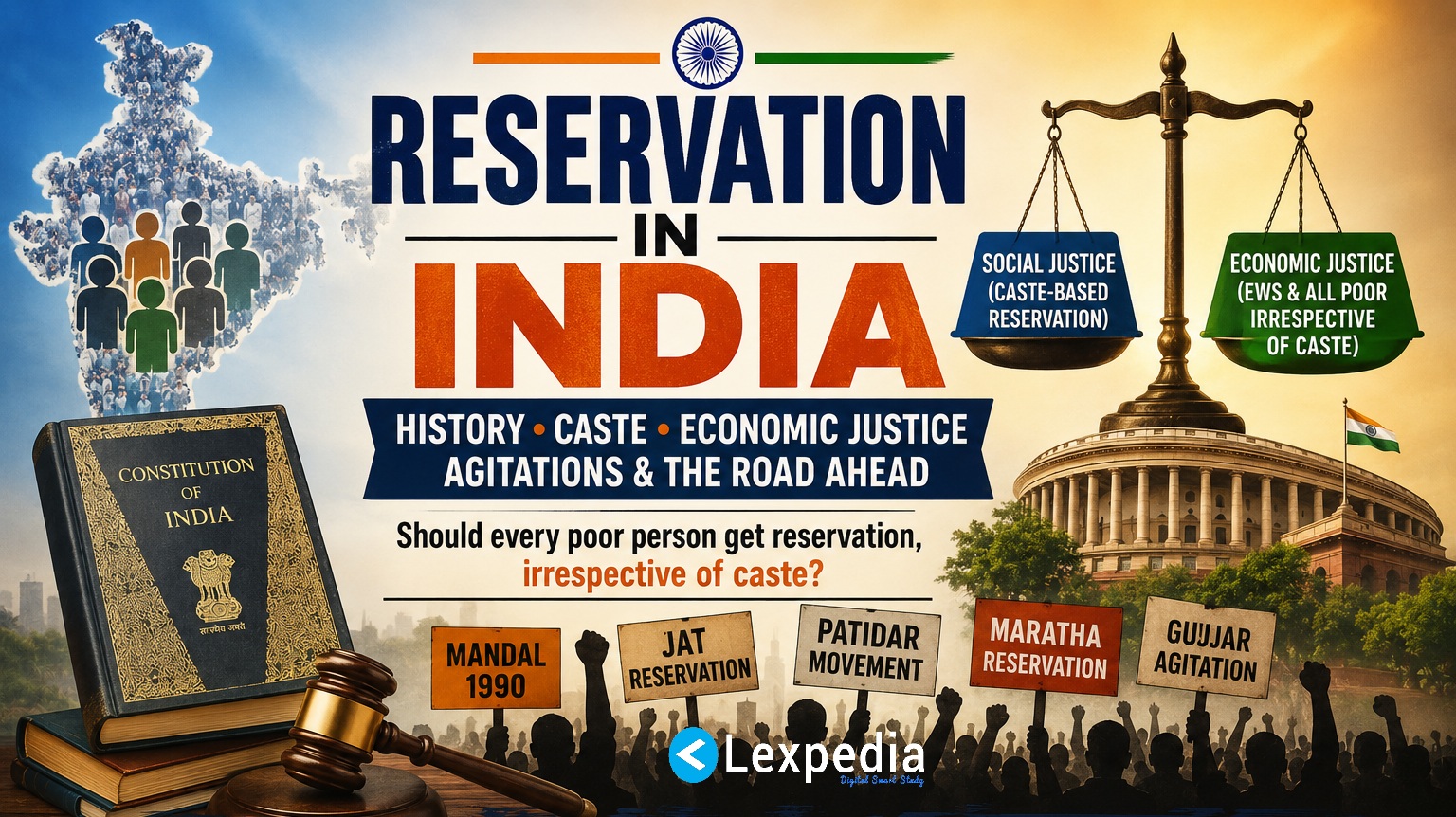
Introduction
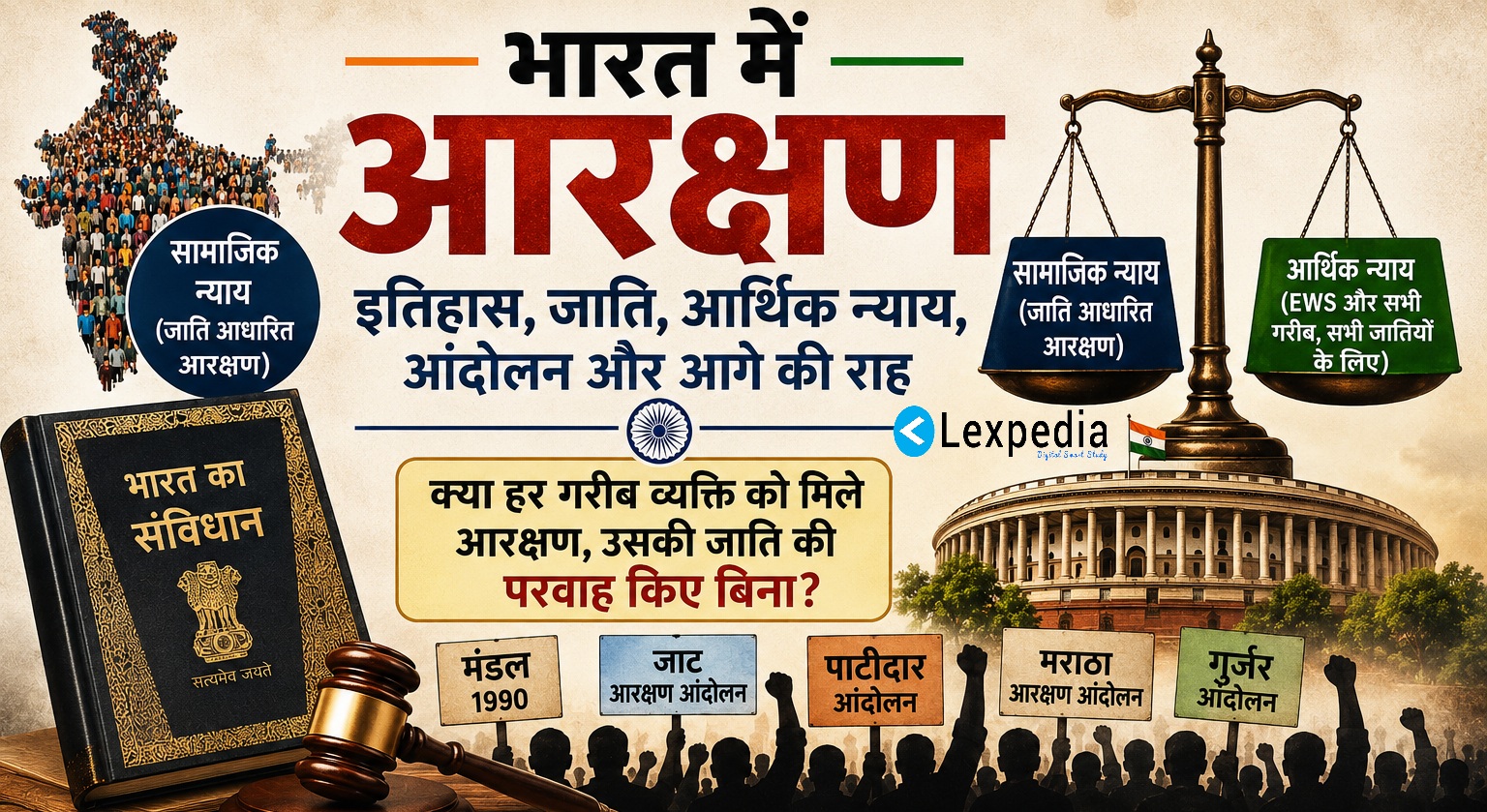
Few issues in India have generated as much political debate, social mobilisation, constitutional litigation and public controversy as the question of reservation.
Reservation was not created merely as a mechanism for distributing government jobs or seats in educational institutions. Its original and central objective was social justice—to provide representation and opportunities to communities that had historically suffered caste-based discrimination, social exclusion, educational deprivation and inadequate representation in public institutions.
However, the character of the reservation debate has changed considerably over the decades.
In the early years of the Republic, the principal focus was on Scheduled Castes (SCs), Scheduled Tribes (STs) and socially and educationally backward classes. Later, the Mandal Commission transformed the national debate by bringing Other Backward Classes (OBCs) to the centre of reservation policy.
In more recent decades, another question has become increasingly important:
Should economic disadvantage by itself be a sufficient basis for reservation, irrespective of caste?
The introduction of Economically Weaker Sections (EWS) reservation in 2019 represented a major constitutional development in this direction. The Constitution now permits up to 10% reservation for EWS, separately from the reservations for SCs, STs and OBCs.
At the same time, India has witnessed powerful reservation agitations by Gujjars, Jats, Patidars, Marathas and other communities, while debates over the 50% ceiling, creamy layer, sub-categorisation, caste census and economic criteria continue.
The question today is therefore much broader than simply "reservation or no reservation."
The real questions are:
-
Who should receive reservation?
-
Should caste remain the principal criterion?
-
Should poverty be given equal or greater importance?
-
Should every poor person, regardless of caste, receive some form of reservation?
-
How should the benefits be distributed within large reserved categories?
-
Should reservation be temporary, periodically reviewed or continue indefinitely?
-
Can reservation alone solve India's deeper problems of inequality and unemployment?
To understand these questions, it is necessary to examine the history, constitutional framework and changing nature of reservation in India.
1. Reservation Did Not Begin in 1950
Although reservation is generally associated with the Constitution of India, its roots go back to the pre-Independence period.
During the late nineteenth and early twentieth centuries, several princely states and provincial administrations introduced measures intended to improve the representation of communities that were considered socially or educationally disadvantaged.
One of the most important early examples was Kolhapur, where Chhatrapati Shahu Maharaj introduced reservation for backward communities in government employment in 1902.
Similar experiments took place in Mysore and other parts of India.
The Madras Presidency also became an important centre of the non-Brahmin movement. The argument was that access to education and government employment was disproportionately concentrated among certain communities and that the state should take corrective measures.
This history is important because it demonstrates that the idea of preferential representation existed before the Constitution.
Reservation therefore emerged from a much older Indian debate about social hierarchy, representation and access to state power.
2. The Poona Pact and Dr B. R. Ambedkar
The question of political representation for historically oppressed communities became particularly important during the freedom struggle.
Dr. B. R. Ambedkar argued that communities then described as the Depressed Classes required political safeguards because social discrimination could not simply be removed by declaring everyone legally equal.
The Communal Award of 1932 proposed separate electorates for the Depressed Classes.
Mahatma Gandhi opposed separate electorates for them, arguing that this would divide Hindu society.
The disagreement eventually resulted in the Poona Pact of 1932.
The Pact abandoned separate electorates in favour of reserved seats for the Depressed Classes within a common electorate.
The episode became a major milestone in the development of India's later system of political reservation for Scheduled Castes.
More importantly, the Ambedkar-Gandhi debate raised a question that remains relevant:
Can formal equality alone create genuine equality in a society that begins with deeply unequal social conditions?
3. Reservation Under the Constitution
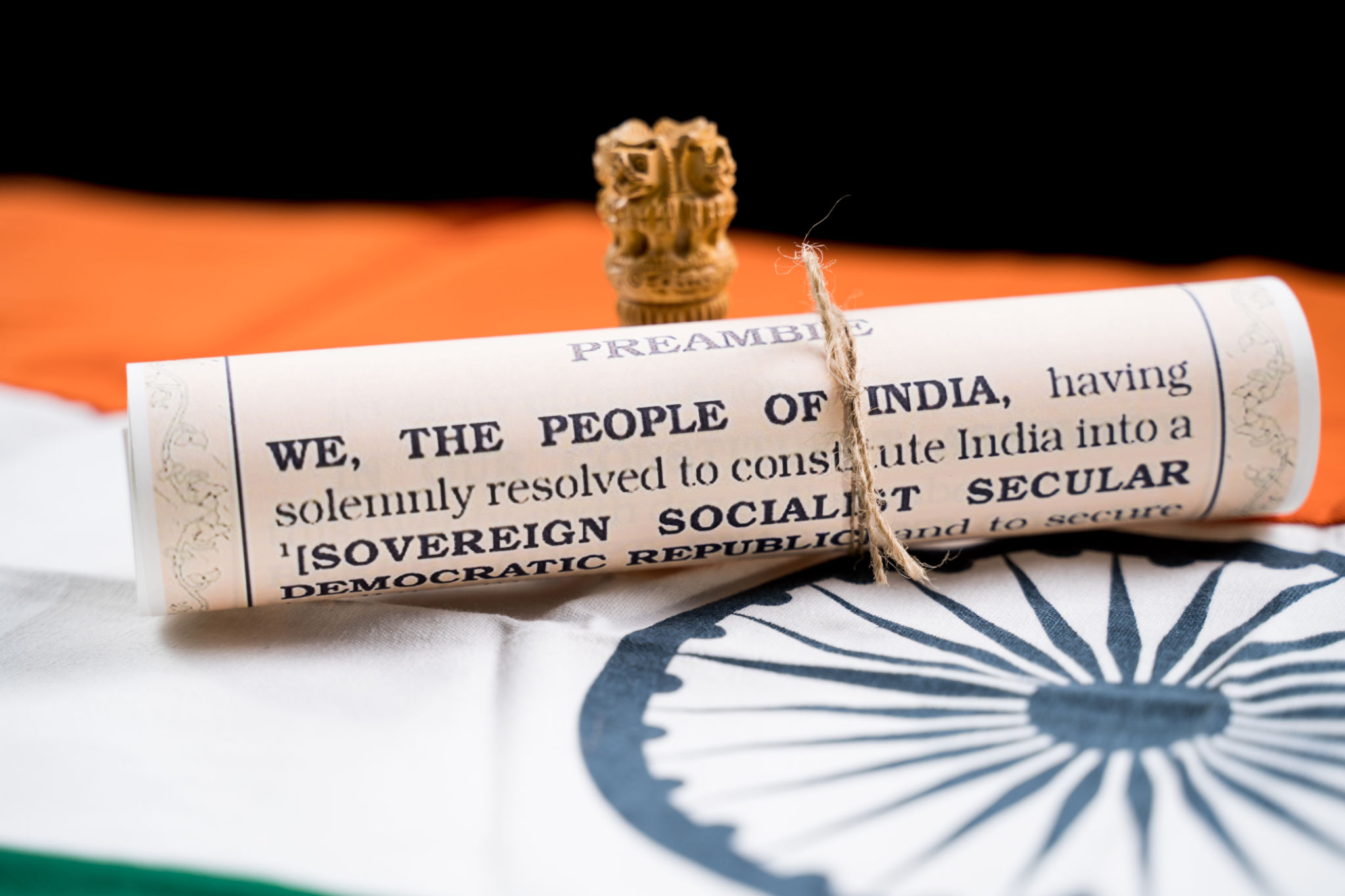
When the Constitution came into force on 26 January 1950, India adopted a system that combined equality before the law with special constitutional provisions for disadvantaged groups.
Article 14 guarantees equality before the law.
At the same time, the Constitution permits special measures for certain disadvantaged groups.
Important constitutional provisions include:
-
Article 15 — equality and prohibition of discrimination, with provisions permitting certain special measures;
-
Article 16 — equality of opportunity in public employment, with provisions permitting reservation for certain backward classes;
-
Articles 330 and 332 — reservation of seats for SCs and STs in the Lok Sabha and State Legislative Assemblies;
-
Article 335 — recognition of the claims of SCs and STs in services and posts, subject to considerations of administrative efficiency.
The constitutional philosophy was therefore not simply "treat everyone identically."
It recognised that substantive equality sometimes requires differential treatment to overcome historical disadvantage.
4. The First Constitutional Amendment
The reservation question reached the Supreme Court soon after Independence.
In State of Madras v. Champakam Dorairajan (1951), the Court struck down the communal allocation of seats in educational institutions.
The political response was the First Constitutional Amendment, which inserted Article 15(4).
This provision expressly permitted the State to make special provisions for the advancement of socially and educationally backward classes and SCs and STs.
This was a crucial moment because it established a constitutional foundation for affirmative action in education.
5. The Kalelkar Commission
In 1953, the Government appointed the First Backward Classes Commission, headed by Kaka Kalelkar.
The Commission attempted to identify socially and educationally backward classes and recommended measures for their advancement.
Its recommendations were not implemented as a nationwide reservation programme.
Nevertheless, the question remained alive, particularly in southern India, where powerful non-Brahmin and backward-class movements had already developed.
The demand for representation would eventually culminate in the Mandal Commission.
6. The Mandal Commission
The most important transformation in post-Independence reservation policy came through the Second Backward Classes Commission, commonly known as the Mandal Commission.
The commission was established in 1979 under the chairmanship of B. P. Mandal.
Its task was to identify socially and educationally backward classes and recommend measures for their advancement.
The Commission submitted its report in 1980.
Among its most important recommendations was 27% reservation for Other Backward Classes (OBCs) in government employment.
For several years, the report remained largely unimplemented at the national level.
That changed in 1990, when Prime Minister V. P. Singh announced the implementation of the Mandal Commission's recommendation for 27% reservation for OBCs in Central Government services.
The announcement fundamentally altered Indian politics.
7. The Anti-Mandal Agitation of 1990
The implementation of the Mandal recommendations triggered one of India's most intense student and youth movements.
Large-scale protests occurred particularly in North India, with students and other groups arguing that reservation would reduce opportunities for candidates outside the reserved categories.
The agitation included:
-
student demonstrations;
-
strikes;
-
road blockades;
-
railway disruptions;
-
clashes with police;
-
and tragic cases of self-immolation.
The most widely remembered case was that of Rajiv Goswami, whose self-immolation became a symbol of the anti-Mandal movement.
Supporters of Mandal, however, argued that the idea of merit could not be separated from unequal access to education, resources and social opportunity.
The Mandal agitation therefore exposed a fundamental conflict between:
individual competition and historical social disadvantage.
8. Indra Sawhney and the 50% Ceiling
The controversy eventually reached the Supreme Court in Indra Sawhney v. Union of India (1992).
The Court upheld the constitutional validity of OBC reservation, while introducing important limitations.
Among the most significant principles were:
-
recognition of OBC reservation;
-
the creamy-layer principle;
-
the general 50% ceiling on reservation under the relevant constitutional provisions;
-
and the principle that reservation should not ordinarily destroy the broader guarantee of equality of opportunity.
The 50% principle became one of the most important features of India's reservation jurisprudence.
It also became a major obstacle whenever new communities demanded additional quotas.
9. Reservation Becomes a Political Force
After Mandal, reservation became deeply embedded in Indian electoral politics.
Political parties increasingly had to respond to the demands of different communities seeking:
-
OBC recognition;
-
inclusion in existing reserved categories;
-
separate sub-categories;
-
higher reservation percentages;
-
or new forms of affirmative action.
Reservation consequently became both a constitutional policy and a powerful instrument of political mobilisation.
10. Why Did Powerful Communities Begin Demanding Reservation?
One of the most interesting developments of recent decades has been the demand for reservation by communities traditionally perceived as relatively influential or dominant in their regions.
Examples include:
-
Gujjars;
-
Jats;
-
Patidars/Patels;
-
Marathas;
-
and several other communities.
At first glance, this may seem contradictory.
If a community is politically influential, why would it demand reservation?
The answer lies partly in the distinction between political influence and economic security.
A large and politically influential community can still face:
-
unemployment among educated youth;
-
declining agricultural income;
-
increasing competition for government employment;
-
rising educational costs;
-
shrinking traditional occupations;
-
and difficulties entering the formal economy.
Thus, many modern reservation movements are driven not only by historical caste discrimination but also by relative economic insecurity.
11. The Gujjar Reservation Agitations
The Gujjar community in Rajasthan has repeatedly demanded reservation, arguing that it remains socially and economically disadvantaged.
The movement became particularly intense in the 2000s, including major protests in 2008, which affected roads and railway services and resulted in deaths and serious disruption.
Subsequent governments attempted various arrangements, including special reservation categories.
The Gujjar movement demonstrated an important feature of modern reservation politics:
A community can demand reservation not merely because of historical untouchability or exclusion, but because it believes that its present access to education and employment is inadequate compared with other communities.
12. The Jat Reservation Agitation
The Jat reservation movement, particularly in Haryana, became another major reservation controversy.
Jat organisations demanded inclusion in the OBC category, citing concerns relating to:
-
agricultural distress;
-
unemployment;
-
educational competition;
-
and declining opportunities in government employment.
The movement reached a dramatic stage in 2016, when widespread protests, blockades and violence occurred in Haryana.
The episode showed how reservation demands could become intertwined with agrarian distress, unemployment and political competition.
13. The Patidar Reservation Movement
The Patidar reservation movement in Gujarat in 2015 represented another major shift.
The movement, associated prominently with Hardik Patel and the Patidar Anamat Andolan Samiti, demanded reservation for Patidars.
A massive rally in Ahmedabad became one of the defining events of the movement.
The movement was particularly significant because it eventually contributed to a broader public discussion about whether economic disadvantage, rather than caste alone, should be a basis for affirmative action.
The Patidar agitation therefore became part of the larger debate that ultimately culminated in the EWS reservation system.
14. The Maratha Reservation Movement
The Maratha reservation movement in Maharashtra became one of India's longest-running contemporary reservation campaigns.
Beginning in an earlier form and gaining enormous momentum after 2016, large Maratha morchas were organised across Maharashtra.
The principal demands concerned reservation in:
-
education;
-
and government employment.
Maharashtra subsequently enacted legislation providing reservation for Marathas.
The issue reached the Supreme Court.
In 2021, the Supreme Court struck down the Maratha reservation law, holding that the circumstances did not justify exceeding the established 50% ceiling.
The controversy nevertheless continued to influence Maharashtra's politics and the national debate over reservation ceilings, backwardness and representation.
15. The Emergence of Economic-Based Reservation
For decades, India's reservation policy was primarily based on social and educational backwardness, particularly where caste-based exclusion was involved.
But a different argument gradually gained strength:
What about a person who is economically poor but does not belong to an SC, ST or OBC community?
This question became increasingly significant as India experienced:
-
expansion of private-sector employment;
-
intense competition for government jobs;
-
rising education costs;
-
agricultural distress;
-
and growing economic inequality.
The demand for economic-based reservation therefore acquired political momentum.
16. The 103rd Constitutional Amendment and EWS Reservation
The major breakthrough came in 2019.
The Constitution (103rd Amendment) Act, 2019 inserted Articles 15(6) and 16(6).
These provisions empowered the State to provide up to 10% reservation for Economically Weaker Sections (EWS) in educational institutions and appointments to civil posts and services.
Importantly, the EWS reservation was designed for economically weaker persons outside the existing SC, ST and OBC reservation framework.
This represented a significant conceptual development.
For the first time, economic weakness itself became an independent constitutional basis for reservation at the Union level.
17. How EWS Differs From SC/ST/OBC Reservation
The distinction is fundamental.
SC/ST/OBC Reservation
The traditional system is primarily concerned with social and educational backwardness and inadequate representation, with caste playing a major role in identifying affected communities.
EWS Reservation
EWS is based on economic weakness, within the constitutional framework and eligibility criteria prescribed by the government.
Therefore:
SC/ST/OBC reservation asks largely:
"Has this social group historically experienced structural disadvantage and inadequate representation?"
EWS reservation asks:
"Is this individual economically weak despite not being covered by the existing SC/ST/OBC reservation framework?"
These are different concepts of disadvantage.
18. Supreme Court and EWS
The constitutional validity of the EWS amendment was challenged before the Supreme Court.
In Janhit Abhiyan v. Union of India (2022), the Supreme Court upheld the 103rd Constitutional Amendment.
The judgment confirmed that reservation based on economic criteria could constitutionally exist and that the EWS framework was not invalid merely because it used economic weakness as its basis.
The Court also considered the exclusion of SCs, STs and non-creamy-layer OBCs from EWS eligibility.
The judgment was therefore a landmark in India's constitutional history because it confirmed that economic disadvantage can independently support a reservation framework.
19. The Bigger Question: Should Every Poor Person Get Reservation?
This is perhaps the most important question in the modern reservation debate.
Imagine two students:
Student A belongs to a historically disadvantaged caste but comes from a financially comfortable family.
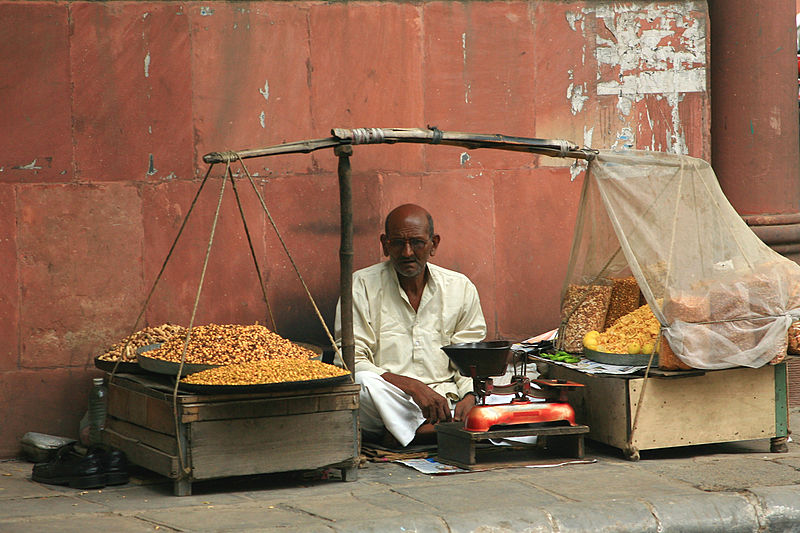
Student B belongs to a non-reserved caste but comes from an extremely poor family and has had limited access to educational resources.
Should Student A receive reservation while Student B receives none?
This question is one reason why economic-based affirmative action has attracted considerable public support.
The argument for a universal economic approach is straightforward:
Poverty does not ask for a person's caste before affecting his or her education, nutrition, living conditions or access to opportunities.
A poor child from any caste can face:
-
inadequate schooling;
-
inability to afford coaching;
-
poor nutrition;
-
lack of digital resources;
-
inability to pay university fees;
-
pressure to leave education early;
-
and limited social mobility.
From this perspective, the State should help all genuinely poor citizens, regardless of caste.
20. The Argument for Reservation for All Poor Persons
There are several powerful arguments in favour of such a model.
1. Poverty is not exclusive to any caste
Economic hardship exists across India's social groups.
2. Economic deprivation directly affects educational opportunity
A poor student may be unable to compete equally because of lack of:
-
coaching;
-
books;
-
technology;
-
private schooling;
-
transportation;
-
and financial security.
3. It reduces resentment against caste-based reservation
Many people who do not qualify for caste-based reservation believe that they are being ignored despite being economically disadvantaged.
An economic component can address this grievance.
4. It focuses assistance on actual need
If properly designed, economic criteria can direct assistance towards families that genuinely lack resources.
5. It can promote broader social acceptance
A system that recognises economic disadvantage across communities may be viewed as more inclusive.
21. But Should Economic Poverty Replace Caste-Based Reservation?
This is where the issue becomes much more complicated.
The strongest argument against completely replacing caste-based reservation with economic reservation is that poverty and caste discrimination are not the same phenomenon.
A poor person may experience economic hardship.
A person from a historically oppressed caste may experience both economic hardship and social discrimination.
Caste-based exclusion has historically affected:
-
access to education;
-
occupation;
-
residential patterns;
-
social status;
-
public interaction;
-
marriage;
-
political representation;
-
and access to institutions.
Therefore, critics of an exclusively economic system argue:
If reservation is based only on income, it may address poverty but fail to address caste-based social exclusion and under-representation.
This is the central reason why economic reservation and caste-based reservation should not automatically be treated as substitutes.
22. Poverty Can Change; Caste Identity Often Does Not
There is another important difference.
Economic status can change relatively quickly.
A family that is poor today may become middle class in the next generation.
Caste identity, however, is generally inherited at birth and has historically operated as a social classification independent of individual income.
Therefore, supporters of caste-based reservation argue that economic improvement does not necessarily eliminate caste-based disadvantage.
At the same time, this argument raises another difficult question:
Should a financially prosperous family continue receiving reservation benefits indefinitely merely because it belongs to a historically disadvantaged community?
This is one reason why the debate over creamy layer and internal targeting has become increasingly important.
23. The Creamy Layer Question
The concept of the creamy layer attempts to prevent relatively advanced sections within certain backward classes from repeatedly capturing the benefits of reservation.
The underlying principle is simple:
If reservation is intended for the disadvantaged, the most advantaged members of a reserved category should not permanently dominate the benefits.
This raises a broader policy question:
Should India move toward a system combining:
caste/social disadvantage + economic disadvantage + family educational background + actual representation?
Such a system could potentially identify disadvantage more precisely than using any single criterion.
24. Reservation for All Poor Persons: A Possible Alternative Model
One possible future model could be a multi-dimensional affirmative-action system.
Instead of asking only:
"Which caste do you belong to?"
the State could consider multiple indicators:
Social disadvantage
-
caste-based historical exclusion;
-
social discrimination;
-
representation in institutions.
Economic disadvantage
-
family income;
-
assets;
-
landholding;
-
housing conditions;
-
other measurable economic indicators.
Educational disadvantage
-
quality of school attended;
-
parental education;
-
rural/remote educational access;
-
first-generation learner status.
Regional disadvantage
-
backward districts;
-
remote areas;
-
tribal regions;
-
areas with inadequate educational infrastructure.
Such a model would recognise that disadvantage has multiple dimensions.
25. But There Is a Major Problem: Who Is Actually Poor?
Economic reservation appears simple in principle but is difficult to administer.
Income can be concealed.
Assets can be transferred.
Cash income may not be reflected accurately in official records.
Property values vary enormously between regions.
A family owning agricultural land may have substantial assets but limited cash income.
Another family may have little land but substantial urban property.
Therefore, a serious economic-reservation system requires reliable, transparent and verifiable economic data.
Otherwise, the system may produce a new form of manipulation.
26. The 50% Ceiling
The 50% reservation ceiling has remained one of the most important legal issues.
The Supreme Court's jurisprudence has generally treated 50% as the ordinary ceiling for reservations under Articles 15(4) and 16(4), subject to exceptional circumstances.
The EWS provision, however, was created through Articles 15(6) and 16(6).
The Union Government has maintained that EWS reservation is constitutionally distinct from the reservations under Articles 15(4) and 16(4).
This distinction was also considered in the Supreme Court's 2022 EWS judgment.
Consequently, the national reservation framework cannot be understood simply by saying:
"India has a 50% reservation limit."
The constitutional position is more complicated.
27. Bihar and the 65% Reservation Debate
The issue became particularly prominent in Bihar after the state's caste survey.
The Bihar government increased reservation for SCs, STs and backward classes, taking the combined quota to 65%, apart from the EWS provision.
The policy faced legal challenge.
The Patna High Court struck down the amendments increasing the reservation beyond the existing ceiling.
The controversy brought an important question into the national debate:
Should reservation be determined by the 50% judicial ceiling, or should it be based primarily on the actual demographic and socio-economic composition of society?
Those favouring higher quotas argue that if a group constitutes a large proportion of the population but remains inadequately represented, a rigid ceiling may prevent genuine representation.
Opponents argue that unlimited expansion of reservation could undermine the constitutional principle of equality of opportunity.
28. Sub-Categorisation Within Reserved Categories
Another major contemporary issue is whether all communities within a reserved category benefit equally.
Suppose a large reservation category contains several communities.
If one or two communities capture most of the educational and employment benefits, smaller and more disadvantaged communities may remain excluded from the practical benefits of reservation.
This has led to demands for sub-categorisation.
In State of Punjab v. Davinder Singh (2024), the Supreme Court held that states can, subject to constitutional requirements and a rational basis, undertake sub-classification within Scheduled Castes for distributing reservation benefits more equitably.
This could become extremely significant.
The future debate may therefore move from:
"How much reservation should SCs/OBCs receive?"
to:
"Which communities within SCs/OBCs are actually receiving the reservation benefits?"
29. The Caste Census and the Future of Reservation
Another development could fundamentally change the reservation debate.
The Government has decided that caste will be enumerated as part of Census 2027.
The Census will be conducted in two phases, and caste enumeration will form part of the second phase.
This is potentially extremely important.
For decades, debates over the numerical strength and representation of various communities have often relied on incomplete or outdated information.
Reliable caste data could provide information concerning:
-
population size;
-
educational attainment;
-
employment;
-
occupation;
-
socio-economic status;
-
regional distribution;
-
and potentially representation in public institutions.
Such data could help governments design evidence-based reservation policies.
But it could also intensify competition.
If communities discover that their population share is larger than their current representation, they may demand higher quotas.
Thus, better data may make reservation policy more rational—but it may also make the political contest over reservation more intense.
30. Reservation and Merit
The word "merit" lies at the centre of the reservation debate.
Critics argue that selection should primarily depend upon performance.
Supporters respond that performance itself is influenced by:
-
quality of schooling;
-
family income;
-
parental education;
-
nutrition;
-
coaching;
-
language;
-
geography;
-
social networks;
-
and historical opportunity.
Two students may therefore obtain different examination scores while having had dramatically different opportunities.
This does not mean that merit is meaningless.
Institutions require capable people.
The real question is whether merit should be measured without considering unequal starting conditions.
A sensible policy must therefore attempt to balance:
merit + equal opportunity + social justice + institutional efficiency.
31. Reservation Cannot Solve Unemployment
This is one of the most important limitations of reservation.
Government jobs are finite.
Even if reservation percentages are increased, the number of available government positions does not automatically increase.
India's larger problem is therefore not merely:
"Who gets the government job?"
but:
"Why are millions of educated young people competing for a relatively small number of secure jobs?"
Reservation cannot by itself solve:
-
unemployment;
-
underemployment;
-
agricultural distress;
-
lack of industrial employment;
-
inadequate private-sector opportunities;
-
or poor school education.
A long-term solution requires economic growth, job creation, better education, vocational training and entrepreneurship.
32. Reservation Is Not a Substitute for Good Education
A student who receives reservation after completing school has already travelled through an educational system.
If that student has attended a poor-quality school, lacks basic literacy and numeracy, and cannot afford coaching, reservation at the university or employment stage may not be enough.
Therefore, one of the strongest long-term strategies for equality is:
Invest heavily in quality public education before students reach the reservation stage.
This includes:
-
better government schools;
-
qualified teachers;
-
digital access;
-
nutrition;
-
scholarships;
-
hostels;
-
transportation;
-
libraries;
-
vocational education;
-
and affordable higher education.
Reservation should ideally be one component of a much larger social-mobility strategy.
33. Should India Have One Common Economic Quota for Every Poor Person?
The idea deserves serious consideration, but it should be approached carefully.
A universal economic-assistance system could operate alongside social reservations.
For example, India could distinguish between:
A. Social Justice Reservation
For communities suffering historical social exclusion and inadequate representation.
B. Economic Opportunity Assistance
Available to poor persons of every caste, including those already covered by reserved categories.
Such economic assistance need not necessarily always take the form of a separate quota.
It could include:
-
scholarships;
-
fee waivers;
-
free coaching;
-
hostels;
-
educational loans;
-
subsidised professional education;
-
skill-development programmes;
-
and employment assistance.
This may be more effective than trying to solve every form of disadvantage through a reservation percentage.
34. The Strongest Case for an Economic Component
There is a powerful moral argument behind economic-based assistance:
A poor child should not be disadvantaged merely because his or her caste does not fall within a reservation category.
A poor child from any community may face the same immediate practical barriers:
poor school + no coaching + inadequate nutrition + lack of technology + financial pressure = reduced opportunity.
From this perspective, the State has a legitimate responsibility to assist every economically disadvantaged citizen.
The EWS framework represents a constitutional recognition of this principle at the Union level.
35. The Strongest Case for Retaining Caste-Based Reservation
But the opposite argument is equally important.
If reservation becomes exclusively economic, it may fail to address structural social exclusion.
A financially secure member of a historically disadvantaged community may still experience social barriers that a poor member of a socially dominant community may not experience.
Therefore:
Economic inequality and social inequality overlap, but they are not identical.
A policy that addresses only one may leave the other unresolved.
36. A Possible Middle Path
The most sustainable future may therefore not be:
"Only caste."
Nor:
"Only income."
It could be:
"Caste + social disadvantage + economic disadvantage + educational disadvantage + actual representation."
Such a framework would recognise that Indian inequality is multi-dimensional.
It would also permit assistance to poor citizens who do not fall within historically reserved categories.
At the same time, it would preserve targeted measures for communities facing historical social discrimination and inadequate representation.
37. The Future of Reservation: Five Major Questions
India's reservation debate is likely to revolve around five major questions.
1. What will the caste data show?
The Census 2027 caste enumeration could provide a new empirical foundation for the debate.
2. Should reservation benefits be redistributed within categories?
The issue of sub-categorisation is likely to become increasingly important.
3. How should economic disadvantage be measured?
The EWS experience may lead to improvements in income and asset-based targeting.
4. How long should reservation continue?
Should every category receive reservation indefinitely, or should there be periodic review based on measurable outcomes?
5. Can India move beyond government-job competition?
Ultimately, the most effective solution may be to create millions of productive employment opportunities, reducing the enormous pressure placed on government jobs and educational quotas.
38. From Social Justice to Equal Opportunity
The deepest purpose of reservation should not be to create a permanent competition between castes for government quotas.
Its ultimate purpose should be to create a society in which birth does not determine destiny.
If reservation succeeds, its long-term achievement should be visible not merely in the number of reserved seats but in:
-
greater educational equality;
-
higher social mobility;
-
better representation;
-
reduced discrimination;
-
improved economic opportunity;
-
and a gradual decline in the importance of inherited social status.
In that sense, reservation should be viewed as a means rather than an end.
Conclusion
The history of reservation in India is ultimately the history of the country's attempt to reconcile equality with historical inequality.
From the early experiments in Kolhapur and the Madras Presidency, through the Poona Pact, the constitutional debates, the Kalelkar Commission, the Mandal Commission, the anti-Mandal agitation, the Indra Sawhney judgment, and the later agitations of Gujjars, Jats, Patidars and Marathas, reservation has repeatedly reflected the changing social and economic realities of India.
The introduction of EWS reservation in 2019 marked another major turning point. It established that economic weakness can itself be a constitutional basis for reservation, subject to the constitutional framework. The Supreme Court's 2022 judgment upholding the EWS amendment gave this principle significant constitutional legitimacy.
At the same time, the continuing importance of caste-based reservation cannot simply be dismissed. Economic poverty and caste-based social exclusion are different forms of disadvantage, even though they frequently overlap.
The question, therefore, should not necessarily be framed as:
"Caste reservation or economic reservation?"
A more productive question may be:
"How can India design a system that addresses historical social exclusion while ensuring that every genuinely poor citizen—irrespective of caste—has access to meaningful opportunities?"
There is a strong argument that no poor child should be abandoned merely because his or her caste does not fall within a traditional reserved category.
At the same time, eliminating caste-based reservation without first eliminating the underlying social inequalities could also create a serious injustice.
The most balanced approach may therefore be a multi-dimensional system of affirmative action—one that recognises historical social disadvantage, present economic deprivation, educational inequality and inadequate representation, while ensuring that benefits reach those who actually need them.
Such a system should also be accompanied by better public education, employment creation, scholarships, skill development and economic opportunities.
The ultimate objective should not be to create an India in which every community permanently competes for a larger share of reservations.
The ultimate objective should be to create an India in which a person's caste or family income becomes progressively less important in determining whether that person can obtain a good education, a decent livelihood and a meaningful place in public life.
That is the real challenge before India's reservation policy in the twenty-first century.
And with Census 2027 set to include caste enumeration, continuing debates over EWS, the 50% ceiling, creamy layer, sub-categorisation and community demands, the reservation question is likely to remain one of India's most important constitutional, political and social debates for years to come.