
X vs. Y, 2026
The judgment reinforces the constitutional protection of privacy and bodily autonomy in matrimonial and family disputes.
Judgement Details
Court
Gujarat High Court
Date of Decision
29 July 2026
Judges
Justice J.C. Doshi
Citation
Acts / Provisions
Facts of the Case
-
respondent-wife instituted a maintenance suit under the Hindu Adoptions and Maintenance Act, 1956 in 1994, claiming that she was the legally wedded wife of the petitioner.
-
She sought maintenance for herself and her minor daughter, alleging that the petitioner was the child's biological father.
-
During the pendency of the proceedings, the Family Court granted interim maintenance.
-
Many years later, in 2010, the wife filed an application seeking a direction for a DNA test to establish the paternity of the daughter.
-
By the time the application was considered, the daughter had attained majority and had also married.
-
The Family Court directed the petitioner-husband to provide a blood sample for DNA profiling and further held that an adverse inference would be drawn if he failed to cooperate.
-
The DNA test was ordered without obtaining the consent of the now-adult daughter.
-
Aggrieved by the Family Court's order, the petitioner approached the Gujarat High Court.
Issues
-
Whether a Family Court can direct a DNA test to determine the paternity of an adult daughter without obtaining her consent?
-
Whether directing a DNA test without the adult daughter's consent violates her fundamental right to privacy under Article 21 of the Constitution?
-
Whether a DNA test should be ordered as a matter of routine in maintenance proceedings?
-
Whether determination of paternity remained relevant after the daughter had attained majority and lost her statutory right to claim maintenance?
Judgement
-
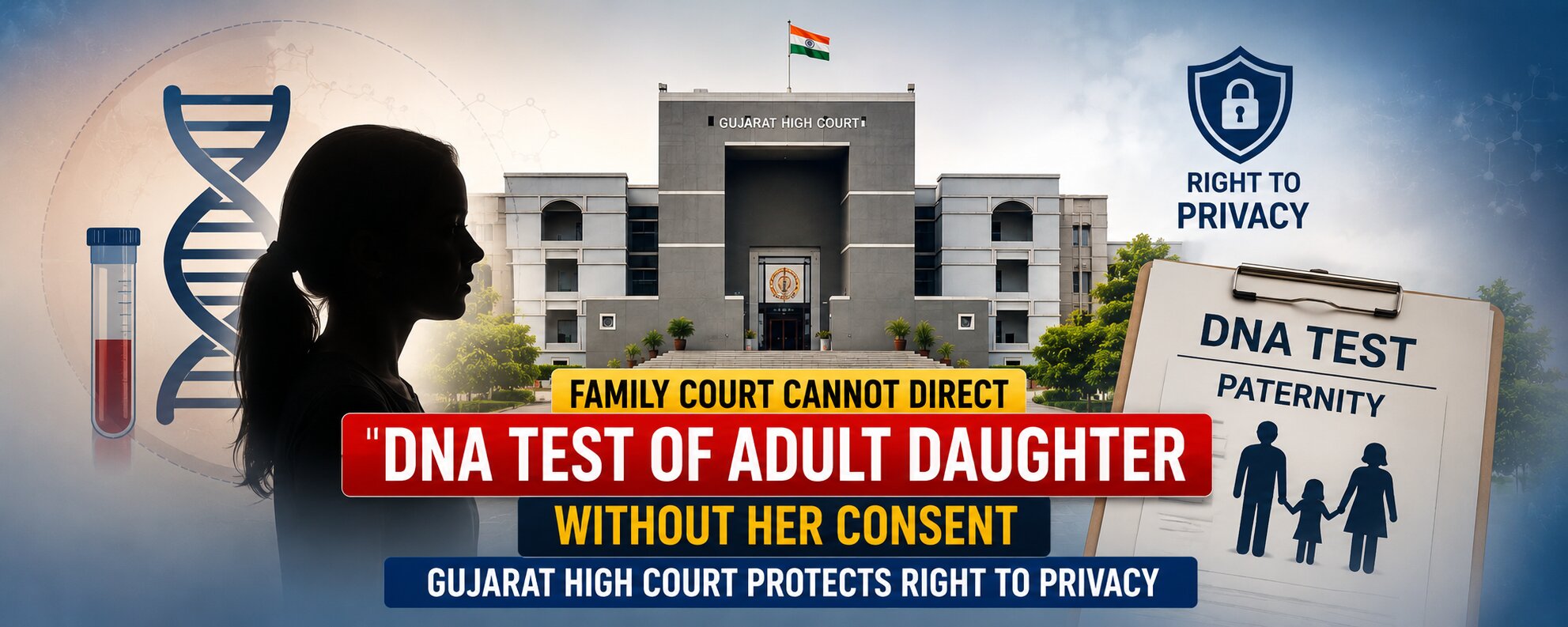
The Gujarat High Court set aside the Family Court's order directing a DNA test.
-
The Court held that a DNA test affecting an adult daughter cannot ordinarily be ordered without her free and informed consent.
-
It observed that compelling such a test without consent infringes the individual's right to privacy protected under Article 21 of the Constitution.
-
The Court emphasized that the outcome of a DNA test may have serious social and personal consequences for the individual concerned.
-
It held that the Family Court failed to apply the principles laid down by the Supreme Court in R. Rajendran v. Kamar Nisha, which caution that DNA tests should not be ordered routinely.
-
The Bench noted that the daughter had become a major and was already married, and therefore no longer possessed a statutory right to claim maintenance from the alleged father.
-
Consequently, the question of determining her paternity had largely become academic for the purpose of the pending maintenance proceedings.
-
The Court observed that any DNA examination at this stage could not be directed without the daughter's consent.
-
The impugned order of the Family Court was quashed.
-
The Family Court was directed to proceed with and conclude the pending maintenance suit expeditiously.
Held
-
A Family Court cannot ordinarily direct a DNA test to determine the paternity of an adult daughter without obtaining her consent.
-
Such a direction violates the individual's right to privacy and may have significant societal consequences.
-
DNA tests should not be ordered routinely and must satisfy the principles laid down by the Supreme Court.
-
The Family Court's order directing the DNA test was set aside.
Analysis
-
It recognizes that an adult individual has an independent right to decide whether to undergo genetic testing.
-
The Court reaffirmed that DNA profiling is an exceptional evidentiary tool and cannot be directed merely because a party requests it.
-
By relying upon the Supreme Court's decision in R. Rajendran v. Kamar Nisha, the High Court strengthened safeguards against unnecessary genetic testing.
-
The ruling emphasizes that courts must carefully balance the need for truth-finding with the protection of fundamental rights.
-
The decision also highlights that relief sought in litigation must retain practical relevance, particularly where statutory rights have already ceased to exist.
-
The judgment protects individuals from potential social stigma arising from involuntary disclosure of biological parentage.
-
The ruling will serve as an important precedent for Family Courts dealing with applications seeking DNA tests in maintenance and matrimonial proceedings.