
X v. Union of India & Ors., 2026
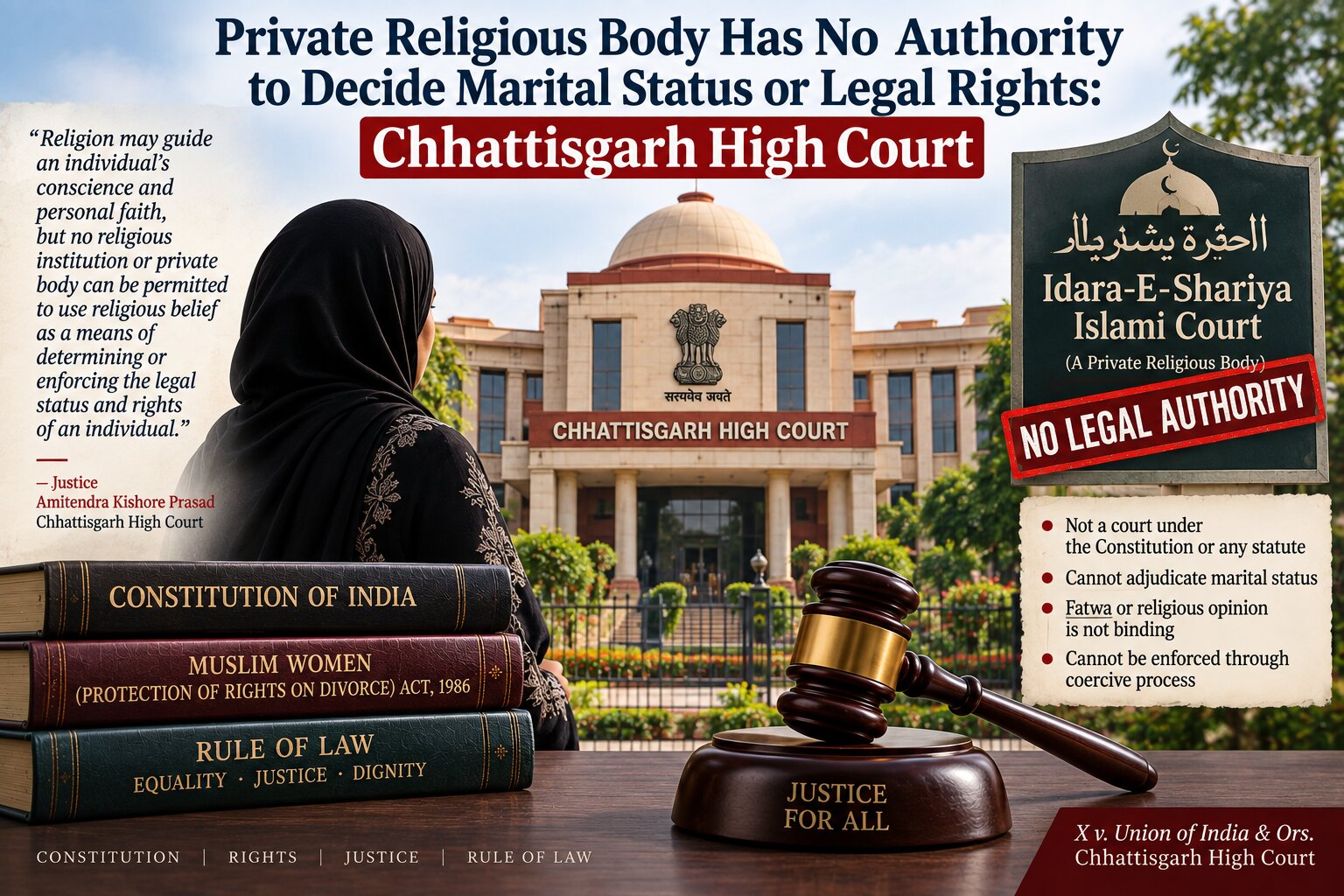
Idara-E-Shariya Islami Court is not a court recognised under the Constitution or any statute.
Judgement Details
Court
Chhattisgarh High Court
Date of Decision
10 September 2026
Judges
Justice Amitendra Kishore Prasad
Citation
Acts / Provisions
Facts of the Case
-
The petitioner had married Respondent No. 10 after the death of her first husband.
-
She had children from her first marriage who, according to Respondent No. 10, were allegedly unable to adjust with the new family.
-
On this purported ground, the petitioner was allegedly subjected to Talaq-e-Biddat/Triple Talaq.
-
An FIR was registered and proceedings were pending before the competent authorities concerning the dispute.
-
Despite the pending proceedings, Respondent No. 9, an institution describing itself as “Idara-E-Shariya Islami Court,” issued an order dated 18 January 2022.
-
Through that communication, the private religious body purported to declare that the petitioner had been divorced from Respondent No. 10.
-
The petitioner challenged the authority and existence of the Idara-E-Shariya as a judicial body and contended that its action violated her constitutional rights and legally protected rights.
-
The principal question before the High Court was whether a private religious body could assume the authority of a legally constituted court and determine the petitioner's marital status and legal rights.
-
The High Court also considered the Supreme Court's decision in Vishwa Lochan Madan v. Union of India concerning Dar-ul-Qaza and fatwas.
-
The Court consciously refrained from deciding the constitutional validity of Talaq-e-Hasan, as related issues were pending before the Supreme Court.
Issues
-
Whether the Idara-E-Shariya Islami Court can be recognised as a court constituted under the Constitution or any statute?
-
Whether a private religious body has jurisdiction to adjudicate upon and determine the marital status of an individual?
-
Whether the communication dated 18 January 2022 issued by the Idara-E-Shariya can legally dissolve the petitioner's marriage or alter her legally enforceable rights and status?
-
Whether a religious opinion, verdict or fatwa issued by a private religious institution can be treated as a binding judicial determination or enforced through coercive legal process?
-
Whether the pendency of constitutional proceedings concerning Talaq-e-Hasan can confer judicial authority upon a private religious body that otherwise possesses no statutory jurisdiction?
-
Whether the High Court should determine the constitutional validity of Talaq-e-Hasan in the present proceedings when the issue is pending consideration before the Supreme Court?
Judgement
-
The Chhattisgarh High Court held that the Idara-E-Shariya Islami Court is not a court constituted under the Constitution or any statute.
-
The Court held that the private body has no legal jurisdiction to adjudicate upon the petitioner's marital status or determine whether her marriage stood dissolved.
-
The order dated 18 January 2022 could not have the legal effect of a decree or judicial determination of dissolution of marriage.
-
The Court characterised the communication, at its highest, as a religious opinion or communication issued by a private body, and not as a legally enforceable judicial order.
-
Such a communication could neither create, extinguish nor alter any legally enforceable right or status of the petitioner.
-
The Court reiterated that adjudicatory power must flow from validly enacted law and cannot be assumed merely because an institution describes itself as a “Court.”
-
Relying upon Vishwa Lochan Madan v. Union of India, the Court held that bodies such as Dar-ul-Qaza are not part of the judicial system recognised by law merely because they provide religious opinions.
-
The Court further held that a fatwa or religious verdict is not binding and cannot be enforced through coercive legal process.
-
The Court emphasised that religion may guide an individual's conscience and personal faith, but a religious institution cannot assume the authority of a court established by law.
-
The Court held that the rule of law and constitutional framework remain paramount.
-
The Court clarified that the pendency of proceedings concerning Talaq-e-Hasan before the Supreme Court did not confer any otherwise nonexistent jurisdiction upon the Idara-E-Shariya.
-
The Court deliberately left the constitutional validity of Talaq-e-Hasan open, confining its decision to the competence and legal effect of the private body's communication.
-
The writ petition was allowed in part, and the communication dated 18 January 2022, insofar as it purported to determine or declare the petitioner's marital status or dissolve the marriage, was declared without legal authority.
Held
-
A private religious body cannot adjudicate marital status or legally determine whether a marriage has been dissolved.
-
A religious institution cannot acquire judicial authority merely by styling itself as a “Court.”
-
A religious opinion or fatwa does not constitute a judicial decree.
-
Such an opinion cannot create, extinguish or modify legally enforceable rights or status.
-
A fatwa issued by a private religious body is not binding and cannot be enforced through coercive legal process.
-
Adjudicatory authority must originate from law, not merely from religious practice, custom or institutional assertion.
-
The rule of law and constitutional supremacy prevail over any attempt by a private religious institution to exercise judicial power.
-
The pendency of proceedings concerning Talaq-e-Hasan before the Supreme Court does not grant jurisdiction to an otherwise unauthorised private body.
-
The High Court's ruling was confined to the legal competence of the Idara-E-Shariya and the effect of its communication and did not decide the constitutional validity of Talaq-e-Hasan.
Analysis
- The judgment draws a clear constitutional boundary between religious autonomy and State-recognised adjudicatory power.
-
Individuals may voluntarily seek religious guidance on personal matters, but such guidance cannot automatically acquire the status of a legally binding judicial determination.
-
The Court's reliance on Vishwa Lochan Madan reinforces the principle that judicial power cannot be created through a private institution's nomenclature or religious authority.
-
The decision protects the distinction between a religious opinion and a legal decree determining matrimonial status.
-
A particularly significant aspect is the Court's refusal to treat the Idara-E-Shariya's declaration as having any legal effect merely because it purported to pronounce upon divorce.
-
The judgment also prevents a private religious body from bypassing statutory courts and competent legal authorities in matters affecting civil and matrimonial rights.
-
The Court appropriately separated two questions: whether a particular form of talaq is legally or constitutionally valid, and whether a private religious institution has authority to adjudicate upon it.
-
By leaving Talaq-e-Hasan's validity open, the Court avoided prejudging an issue already pending before the Supreme Court.
-
The ruling therefore does not amount to a determination on the validity or invalidity of Talaq-e-Hasan itself.
-
The broader constitutional principle is that religious belief cannot be used as a mechanism for privately determining or enforcing an individual's legal status, rights or obligations.
-
The judgment strengthens the principle that matrimonial status must be determined according to lawfully recognised procedures and competent legal authorities, rather than through an unauthorised private adjudicatory mechanism.