
X v. State of Telangana & Anr., 2026
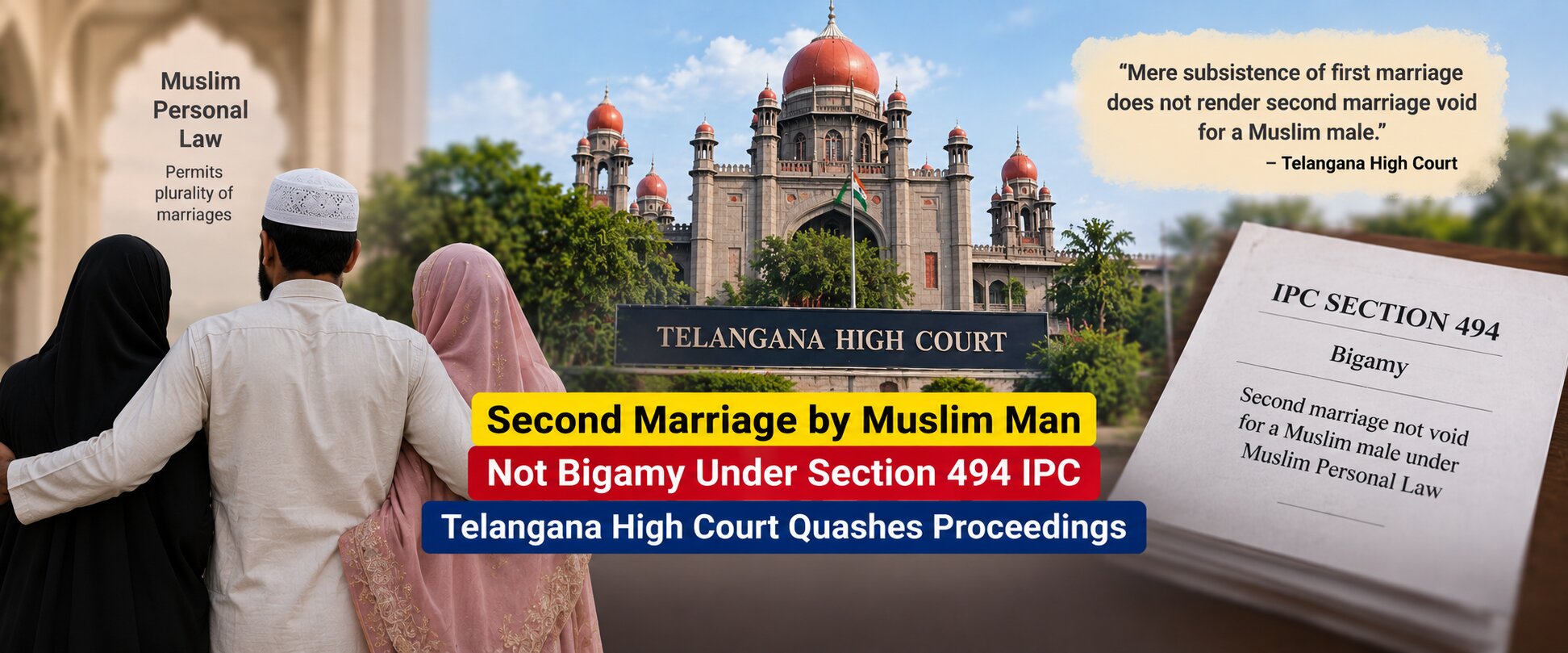
Mere existence of a previous marriage is insufficient to establish an offence under Section 494 IPC.
Judgement Details
Court
Telangana High Court
Date of Decision
10 September 2026
Judges
Justice N. Tukaramji
Citation
Acts / Provisions
Facts of the Case
-
The complainant married Petitioner No. 1 on 28 February 2009 according to Muslim rites.
-
She alleged that after marriage, her husband and his mother subjected her to mental cruelty relating to additional dowry and her inability to conceive.
-
The complainant subsequently initiated separate criminal proceedings concerning those allegations.
-
She further alleged that while her first marriage was still subsisting, Petitioner No. 1 married Petitioner No. 2 on 24 May 2015.
-
On the basis of the allegation of a second marriage, a case under Section 494 IPC was registered in 2021.
-
A charge sheet was subsequently filed against the petitioners.
-
The petitioners approached the Telangana High Court seeking to quash the criminal proceedings.
-
The petitioners argued that the first marriage had already been dissolved under Muslim Personal Law before the alleged second marriage took place.
-
They therefore contended that there was no legally subsisting first marriage when the second marriage was contracted.
-
It was also argued that Section 494 IPC could not be invoked against the alleged second wife in the circumstances of the case.
-
The Assistant Public Prosecutor argued that the question regarding the existence and subsistence of the first marriage involved disputed questions of fact that should ordinarily be determined by the trial court.
-
The High Court examined whether the allegations in the charge sheet and the investigation material disclosed the essential ingredients of bigamy under Section 494 IPC.
Issues
-
Whether the charge-sheet allegations and material collected during investigation disclosed the essential ingredients of an offence under Section 494 IPC?
-
Whether the first marriage between Petitioner No. 1 and the complainant was legally subsisting at the time of the alleged second marriage?
-
Whether the alleged dissolution of the first marriage under Muslim Personal Law, before the second marriage, excluded the application of Section 494 IPC?
-
Whether, even assuming that the first marriage continued to subsist, a subsequent marriage contracted by a Muslim male would become void merely because the earlier marriage remained in existence?
-
Whether the criminal proceedings for bigamy were liable to be quashed when the prosecution material itself indicated that the first marriage had already been dissolved?
Judgement
-
The Telangana High Court allowed the criminal petition and quashed the FIR/proceedings against the petitioners.
-
The Court explained that Section 494 IPC contains specific cumulative requirements for establishing the offence of bigamy.
-
These include the existence of a living spouse, a legally valid and subsisting first marriage, a subsequent marriage, and the subsequent marriage being void because of the subsistence of the earlier marriage.
-
The Court found that the prosecution could not establish the necessary foundation merely by showing that a prior matrimonial relationship had once existed.
-
The relevant question was whether the first marriage was legally subsisting on the date of the alleged second marriage.
-
The Court noted that the prosecution material itself prima facie indicated that the first marriage had already been dissolved under the law applicable to the parties.
-
Consequently, if that dissolution was legally effective, there was no subsisting first marriage when the alleged second marriage took place.
-
The Court further considered an alternative situation: even if the first marriage were assumed to have continued, mere subsistence of the marriage would not automatically make a subsequent marriage by a Muslim male governed by Muslim Personal Law void.
-
The Court held that the prosecution would still have to establish that the second marriage was void because of the subsistence of the first marriage.
-
Since the governing personal law permits a Muslim male to contract plural marriages, the mere existence of an earlier marriage does not by itself satisfy this essential requirement of Section 494 IPC.
-
The Court therefore concluded that the necessary ingredients of Section 494 IPC were absent.
-
The criminal proceedings were accordingly quashed.
Held
-
The prosecution must establish that the earlier marriage was legally valid and subsisting at the time of the subsequent marriage.
-
The prosecution material in the present case prima facie indicated that the first marriage had already been dissolved before the alleged second marriage.
-
Therefore, there was no subsisting first marriage capable of attracting the first essential requirement of Section 494 IPC.
-
The Court further held that, even assuming the first marriage continued, its mere subsistence would not by itself render a subsequent marriage by a Muslim male void under the personal law applicable to the parties.
-
The prosecution must additionally establish that the subsequent marriage was legally void because of the subsistence of the earlier marriage.
-
The essential ingredients of Section 494 IPC were not satisfied.
-
The High Court therefore quashed the FIR/criminal proceedings against the petitioners.
Analysis
-
The judgment focuses on the distinction between the existence of a previous marriage and the legal subsistence of that marriage at the time of the subsequent marriage.
-
The Court treated the requirements of Section 494 IPC as cumulative, meaning that failure to establish an essential ingredient can prevent the offence of bigamy from being made out.
-
A central aspect of the ruling is that bigamy under Section 494 IPC depends upon the legal invalidity of the subsequent marriage, not merely upon the fact that an earlier marriage existed.
-
The Court applied the personal law governing the parties while determining whether the second marriage could be considered void.
-
The judgment recognises that Muslim Personal Law permits plurality of marriages for a Muslim male, subject to the governing legal framework.
-
Therefore, according to the Court, the mere continuation of an earlier Muslim marriage does not automatically make a subsequent marriage void for the purpose of Section 494 IPC.
-
The Court also relied upon the prosecution's own material, which prima facie suggested that the first marriage had been dissolved before the second marriage.
-
This made the prosecution's case particularly weak because the existence of a subsisting first marriage was itself not established from the material relied upon.
-
The ruling demonstrates the importance of determining the applicable personal law before applying the statutory offence of bigamy.
-
The Court also illustrates the limits of criminal prosecution: where the basic statutory ingredients of an offence are absent from the allegations and investigation material, continuation of the criminal proceedings may amount to an abuse of the process of law.
-
The judgment should not be read as holding that every second marriage by a Muslim male is automatically legally valid in every circumstance; the Court's reasoning turned on the specific requirements of Section 494 IPC and the personal law applicable to the parties.
-
The case is particularly relevant to understanding the interaction between personal law and criminal law, especially where the validity of a subsequent marriage is questioned under the IPC.