
Vishnu Kumar Gupta v. State of Madhya Pradesh & Anr., 2026
The judgment adopts a strict textual interpretation of Section 374 CrPC by emphasizing the words "on a trial" and "held by".
Judgement Details
Court
Supreme Court of India
Date of Decision
31 July 2026
Judges
Justice Aravind Kumar & Justice Prasanna B. Varale
Citation
Acts / Provisions
Facts of the Case
-
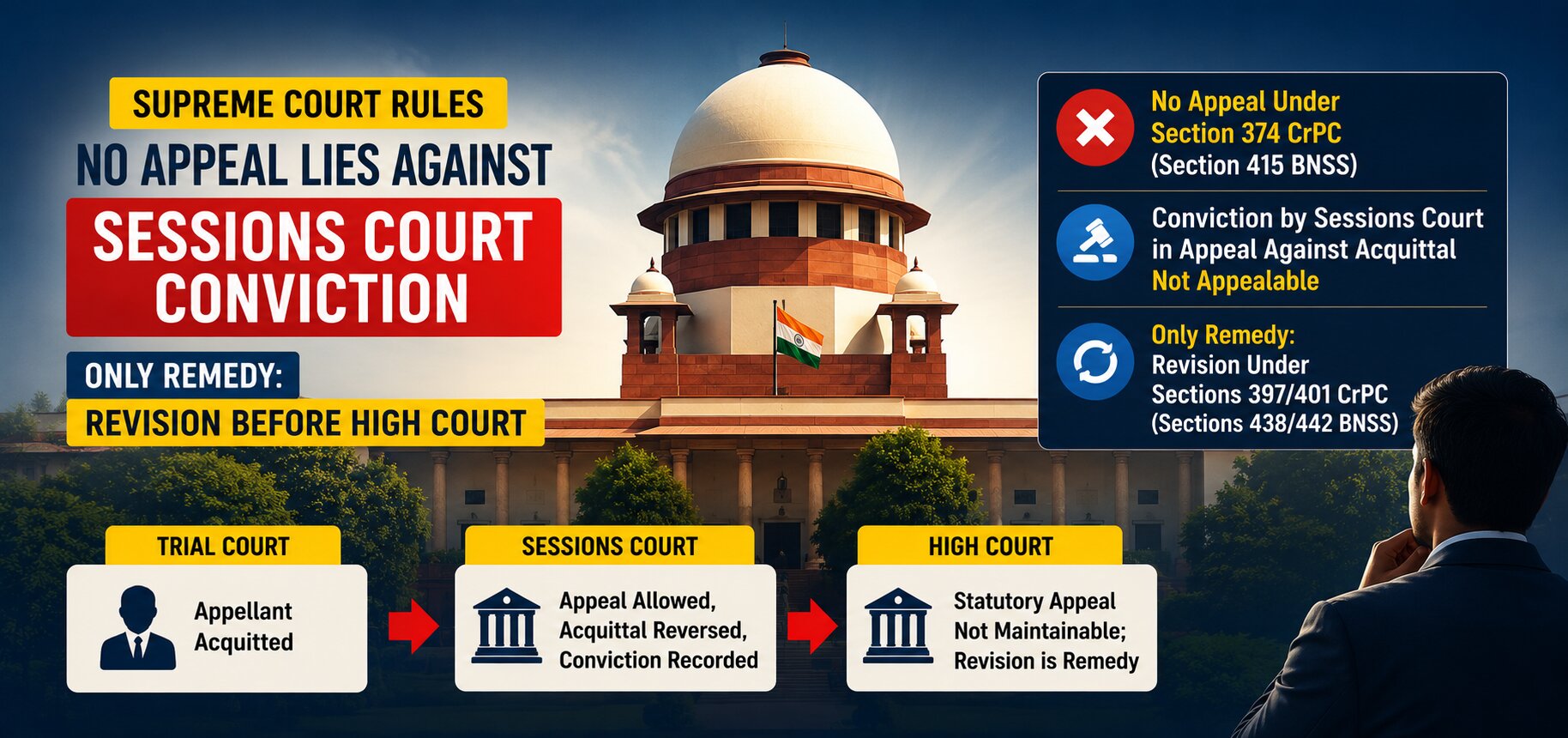
The appellant was tried before the Judicial Magistrate First Class and was acquitted of the criminal charges.
-
Dissatisfied with the acquittal, the complainant preferred an appeal before the Sessions Court under Section 378 CrPC (Section 419 BNSS).
-
The Sessions Court, while exercising appellate jurisdiction, reversed the order of acquittal and convicted the appellant for the first time.
-
Aggrieved by the conviction, the appellant filed a statutory appeal before the High Court under Section 374 CrPC (Section 415 BNSS).
-
The High Court dismissed the appeal as not maintainable, holding that no statutory appeal lies against a conviction recorded by a Sessions Court while exercising appellate jurisdiction.
-
The High Court observed that the appropriate remedy available to the appellant was to file a criminal revision.
-
The appellant challenged the High Court's decision before the Supreme Court.
Issues
-
Whether an appeal under Section 374 of the Code of Criminal Procedure, 1973 (corresponding to Section 415 of the Bharatiya Nagarik Suraksha Sanhita, 2023) is maintainable against a judgment of conviction recorded by a Sessions Court while exercising appellate jurisdiction and reversing an order of acquittal passed by a Trial Court?
-
Whether the doctrine of continuation of proceedings converts an appellate court into a court exercising trial jurisdiction for the purpose of invoking Section 374 CrPC?
-
Whether the proper remedy against such a conviction is a statutory appeal or a criminal revision before the High Court?
Judgement
-
The Supreme Court held that no statutory appeal under Section 374 CrPC (Section 415 BNSS) is maintainable against a conviction recorded by a Sessions Court while exercising appellate jurisdiction after reversing an acquittal.
-
The Court observed that Section 374 permits an appeal only against a conviction recorded by the court that has itself conducted the trial.
-
It clarified that a Sessions Court hearing an appeal against acquittal does not conduct the trial but merely exercises appellate jurisdiction.
-
The Court held that the expression "on a trial" in Section 374 refers only to the court before which the trial commenced and concluded.
-
It rejected the argument that the doctrine of continuation of proceedings transforms an appellate court into a trial court.
-
The Court ruled that the doctrine merely ensures procedural continuity and does not alter the nature of appellate jurisdiction.
-
The Supreme Court declared the Himachal Pradesh High Court decision in Arun Sharma v. State of Himachal Pradesh (2019) to be bad in law insofar as it held otherwise.
-
The Court affirmed the High Court's order dismissing the statutory appeal as not maintainable.
-
Liberty was granted to the appellant to file a criminal revision before the High Court against the Sessions Court's judgment.
Held
-
A statutory appeal under Section 374 CrPC / Section 415 BNSS is not maintainable against a conviction recorded by a Sessions Court while exercising appellate jurisdiction.
-
The appropriate legal remedy is a criminal revision under Section 397 read with Section 401 CrPC (corresponding to Section 438 read with Section 442 BNSS).
-
The doctrine of continuation of proceedings does not convert an appellate court into a trial court.
-
The appeal was dismissed with liberty to pursue the revisional remedy.
Analysis
-
It clearly distinguishes between trial jurisdiction and appellate jurisdiction, thereby preventing an unwarranted expansion of statutory appeal provisions.
-
The Court reaffirmed the principle that a right of appeal is purely statutory and cannot be inferred unless expressly provided by law.
-
The decision reinforces that appellate courts exercising appellate powers cannot be equated with courts conducting trials.
-
By rejecting the broad application of the doctrine of continuation of proceedings, the Court clarified an important procedural principle in criminal jurisprudence.
-
The ruling removes uncertainty regarding the remedy available when a Sessions Court reverses an acquittal and records a conviction.
-
The judgment overrules the contrary view adopted by the Himachal Pradesh High Court in Arun Sharma, thereby ensuring uniformity in criminal procedural law.
-
The decision will guide litigants and courts in determining the proper procedural remedy under both the CrPC and the BNSS.
-
The judgment strengthens the principle that statutory rights of appeal must be interpreted strictly in accordance with legislative intent.