
The State of Tripura v. Md. Jangsar Ali, 2026
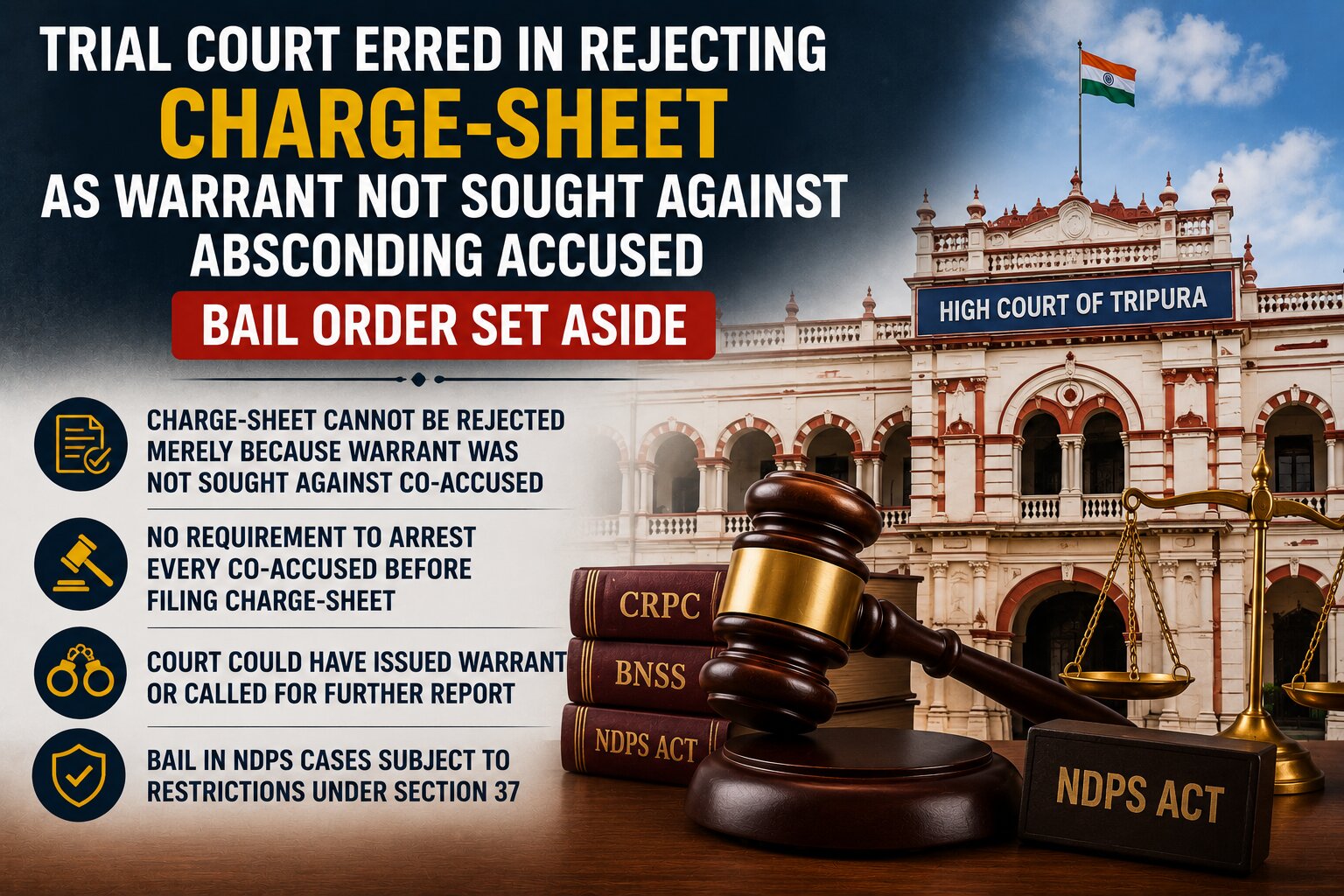
A Trial Court cannot refuse to accept a charge-sheet against an accused merely because a co-accused is absconding and no warrant or proclamation has yet been issued against that person.
Judgement Details
Court
High Court of Tripura
Date of Decision
19 August 2026
Judges
Justice Biswajit Palit
Citation
Acts / Provisions
Facts of the Case
- The proceedings arose out of an NDPS case registered for offences under Sections 20(b)(ii)(C), 25 and 29 of the NDPS Act.
-
Md. Jangsar Ali was an accused in the case.
-
During the investigation, one of the co-accused was allegedly absconding.
-
The Investigating Officer completed the investigation concerning the accused in custody and submitted the charge-sheet within the applicable statutory period.
-
The statutory period of detention of Jangsar Ali was due to expire on 28 May 2025.
-
The Investigating Officer submitted the charge-sheet on that date.
-
The Special Court, however, refused to accept the charge-sheet because the Investigating Officer had not sought a warrant or initiated proclamation proceedings against the absconding co-accused.
-
Since the charge-sheet was not accepted, the Special Court granted bail to Jangsar Ali.
-
The State challenged the Special Court's order before the Tripura High Court.
-
The State argued that the Trial Court had misunderstood the law because there was no requirement that proceedings concerning an absconding co-accused must first be completed before a charge-sheet could be accepted against an accused who was available for prosecution.
-
The High Court examined whether the absence of a warrant or proclamation against the absconding co-accused could legally justify the Special Court's refusal to accept the charge-sheet.
-
The Court also considered the special restrictions governing bail under Section 37 of the NDPS Act.
Issues
-
Whether a Trial Court can refuse to accept a charge-sheet against an accused merely because the Investigating Officer has not sought a warrant or initiated proclamation proceedings against an absconding co-accused?
-
Whether the filing of a charge-sheet against an accused is legally dependent upon the arrest or appearance of every co-accused named during investigation?
-
Whether the absence of warrant or proclamation proceedings against an absconding co-accused provides a lawful basis for granting bail to an accused facing prosecution under the NDPS Act?
-
Whether the Trial Court was justified in granting bail after refusing to accept the charge-sheet despite the statutory restrictions contained in Section 37 of the NDPS Act?
-
Whether the High Court could exercise its inherent jurisdiction under Section 528 BNSS to set aside the Trial Court's order where the charge-sheet had been wrongly rejected and bail had consequently been granted?
Judgement
-
The Tripura High Court set aside the Trial Court's order granting bail to Md. Jangsar Ali.
-
The Court held that the Special Court had committed an error by refusing to accept the charge-sheet merely because the Investigating Officer had not sought a warrant or proclamation against the absconding co-accused.
-
The Court described the Trial Court's reasoning as “wholly illegal, unreasonable and unjustified.”
-
The Court found no legal requirement under the applicable criminal-procedure framework that an accused must be arrested before a charge-sheet can be filed against another accused.
-
The fact that a co-accused remained absconding did not prevent the Investigating Officer from submitting a charge-sheet concerning the accused against whom the investigation had been completed.
-
The Court observed that if the Special Judge considered proceedings against the absconding accused necessary, the Court could have issued an appropriate warrant or called for a further report from the Investigating Officer.
-
Rejecting the charge-sheet was therefore not a legally appropriate response to the absence of warrant or proclamation proceedings.
-
The Court further considered the consequences for bail.
-
Since the offences alleged were under the NDPS Act, the Court held that the stringent requirements of Section 37 NDPS Act had to be taken into account.
-
The Trial Court could not effectively bypass the Section 37 restrictions by refusing to accept a properly filed charge-sheet.
-
The High Court therefore found the grant of bail to Jangsar Ali to be unjustified.
-
The bail order was set aside.
-
The accused was directed to surrender before the Trial Court.
Held
-
The Court held that a charge-sheet cannot be rejected merely because an absconding co-accused has not yet been subjected to warrant or proclamation proceedings.
-
The Court held that the arrest or appearance of every co-accused is not a prerequisite for filing a charge-sheet against an accused whose investigation has been completed.
-
The Court held that the Trial Court's refusal to accept the charge-sheet on this ground was legally erroneous.
-
The Court held that the Trial Court should have accepted the charge-sheet and, if necessary, separately directed appropriate proceedings against the absconding co-accused.
-
The Court held that bail in an NDPS case must be considered in accordance with the stringent requirements of Section 37 of the NDPS Act.
-
The Court held that the bail granted after the improper rejection of the charge-sheet could not be sustained.
-
The order granting bail was therefore set aside, and the accused was directed to surrender before the Trial Court.
Analysis
-
Charge-sheet need not await every accused: The core principle is that criminal investigation and prosecution can proceed against an accused who is available even if another accused remains absconding. The prosecution is not legally required to keep the entire case pending indefinitely because one suspect has not been apprehended.
-
Absconding co-accused: The procedural position of an absconding accused is separate from the prosecution of an accused who is available before the court. Appropriate warrants or proclamation proceedings can be pursued independently.
-
Trial Court's jurisdiction: The Special Court was not powerless merely because the Investigating Officer had not requested a warrant or proclamation. If judicial action against the absconding accused was considered necessary, the Court could take appropriate procedural steps rather than reject the charge-sheet.
-
Rejection of charge-sheet was the critical error: The High Court considered the Trial Court's refusal to accept the charge-sheet fundamentally misconceived. The filing of a charge-sheet is concerned with the completion of investigation and the material collected against the accused, not with ensuring that every co-accused has already been arrested.
-
Default-bail implications: The timing of the charge-sheet was particularly important because the accused's statutory detention period was expiring. An improper refusal to accept a charge-sheet can have significant consequences for the accused's custody and bail rights.
-
NDPS Act creates a special bail regime: The Court emphasised that an accused facing specified NDPS offences cannot be released on bail merely by relying upon ordinary bail principles. Section 37 NDPS Act imposes additional statutory restrictions.
-
Section 37 cannot be bypassed: The judgment is important because it prevents a procedural error concerning the charge-sheet from indirectly defeating the special bail restrictions Parliament has imposed for serious narcotics offences.
-
Procedural irregularity and substantive prosecution: The Court distinguished between a procedural issue relating to an absconding co-accused and the prosecution of the accused actually before the Court. The former could not be used to invalidate or refuse acceptance of the latter's charge-sheet.
-
Role of inherent jurisdiction: The High Court exercised its inherent jurisdiction to correct what it regarded as a serious procedural and legal error by the Special Court.
-
Protection of investigation and trial: Allowing the Trial Court's approach to stand could potentially encourage accused persons to obtain bail because another accused had not yet been apprehended. The ruling avoids such a consequence.
-
Practical significance: Investigating agencies can submit a charge-sheet against available accused persons even where one or more co-accused remain absconding, while taking separate steps to secure the presence of those absconders.
-
Important limitation: The judgment does not mean that an NDPS accused can never obtain bail merely because a charge-sheet has been filed. The ordinary and special statutory requirements for bail, particularly Section 37 NDPS Act, must still be independently satisfied.