
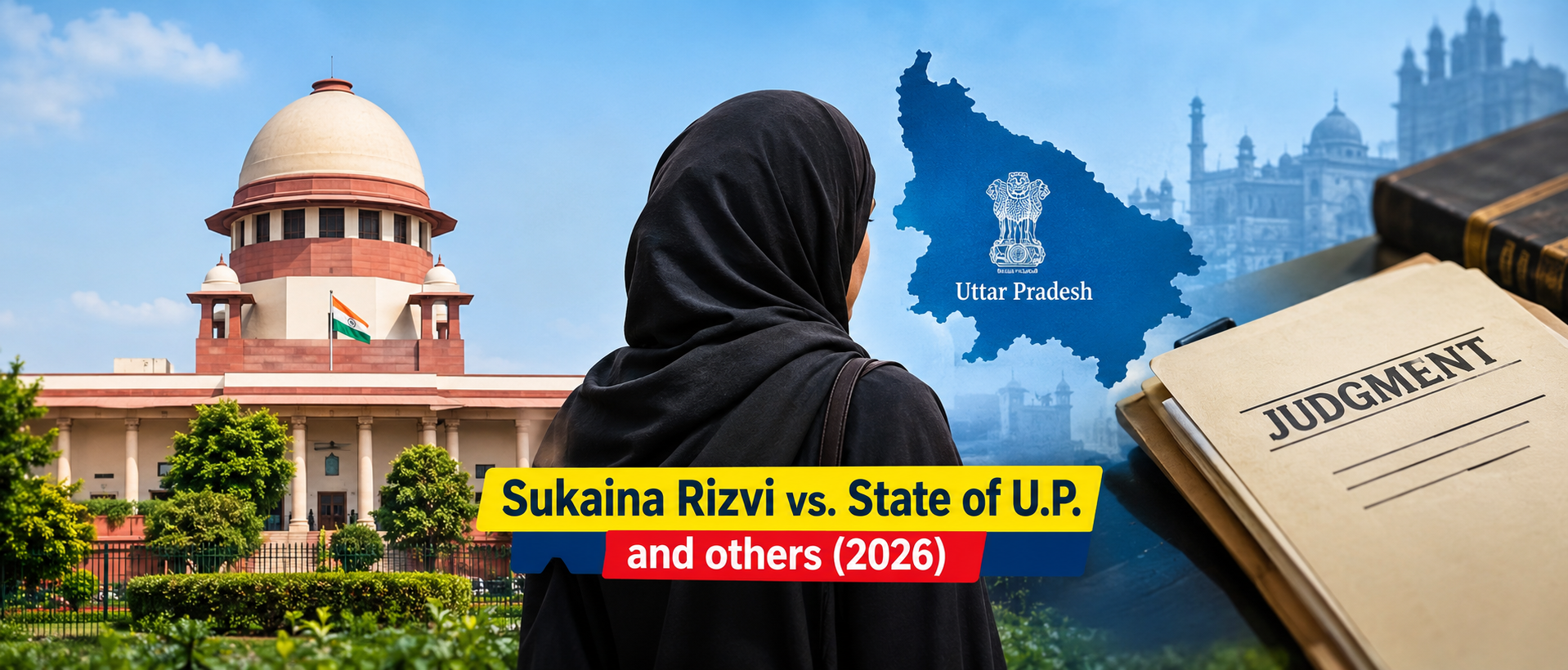
Sukaina Rizvi v. State of U.P. and Others, 2026
Allahabad HC on Hijab and School Uniform
Judgement Details
Court
High Court of Allahabad
Date of Decision
2 September 2026
Judges
Justice J.J. Munir and Justice Indrajeet Shukla
Citation
Acts / Provisions
Facts of the Case
-
Sukaina Rizvi, a minor student, had studied at Tagore Public School, Attarsuiya, Prayagraj, from Classes VI to X. The school is a private unaided institution affiliated with CBSE.
-
The petitioner had previously worn a headscarf along with the school uniform. When she sought admission to Class XI, the school insisted that she comply with its prescribed uniform and did not permit the addition of a headscarf.
-
The petitioner approached the authorities and ultimately filed a writ petition before the Allahabad High Court. She sought a writ of mandamus directing the school to permit her to wear a headscarf along with the prescribed uniform.
-
She argued, among other things, that wearing the headscarf was connected with her religious faith and was protected by Article 25, while also invoking Articles 14, 19(1)(a) and 21.
-
The school maintained that its dress code was uniformly applicable to students and that permitting an individual exemption would undermine discipline, uniformity and institutional identity.
Issues
- Whether the petitioner had an enforceable constitutional right to wear a headscarf in addition to the school's prescribed uniform.
- Whether wearing a headscarf constituted an essential religious practice of Islam protected by Article 25 of the Constitution.
- Whether the school's uniform policy violated Articles 14, 19(1)(a) or 21 of the Constitution.
- Whether a private unaided CBSE-affiliated school could prescribe and enforce a uniform dress code as part of institutional discipline.
- Whether the petitioner's previous practice of wearing a headscarf at the school created an enforceable right or prevented the school from subsequently enforcing its uniform policy.
- Whether the High Court should exercise its Article 226 jurisdiction to interfere with the school's decision concerning its uniform policy.
- Whether permitting an individual student to deviate from the prescribed uniform would undermine the concept and purpose of a uniform.
Judgement
-
The Allahabad High Court dismissed the writ petition.
-
The Division Bench held that where a school's dress code is uniform, bona fide, non-discriminatory and intended to maintain discipline and institutional identity, determining the prescribed uniform falls within the school's institutional domain.
-
The Court was also not persuaded that the petitioner had established, through sufficient pleadings and supporting material, that wearing a headscarf was an essential religious practice whose non-observance would affect the fundamental character of her faith.
-
The Court noted that the petition contained essentially an assertion regarding the religious necessity of the headscarf but lacked adequate supporting religious material or evidence to establish the claim.
-
The Court further reasoned that the school's requirement was not directed at suppressing the petitioner's religion; rather, it required compliance with a generally applicable institutional dress code.
-
The Court therefore declined to issue the requested writ of mandamus.
-
There was no order as to costs.
Held
The Court essentially held that:
-
A student cannot ordinarily insist upon modifying a prescribed school uniform where the dress code is uniformly applied, bona fide, non-discriminatory and intended to maintain institutional discipline and identity.
-
The Court further held that the petitioner had not placed sufficient material to establish that wearing a headscarf was an essential religious practice protected by Article 25 in the circumstances of the case.
-
Writ Petition — Dismissed
Analysis
-
A central principle in the judgment is the distinction between an institution's uniform policy and an individual's preference concerning dress.
-
The Court considered a uniform to be more than merely clothing. It serves institutional purposes such as:
-
discipline;
-
equality among students;
-
institutional identity; and
-
maintaining a common educational environment.
-
The Court therefore considered that allowing individual students to make exceptions based on individual preferences could weaken the very concept of a uniform.
-
The petitioner relied heavily on freedom of religion under Article 25.
-
However, the Court found that the pleadings did not adequately establish that wearing a headscarf was an essential religious practice, particularly because there was insufficient supporting religious material demonstrating that failure to wear it would fundamentally affect the petitioner's faith.
-
Thus, the judgment distinguishes between a personal religious practice or belief and an essential religious practice capable of attracting constitutional protection in the manner claimed.
-
The Court considered the school's policy to be applicable generally rather than being directed specifically against the petitioner because of her religion.
-
The fact that the school required students to comply with a common dress code was therefore important to the Court's assessment of the Article 14 claim.
-
An important aspect of the reasoning was that the petitioner had previously worn a headscarf while attending the school.
-
The Court nevertheless did not treat the school's earlier tolerance or non-enforcement as creating a permanent legal right to an exemption. The school's previous conduct could not, by itself, prevent it from subsequently enforcing its uniform policy.
-
The Court was cautious about substituting judicial opinion for the school's decision regarding its internal dress policy.
-
The judgment indicates that Article 226 jurisdiction is not ordinarily a mechanism for courts to redesign institutional policies, particularly where there is no demonstrated violation of an enforceable fundamental right.
-
The Bench considered earlier decisions from the Kerala, Bombay and Karnataka High Courts, including decisions addressing whether wearing a hijab/headscarf constitutes an essential religious practice and whether schools may enforce uniform policies.
-
The Karnataka Full Bench decision in Resham v. State of Karnataka was particularly relevant to the reasoning concerning hijab and school uniforms. The Allahabad High Court treated the existing High Court jurisprudence as persuasive in assessing the petitioner's claim.
-
The judgment is significant because it reinforces several principles:
-
School uniform policies receive substantial institutional deference.
-
A student does not automatically acquire a constitutional right to modify a uniform.
-
A claim under Article 25 requires more than a bare assertion that a particular practice is religiously obligatory.
-
The Court distinguished religious freedom from the right to demand an individual exemption from a neutral institutional rule.
-
The decision contributes to the continuing Indian constitutional debate concerning religious freedom, educational institutions, dress codes and the essential religious practice doctrine.
-
Importantly, the decision should be understood in the context of its particular facts and pleadings rather than as establishing an absolute proposition that no student can ever seek accommodation for religious dress.