
Smt. Mamta Jangid v. State of Rajasthan, 2026
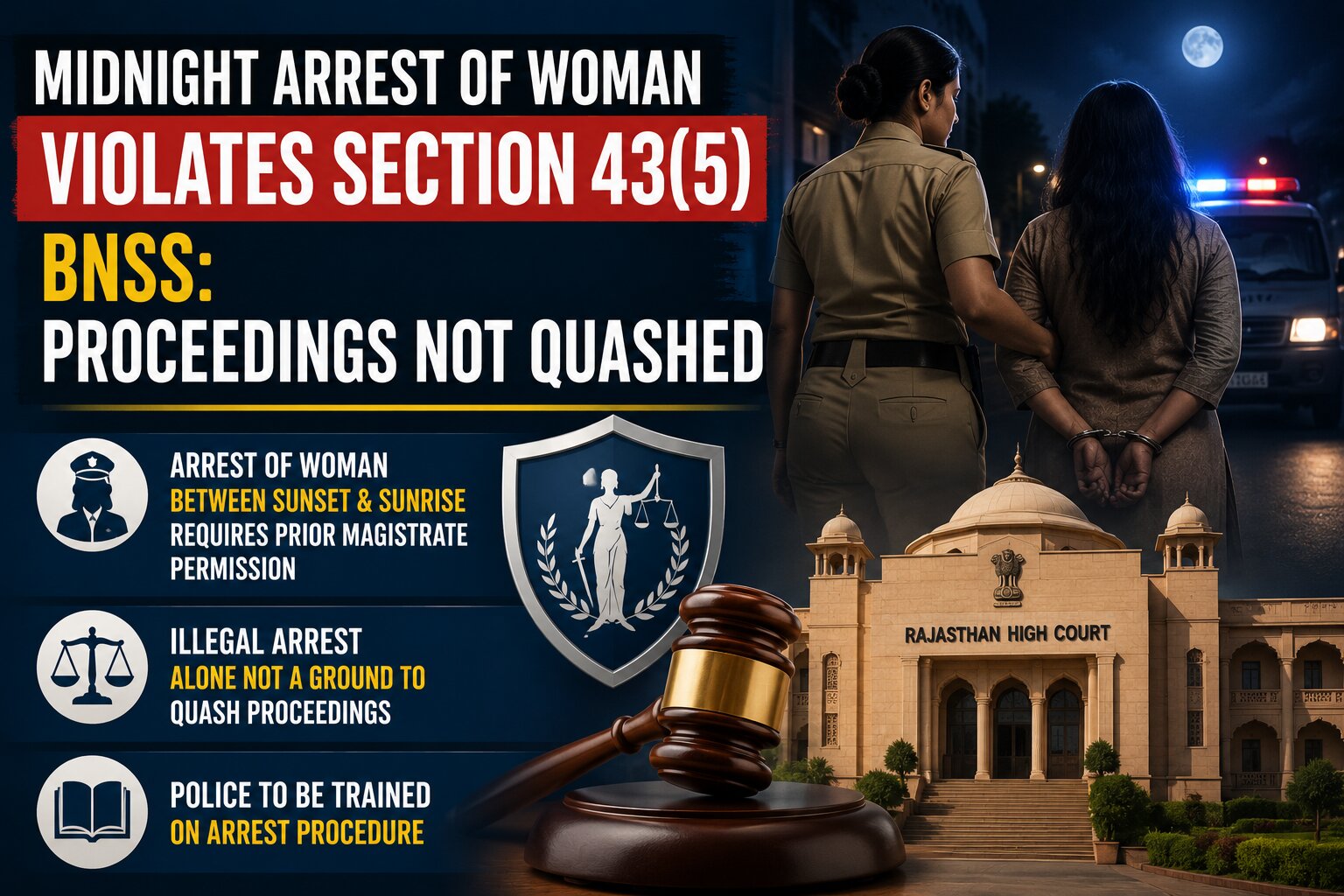
A woman cannot ordinarily be arrested between sunset and sunrise under Section 43(5) BNSS. Even in exceptional circumstances, the prescribed written report and prior Magistrate-permission requirements must be followed.
Judgement Details
Court
Rajasthan High Court
Date of Decision
19 August 2026
Judges
Justice Ashok Kumar Jain
Citation
Acts / Provisions
Facts of the Case
-
The petitioner was a woman accused in proceedings registered under Section 8/20 of the NDPS Act.
-
The police received information concerning the petitioner and the co-accused and proceeded to search their house.
-
The search was conducted after sunset.
-
Following the search, the petitioner was arrested at approximately 1:15 a.m.
-
The petitioner challenged the legality of her arrest on the ground that she had been arrested during the prohibited nighttime period.
-
She argued that the police had failed to comply with Section 43(5) BNSS, which regulates the arrest of women after sunset and before sunrise.
-
According to the petitioner, no exceptional circumstances had been established and no prior permission of the Judicial Magistrate had been obtained.
-
The prosecution argued that the search and arrest had been conducted by a female police officer.
-
The High Court examined Section 43(5) BNSS and found that even in exceptional circumstances, the prescribed statutory safeguards had to be followed.
-
The Court found that prior permission of the concerned Judicial Magistrate had not been obtained.
-
The Court therefore concluded that the arrest had been made in violation of the mandatory statutory procedure and was consequently illegal.
-
Despite finding the arrest illegal, the Court had to determine whether that illegality was sufficient to justify quashing the entire criminal proceedings under the NDPS Act.
-
For this purpose, the Court considered the principles laid down by the Supreme Court governing the exercise of the High Court's jurisdiction to quash criminal proceedings.
Issues
-
Whether the arrest of a woman after sunset and before sunrise without prior permission of the concerned Judicial Magistrate violates the mandatory requirements of Section 43(5) BNSS?
-
Whether an arrest made in violation of Section 43(5) BNSS is rendered illegal even when the arrest and search were conducted by a female police officer?
-
Whether an illegal arrest in violation of the mandatory safeguards under Section 43(5) BNSS, by itself, constitutes a sufficient ground for quashing criminal proceedings under the NDPS Act?
-
Whether the violation of the statutory procedure governing the arrest of a woman warrants quashing of the FIR or criminal proceedings when the allegations disclose a substantive offence under the NDPS Act?
-
Whether the petitioner could nevertheless rely upon the illegality of her arrest as a ground for seeking appropriate relief, including bail, even though the criminal proceedings themselves could not be quashed?
Judgement
-
The Rajasthan High Court dismissed the petition seeking quashing of the criminal proceedings.
-
At the same time, the Court categorically held that the petitioner's midnight arrest was illegal because the mandatory requirements of Section 43(5) BNSS had not been complied with.
-
The Court explained that Section 43(5) BNSS prohibits the arrest of a woman between sunset and sunrise, except in exceptional circumstances.
-
Where exceptional circumstances exist, the woman police officer must prepare a written report and obtain prior permission from the concerned Judicial Magistrate.
-
The Court found that no such prior permission had been obtained in the present case.
-
The fact that the arrest had been carried out by a female police officer did not cure the statutory violation.
-
The Court relied upon the earlier decision in Deepa v. S. Vijayalakshmi, which treated the corresponding provision under Section 46(4) CrPC as mandatory.
-
However, the Court distinguished between the illegality of the arrest and the validity of the underlying criminal proceedings.
-
It held that the violation of the arrest procedure, standing alone, did not fall within the recognised grounds for quashing criminal proceedings.
-
The Court examined the principles governing quashing of criminal proceedings, including those laid down in State of Haryana v. Bhajan Lal and Ankul Singh v. State of Uttar Pradesh.
-
The Court found no sufficient basis to conclude that the FIR amounted to an abuse or misuse of the process of law.
-
Since the allegations concerned an offence under the NDPS Act, the Court held that the criminal proceedings could not be quashed merely because the arrest procedure had been violated.
-
The Court nevertheless observed that the petitioner could take advantage of the illegality of the arrest while seeking bail.
-
The Court also took serious note of the failure of the Sub-Inspector to comply with the statutory requirements.
-
The Court directed the Director General of Police, Rajasthan, to take appropriate steps for training police personnel regarding the legally prescribed procedure for arresting women.
-
The Court observed that police personnel require either extensive training or accessible handbook-type material to ensure compliance with the law.
-
The petition was accordingly dismissed, while the Court preserved the petitioner's ability to rely upon the illegal arrest in appropriate proceedings for bail.
Held
-
The Court held that the arrest of a woman after sunset and before sunrise without prior permission of the Judicial Magistrate is in violation of Section 43(5) BNSS.
-
The Court held that the requirement of prior Magistrate permission in exceptional circumstances is mandatory.
-
The Court held that the fact that the arrest was carried out by a female police officer does not eliminate the requirement of complying with Section 43(5) BNSS.
-
The Court held that an illegal arrest does not automatically invalidate or require quashing of the substantive criminal proceedings under the NDPS Act.
-
The Court held that the illegality of the arrest may nevertheless be relied upon by the accused while seeking bail.
-
The Court held that the circumstances did not satisfy the established principles for quashing the FIR or criminal proceedings.
-
The Court directed the Director General of Police, Rajasthan, to take steps to train police personnel regarding the mandatory procedure governing the arrest of women.
-
The petition seeking quashing of the proceedings was therefore dismissed.
Analysis
-
Mandatory protection for women: The judgment reinforces that Section 43(5) BNSS is not merely a procedural guideline. The Court treated its safeguards as mandatory and found the nighttime arrest unlawful.
-
Female officer does not cure illegality: A particularly important aspect is that the arrest being conducted by a female police officer did not satisfy the statutory requirement. The law regulates the time and procedure of arrest, not merely the gender of the arresting officer.
-
Prior Magistrate permission is essential: Where exceptional circumstances justify a nighttime arrest of a woman, the police must follow the statutory mechanism of preparing a written report and obtaining prior permission from the Judicial Magistrate.
-
Illegal arrest versus illegal prosecution: The judgment draws a critical distinction between an unlawful arrest and an invalid criminal case. A procedural violation at the arrest stage does not necessarily mean that the allegations contained in the FIR cease to disclose a criminal offence.
-
NDPS proceedings receive independent consideration: Since the allegations concerned an offence under the NDPS Act, the Court was unwilling to terminate the prosecution merely because the arrest procedure had not been followed correctly.
-
Quashing jurisdiction is exceptional: The Court applied the principles governing quashing of criminal proceedings and found that the case did not fall within the recognised categories warranting such extraordinary intervention.
-
Potential benefit at the bail stage: Although the illegal arrest did not justify quashing, the Court expressly recognised that the petitioner could rely upon the illegality as a ground in support of bail. This creates a meaningful legal consequence for the police violation without automatically terminating the prosecution.
-
Police accountability: The Court went beyond merely declaring the arrest illegal. By directing the DGP to take steps for police training, it addressed the institutional cause of the violation.
-
Importance of legal training: The Court's observation that police personnel may require a handbook or extensive training highlights the practical importance of ensuring that officers understand the procedural safeguards introduced under the BNSS.
-
Continuity from CrPC to BNSS: The Court's reliance on Section 46(4) CrPC and Deepa v. S. Vijayalakshmi demonstrates continuity between the earlier safeguards governing women's arrest and the corresponding protection now contained in Section 43(5) BNSS.
-
Balance between individual rights and prosecution: The judgment attempts to balance two competing concerns: protecting an accused woman's statutory and constitutional rights while ensuring that a procedural lapse does not automatically destroy a prosecution involving substantive allegations under a special penal statute.
-
Broader significance: The decision serves as a warning that the procedural safeguards governing arrest under the BNSS must be strictly followed. At the same time, it clarifies that an illegal arrest and the merits or sustainability of the underlying prosecution are legally distinct questions.