
Sharif Ahmad & Others v. State of Uttar Pradesh & Others, 2026
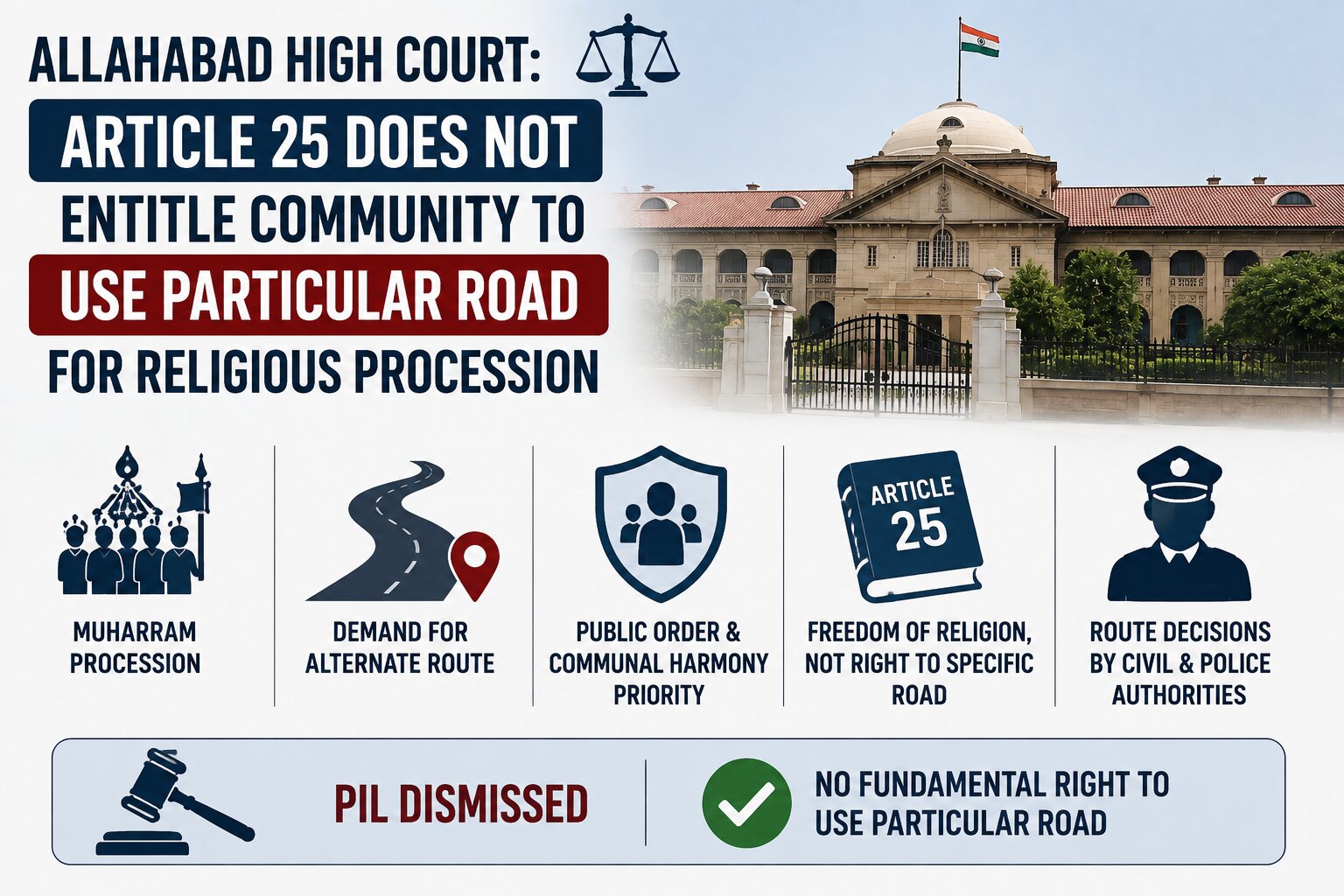
The Court held that Article 25 guarantees the freedom to profess and practice religion but does not confer a fundamental right to use a particular public road for religious ceremonies or processions.
Judgement Details
Court
Allahabad High Court
Date of Decision
8 July 2026
Judges
Justice J.J. Munir & Justice Arun Kumar
Citation
Acts / Provisions
Facts of the Case
-
The petitioners, residents of Sambhal district, filed a Public Interest Litigation (PIL) seeking permission to conduct the customary Alam/Tazia procession during Muharram through an alternate route.
-
From 1952 to 2022, the procession traditionally passed through a railway crossing leading to the Karbala at Sirsi village.
-
In 2023, after electrification of the railway line, an Alam came into contact with overhead high-voltage electric wires, causing severe injuries to four participants.
-
Following the accident, the Railways permanently closed the traditional route by constructing walls on both sides.
-
The petitioners requested permission to use the Sirsi-Bilari Main Road as a new route to reach the Karbala.
-
The State opposed the request, relying upon a written agreement entered into between representatives of both Hindu and Muslim communities and the district administration after the 2023 incident.
-
Under the agreement, the procession would proceed only up to the government tubewell, where the required religious rites would be performed after dismantling the Alam.
-
The State contended that allowing the proposed alternate route would introduce a new tradition and could lead to communal tension and disturbances of public order.
-
The petitioners challenged the refusal, asserting that the authorities were duty-bound to permit the alternate route for performance of their religious rites.
Issues
-
Whether Article 25 of the Constitution guarantees a fundamental right to conduct a religious procession through a particular public road?
-
Whether the civil and police administration possesses the authority to regulate and earmark routes for religious processions in the interest of public order?
-
Whether refusal to permit the proposed alternate route amounted to an infringement of the petitioners' fundamental right to freely practice their religion under Article 25?
-
Whether the inter-community agreement entered into after the 2023 incident was binding upon the petitioners?
Judgement
-
The Allahabad High Court dismissed the Public Interest Litigation.
-
The Bench observed that the exercise of religious freedom is subject to public order, law and order, and the rights of other sections of society.
-
The Court distinguished between the right to practice religion and the insistence upon practicing it through a particular route or in a particular manner.
-
It held that determining and regulating procession routes is an administrative function entrusted to the civil and police authorities.
-
The Court accepted the State's contention that permitting the proposed alternate route could create communal friction and disturb public order.
-
It observed that there was no prohibition on the petitioners performing their religious rites; only the requested route had been declined.
-
The Court further held that the petitioners were bound by the mutually agreed arrangement recorded between both communities and the district administration after the 2023 accident.
-
Finding no violation of any fundamental right, the Court dismissed the petition.
Held
-
Article 25 does not guarantee the right to use a specific public road for conducting religious processions.
-
Regulation of procession routes falls within the powers of the civil and police administration.
-
Religious freedom remains subject to considerations of public order, law and order, and communal harmony.
-
The writ petition was dismissed.
Analysis
-
The judgment reinforces that Article 25 protects religious freedom but not every preferred mode or location of its exercise.
-
The Court emphasized that fundamental rights must be balanced with public safety and maintenance of public order.
-
By distinguishing religious practice from the insistence on a particular route, the Court clarified the scope of constitutional protection under Article 25.
-
The ruling recognizes the statutory and administrative responsibility of the police and civil authorities in planning and regulating public processions involving large gatherings.
-
The decision highlights that courts ordinarily defer to administrative assessments regarding law-and-order concerns unless shown to be arbitrary or unconstitutional.
-
The judgment also gives significance to consensus-based arrangements between different communities, particularly where such arrangements promote communal harmony.
-
The ruling will serve as an important precedent for disputes involving regulation of religious processions, emphasizing that public roads cannot be claimed as a matter of fundamental right for religious observances.
-
The decision balances individual religious liberties with the State's constitutional obligation to preserve peace, safety, and social harmony.