
R Manimaran v. State of Tamil Nadu, 2026
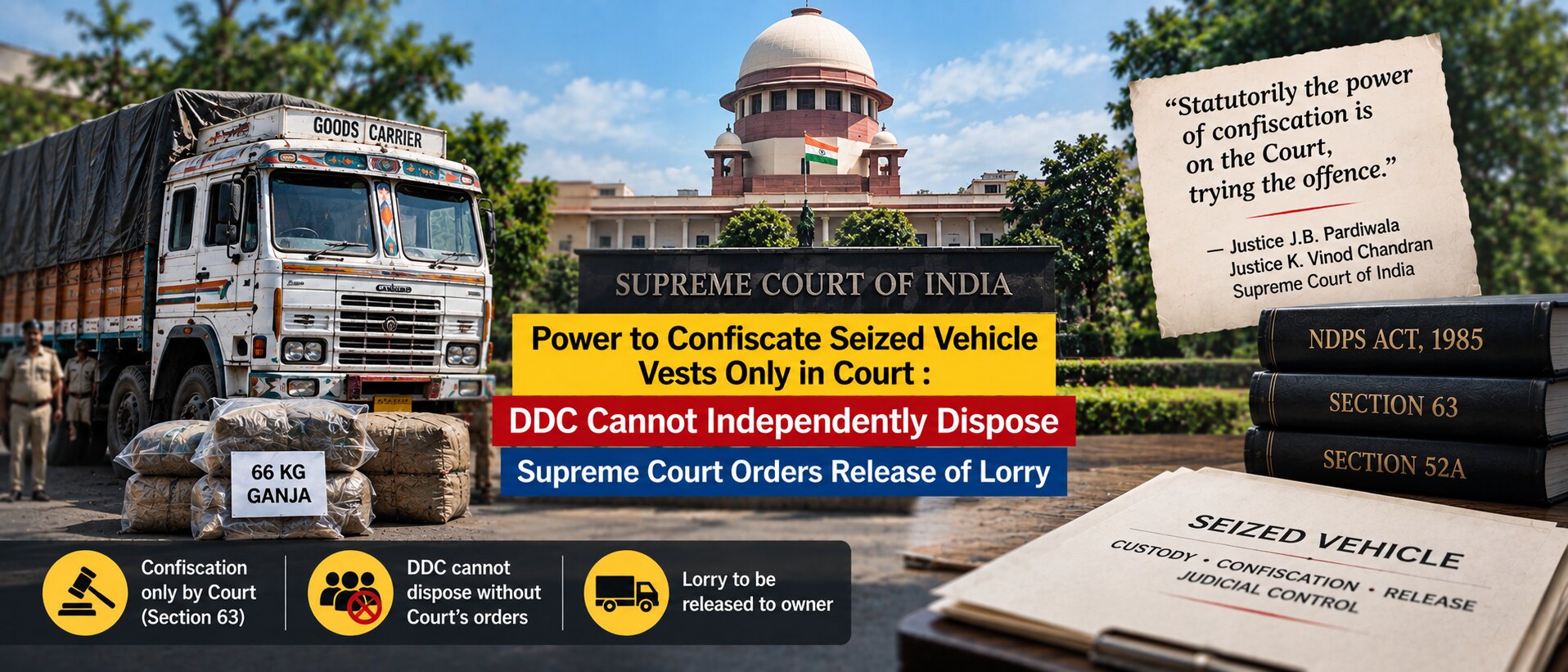
The power of confiscation under Section 63(1) NDPS Act is vested in the Court trying the offence.
Judgement Details
Court
Supreme Court of India
Date of Decision
4 September 2026
Judges
Justice J.B. Pardiwala and Justice K. Vinod Chandran
Citation
Acts / Provisions
Facts of the Case
-
The petitioner was the owner of a lorry that was seized by the authorities in connection with an NDPS case.
-
During the interception of the lorry, the authorities allegedly recovered 66 kg of ganja from the vehicle.
-
Four persons were prosecuted under the provisions of the NDPS Act in connection with the alleged recovery.
-
The prosecution case subsequently suffered several difficulties during trial.
-
The trial court noted discrepancies in the arrest memo, absence of proper registered records regarding the safe custody of the seized contraband, and other inconsistencies in the investigation.
-
The prosecution was also unable to satisfactorily explain how the lorry was permitted to operate during the pandemic period.
-
There was also a delay in sending the samples to the court and the laboratory.
-
The trial court ultimately acquitted all four accused persons.
-
While acquitting them, the trial court directed that the lorry be released to its owner after expiry of the appeal period.
-
After the appeal period expired, the petitioner approached the trial court seeking release of the vehicle.
-
The application was subsequently rejected, particularly in view of proceedings concerning disposal of the vehicle under Section 52A of the NDPS Act and the NDPS Rules, 2022.
-
The Madras High Court upheld the rejection of the petitioner's request.
-
The High Court relied upon its earlier decision in Nahoorkani v. State.
-
Aggrieved by the High Court's decision, the petitioner approached the Supreme Court.
-
The Supreme Court examined the relationship between Sections 52A and 63 of the NDPS Act, the 2022 Rules and the power of the Drug Disposal Committee.
-
The Court also considered the earlier Supreme Court decision in Biswajit Dey v. State of Assam concerning custody and release of vehicles seized in NDPS cases.
-
The Supreme Court ultimately found that the trial court had correctly directed release of the vehicle and that the subsequent rejection of the petitioner's application was unwarranted.
Issues
-
Whether the power to confiscate a seized vehicle under the NDPS Act lies exclusively with the Court trying the offence under Section 63 of the Act?
-
Whether the Drug Disposal Committee can independently dispose of a seized vehicle under Section 52A and the 2022 Rules without obtaining permission from the Court?
-
Whether the Court can order interim custody or release of a seized vehicle during the pendency of an NDPS trial?
-
Whether an acquittal of the accused automatically requires the release of a vehicle seized in connection with the NDPS offence?
-
Whether the trial court was justified in releasing the lorry to the owner after acquitting the accused persons?
-
Whether the subsequent rejection of the petitioner's application for release of the vehicle was legally sustainable?
Judgement
-
The Supreme Court allowed the appeal filed by R Manimaran.
-
The Court held that the statutory power of confiscation under Section 63(1) of the NDPS Act vests in the Court trying the offence.
-
The Court clarified that Section 63 requires the Court to determine whether a seized article is liable to confiscation regardless of whether the accused is convicted, acquitted or discharged.
-
The Court held that the Drug Disposal Committee cannot independently exercise the power of confiscation.
-
The Court examined Rule 16 of the NDPS Rules, 2022, which permits disposal of seized conveyances after seizure.
-
The Court harmonised the Rules with Section 63 and held that disposal under the Rules must take place with the permission of the competent Court.
-
The Court held that the DDC cannot independently proceed to auction or otherwise dispose of the vehicle during the criminal proceedings without appropriate orders from the Court.
-
The Supreme Court also reaffirmed that the general powers concerning custody of seized property under Sections 451 and 457 CrPC can be invoked in appropriate NDPS cases.
-
The Court noted that these powers correspond to Sections 497 and 503 BNSS, 2023.
-
The Court clarified that where nobody seeks custody of the vehicle, the Investigating Officer may approach the Court for referral of the vehicle to the DDC.
-
Such action must be preceded by notice to the owner and an opportunity of hearing.
-
The DDC must also provide the owner an opportunity to be heard before proceeding with auction or disposal.
-
The sale proceeds are required to be deposited before the jurisdictional Court and should not be treated as confiscation by the DDC.
-
In the present case, the Supreme Court found that the trial court had originally exercised its power under Section 63(1) correctly when it directed release of the lorry.
-
The Court took note of the serious inconsistencies in the prosecution case and the circumstances surrounding the seizure.
-
The Court observed that the circumstances, taken together with the grounds of acquittal, made the very interception of the vehicle suspect.
-
The Court held that the subsequent rejection of the application for release was unwarranted.
-
The Supreme Court set aside the orders of the trial court and the judgment of the Madras High Court.
-
The Court directed that the lorry be released to the petitioner.
-
If the vehicle had already been transferred to the Drug Disposal Committee, the DDC was directed to release it forthwith to the petitioner.
Held
-
The DDC does not have an independent power to confiscate or dispose of a seized conveyance without appropriate orders of the Court.
-
The 2022 Rules must be interpreted consistently with the statutory scheme of the NDPS Act.
-
Courts can exercise their powers under Sections 451 and 457 CrPC for interim custody of vehicles seized in NDPS cases.
-
Acquittal does not automatically result in release of the seized vehicle; the Court must decide the issue of confiscation under Section 63.
-
In the present case, considering the serious deficiencies in the prosecution case and the trial court's findings, the lorry was rightly ordered to be released.
-
The Supreme Court therefore directed release of the vehicle to the owner.
Analysis
-
Court's power over confiscation: The judgment clearly establishes that confiscation is a judicial function under Section 63 and cannot be independently assumed by the DDC.
-
Section 63 is central: The Court emphasised that the Court trying the NDPS offence must determine the question of confiscation even when the accused has been acquitted or discharged.
-
DDC's role is limited: The Drug Disposal Committee may undertake disposal-related functions under the 2022 Rules, but it cannot bypass the Court's statutory authority under Section 63.
-
Rules cannot override the statute: Rule 16 must be interpreted consistently with Section 63. The Rules provide a mechanism for disposal but cannot independently confer a power of confiscation upon the DDC.
-
Interim custody remains available: The Court reaffirmed that the ordinary judicial powers relating to custody of seized property can operate even in NDPS cases.
-
Acquittal and confiscation are separate: The Court explained that criminal prosecution and confiscation proceedings operate on different legal considerations. Therefore, acquittal does not automatically mean that the vehicle must be released.
-
Owner's hearing is important: Before disposal of a vehicle through the DDC, the owner must receive notice and an opportunity of hearing.
-
Protection of property: The decision prevents seized vehicles from remaining unnecessarily in custody or being disposed of administratively without judicial supervision.
-
Vehicle deterioration: The Court recognised that vehicles kept in police or court custody for long periods may deteriorate and become unusable, making timely judicial consideration of custody important.
-
Application of Biswajit Dey: The Court clarified that the distinction regarding different categories of vehicle possession in Biswajit Dey primarily concerned interim custody and did not prevent final release after conclusion of the trial.
-
Present case: The serious deficiencies in the prosecution evidence, together with the acquittal, made the continued retention of the lorry particularly unjustified.
-
Broader significance: The judgment strengthens judicial control over confiscation and disposal of vehicles seized in NDPS cases and limits independent administrative action by the DDC.