
Geeta Bai & Ors. v. K. Arjun Singh & Ors., 2026
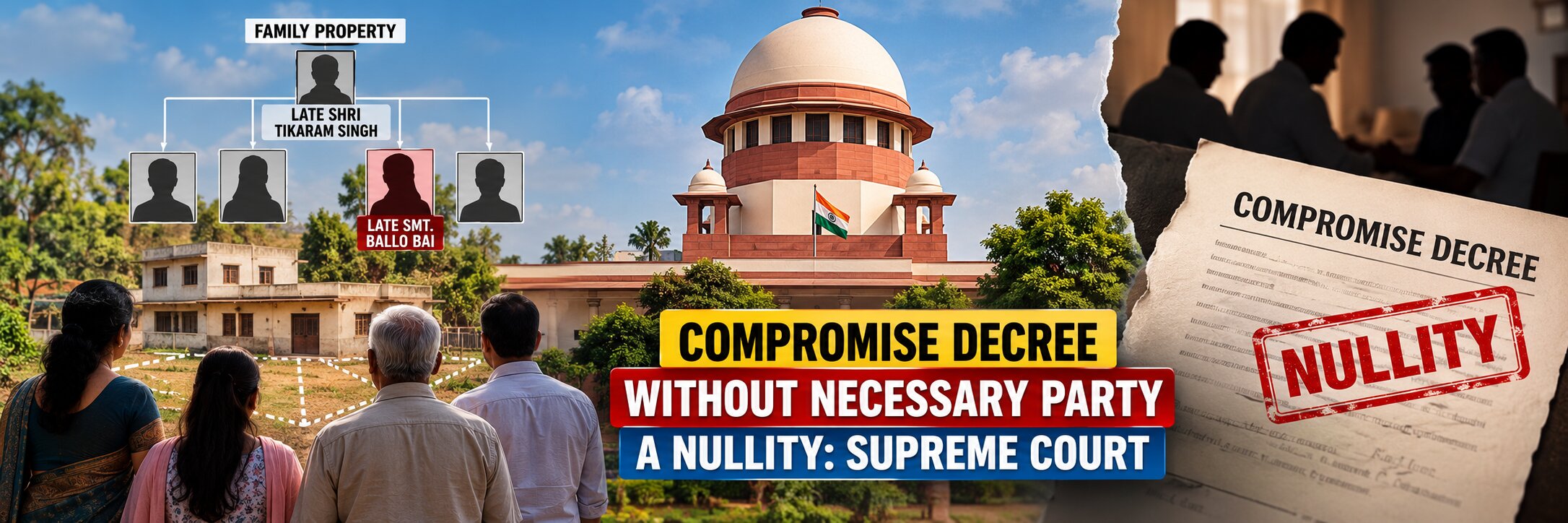
A compromise decree cannot bind a necessary party whose rights are directly affected when that party was never impleaded in the proceedings.
Judgement Details
Court
Supreme Court of India
Date of Decision
30 September 2026
Judges
Justice Vikram Nath & Justice Sandeep Mehta
Citation
Acts / Provisions
Facts of the Case
-
The dispute concerned family property belonging to Late Shri Tikaram Singh and arose in the context of a partition dispute. The Law Advice
-
Tikaram Singh had four children, including his daughter Late Smt. Ballo Bai.
-
Ballo Bai was a necessary heir in relation to the property rights being litigated. After her death, her legal heirs, including the appellants, claimed entitlement to her share.
-
The appellants claimed 1/4th equal shares in the property on the basis of succession rights arising under the Hindu Succession Act.
-
Litigation concerning the property proceeded between other family members, but Ballo Bai and subsequently her legal heirs were not impleaded in the proceedings.
-
During the litigation, the parties who were before the court entered into a compromise.
-
A compromise decree was consequently passed by the High Court.
-
The appellants were affected by the decree despite never having been made parties to the litigation.
-
The appellants therefore sought recall of the compromise decree, contending that their rights could not lawfully be determined in proceedings conducted in their absence.
-
The High Court declined to grant the recall relief and indicated that the appellants could pursue another remedy, including a separate suit or an appeal after obtaining appropriate leave.
-
The appellants approached the Supreme Court challenging that approach.
-
The Supreme Court ultimately held that the appellants could not be treated as strangers to the litigation because their legal rights in the property were directly implicated.
Issues
-
Whether a compromise decree passed in a partition proceeding without impleading a necessary party whose property rights are directly affected is a nullity in law?
-
Whether the legal heirs of a necessary party who was not impleaded in the proceedings can challenge or seek recall of a compromise decree passed behind their back?
-
Whether the bar contained in Order XXIII Rule 3A CPC prevents an omitted necessary party from seeking recall of a compromise decree before the court that recorded the compromise?
-
Whether the High Court was correct in directing the appellants to pursue a separate suit or an appeal instead of considering their application seeking recall of the compromise decree?
Judgement
-
The Supreme Court allowed the appeal filed by Geeta Bai and the other appellants. Live Law
-
The Court held that Late Smt. Ballo Bai and her legal heirs could not be considered strangers to the litigation because their rights in the property were directly involved.
-
The Court found that the compromise decree had been obtained without impleading a necessary party, despite that party having a legal interest in the subject matter.
-
The Supreme Court characterised the compromise decree obtained in such circumstances as a nullity in the eyes of law.
-
The Court rejected the proposition that the appellants were completely barred from challenging the compromise merely because of Order XXIII Rule 3A CPC.
-
The Court specifically observed that the appellants could seek recall of the decree because the decree had been obtained behind their back.
-
The Supreme Court found the High Court's approach to the recall applications to be erroneous.
-
The matter was therefore remitted to the High Court for reconsideration of the recall applications afresh in light of the Supreme Court's observations.
Held
-
A compromise decree obtained without impleading such a necessary party may be treated as a nullity in law.
-
An omitted necessary party is entitled to challenge the decree and seek recall before the court that passed or recorded the decree.
-
Order XXIII Rule 3A CPC does not operate to prevent such a necessary party from seeking recall merely because the provision bars a separate suit challenging an unlawful compromise.
-
The legal heirs of Late Smt. Ballo Bai were not strangers to the lis and therefore could not be deprived of a remedy against a decree affecting their rights.
-
The High Court was directed to reconsider the recall applications afresh.
Analysis
-
Protection of necessary parties: The central principle is that a court cannot effectively determine or compromise rights belonging to a person who was a necessary party but was never brought before the court. The requirement of impleading necessary parties protects the integrity of judicial proceedings.
-
Meaning of nullity: The Supreme Court's use of the expression “nullity in the eyes of law” is significant. It indicates that the defect was not merely an ordinary procedural irregularity. The compromise purported to affect persons whose rights had not been properly brought before the court.
-
Natural justice: The judgment reinforces the basic procedural principle that a person should not have their property rights affected without being given an opportunity to participate in the proceedings.
-
Order XXIII Rule 3A CPC: Rule 3A ordinarily prevents a party from instituting a separate suit to challenge a compromise decree on the ground that the compromise was unlawful. The Supreme Court nevertheless distinguished the position of an omitted necessary party from that of a person who participated in the litigation and subsequently sought to challenge the compromise. Live Law
-
Recall as an appropriate remedy: The judgment recognises the significance of approaching the same court that passed the decree when the decree was allegedly obtained without impleading a necessary party. This avoids treating the omitted party as though they had voluntarily participated in the compromise.
-
Partition litigation: The decision is particularly relevant to partition disputes because property rights may extend across several branches of a family. A compromise between only some family members cannot automatically extinguish the independent rights of another branch that was legally entitled to participate.
-
Legal heirs: Where a person having a legally relevant interest dies, their legal heirs may inherit or represent that interest. They cannot simply be ignored where the litigation directly affects the inherited property rights.
-
Limits of compromise: A compromise is based on consent between the parties before the court. The decision emphasises that such consent cannot ordinarily be used as a mechanism for determining the rights of persons who were never parties to the proceeding.
-
Effect on existing procedural law: The judgment does not simply eliminate Order XXIII Rule 3A. Rather, it clarifies its application in a situation involving a necessary party who was excluded from the litigation.
-
Practical significance: Parties conducting partition litigation must identify and implead all persons whose proprietary or succession rights may be affected before entering into a compromise. Otherwise, the resulting decree may face a serious challenge from an omitted necessary party.