
M.R.R. Setty (Dead), by LRs v. Government of Karnataka & Ors., 2026
Section 5 of the Limitation Act has no application where the matter concerns the exercise of revisional power, rather than an appeal.
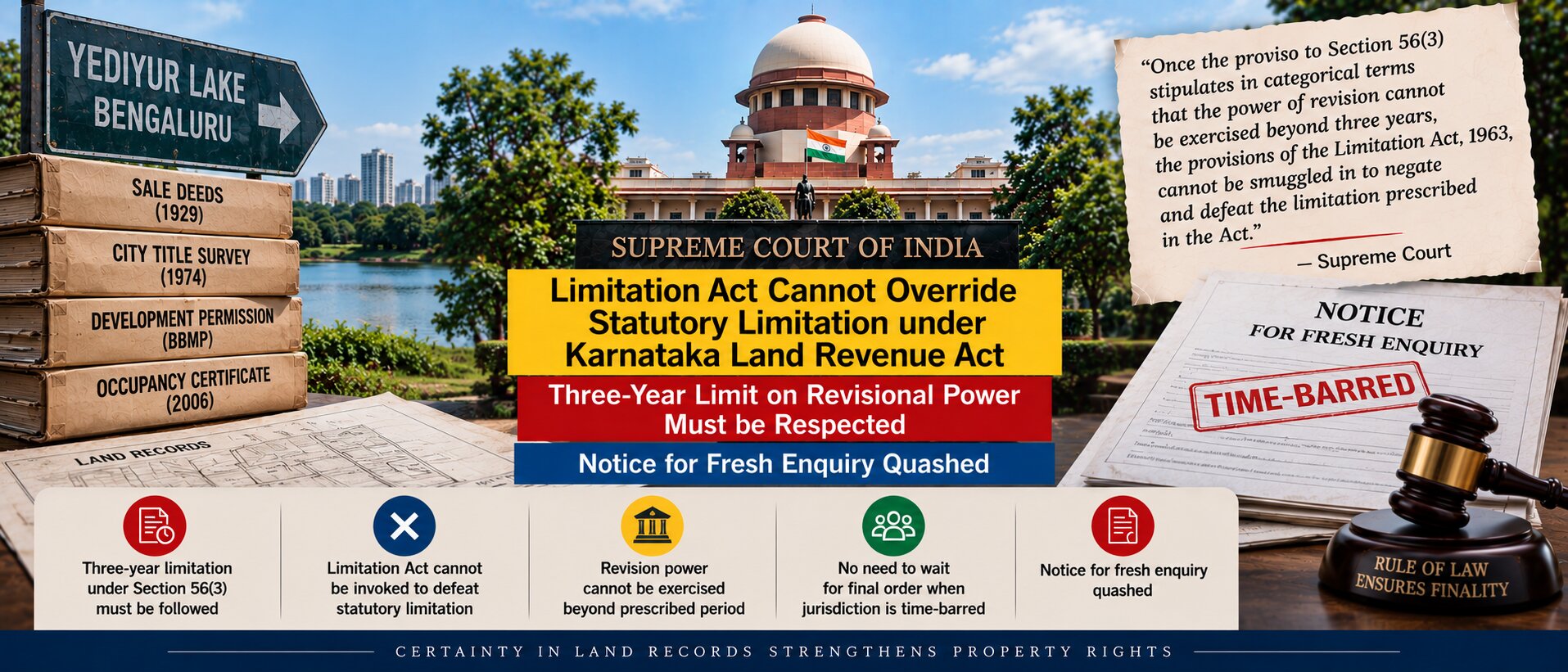
Judgement Details
Court
Supreme Court of India
Date of Decision
4 September 2026
Judges
Justice Sanjay Kumar and Justice Sanjeev Sachdeva
Citation
Acts / Provisions
Facts of the Case
-
The appellant claimed ownership over 28 guntas of land in Bengaluru, which had been purchased through eight sale deeds in 1929.
-
During the 1974 City Title Survey, the land was assigned different City Survey (CTS) numbers.
-
The appellant subsequently obtained development permissions from the BBMP and constructed a residential apartment complex on the property.
-
An occupancy certificate was issued in 2006.
-
In 2014, nearly four decades after the CTS numbers had been assigned, the Joint Director/Registrar of Land Records issued a notice under Section 56 of the Karnataka Land Revenue Act.
-
The notice proposed a fresh enquiry into the CTS entries following a complaint alleging encroachment of Yediyur Lake.
-
The appellant challenged the notice before the Karnataka High Court.
-
The Single Judge of the High Court quashed the notice, holding that the revisional power under Section 56 could not be exercised beyond the prescribed three-year limitation period.
-
The Division Bench subsequently reversed the Single Judge's decision in January 2020 and permitted the authorities to conduct a fresh enquiry.
-
The appellant's review petition was dismissed in June 2023.
-
The appellant then approached the Supreme Court.
-
During the pendency of the proceedings, the appellant died in December 2024, and his legal representatives were brought on record.
-
The Karnataka Government argued that the Limitation Act, 1963 could be applied to the proceedings and that the delay could therefore be condoned.
-
The Supreme Court examined whether the Limitation Act could be invoked to overcome the specific three-year limitation prescribed for exercising revisional powers under Section 56(3) of the Karnataka Land Revenue Act.
-
The Court found that the proceedings concerned revisional jurisdiction, and not an appeal for which the delay-condonation provision under Section 5 of the Limitation Act could be relevant.
Issues
-
Whether the Limitation Act, 1963 can be invoked to extend or defeat the three-year limitation prescribed for exercising revisional powers under Section 56 of the Karnataka Land Revenue Act?
-
Whether the Joint Director/Registrar of Land Records could exercise revisional powers after the expiry of three years from the relevant order?
-
Whether the High Court Division Bench was justified in permitting a fresh enquiry into the survey entries despite the statutory limitation period having expired?
-
Whether the absence of a final adverse order justified the authorities in continuing the enquiry despite the revisional power having been invoked beyond the prescribed limitation?
-
Whether the notice issued for the fresh enquiry was legally sustainable when the revisional jurisdiction itself had been invoked beyond the statutory period?
Judgement
-
The Supreme Court allowed the appeal filed by the appellant's legal representatives.
-
The Court held that the proceedings concerned the exercise of revisional power under Section 56 of the Karnataka Land Revenue Act and not an appeal.
-
The Court rejected the Government's reliance on Section 5 of the Limitation Act, 1963.
-
The Court held that the delay-condonation provision could not be used to overcome the specific limitation prescribed by the Karnataka Land Revenue Act for exercise of revisional jurisdiction.
-
The proviso to Section 56(3) expressly restricts the exercise of revisional power in respect of an order, against which no appeal has been preferred, to a period of three years from the date of that order.
-
The Court held that the Limitation Act could not be “smuggled in” to defeat or negate this specific statutory limitation.
-
The revisional power exercised by the Joint Director/Registrar of Land Records in 2014, in relation to entries dating back several decades, was therefore beyond the statutory period.
-
The Court found that the exercise of revisional jurisdiction was without statutory basis from its very inception.
-
The Court rejected the Division Bench's reasoning that interference was premature because no adverse order had yet been passed.
-
The Court held that requiring the appellant or his successors to participate in an enquiry based upon a time-barred exercise of revisional power could not be sustained.
-
The Supreme Court held that the Single Judge had correctly quashed the notice.
-
The Division Bench's decision reversing the Single Judge was set aside.
-
The subsequent order rejecting the review petition was also set aside.
-
The notice was quashed insofar as it related to the appellants' land.
Held
-
The specific three-year limitation under the proviso to Section 56(3) of the Karnataka Land Revenue Act cannot be defeated by invoking the Limitation Act.
-
Revisional jurisdiction cannot be exercised beyond the statutory period prescribed by Section 56(3).
-
An authority cannot initiate or continue an enquiry based on a revisional power that was time-barred at its inception.
-
The fact that no final adverse order had yet been passed does not prevent the High Court from interfering with an invalid exercise of jurisdiction.
-
The Single Judge was correct in quashing the notice.
-
The Supreme Court therefore quashed the notice concerning the appellants' land.
Analysis
-
Specific limitation prevails: The judgment reinforces that where a special statute prescribes a specific limitation period for exercise of a particular power, that limitation cannot ordinarily be defeated by importing a general limitation provision.
-
Revision versus appeal: The Supreme Court drew a clear distinction between an appeal and revision. Section 5 of the Limitation Act could not assist the Government because the proceedings involved revisional jurisdiction under Section 56, not an appeal.
-
Jurisdictional limitation: The three-year period was treated as a substantive restriction on the authority's power. Once that period expired, the authority could no longer invoke the statutory revisional jurisdiction in the circumstances specified by Section 56(3).
-
No indirect extension: The Government could not use the Limitation Act as an indirect mechanism to extend a period that the Karnataka Legislature had expressly prescribed.
-
Invalidity from inception: The Court characterised the exercise of revisional power as lacking statutory foundation from the beginning because it was initiated well beyond the prescribed period.
-
No need to wait for final order: The Division Bench's reasoning that judicial intervention was premature because no adverse order had yet been passed was rejected. If the underlying jurisdiction itself is legally unavailable, the affected party need not necessarily wait for an adverse final order.
-
Protection against prolonged uncertainty: The ruling protects landowners from being subjected to potentially indefinite administrative scrutiny after the statutory period for revision has expired.
-
Finality of administrative orders: Limitation provisions serve an important function in creating legal certainty. Allowing authorities to reopen matters decades later could undermine the finality of land records and completed transactions.
-
Impact on land administration: The decision places a significant limitation on the revisional powers of land-record authorities under the Karnataka Land Revenue Act.
-
Importance for property rights: Where property has been developed and occupied over a long period, reopening survey records after the statutory limitation period can have serious consequences. The judgment reinforces the need for authorities to act within their legally prescribed jurisdiction.
-
Judicial review: The Supreme Court confirmed that courts can intervene at the stage of an invalid notice where the authority's jurisdiction is clearly barred by statute.
-
Broader legal principle: A general statutory provision cannot be used to circumvent a specific limitation and jurisdictional restriction imposed by a special statute.