
Mahavir @ Anvish v. State of Madhya Pradesh, 2026
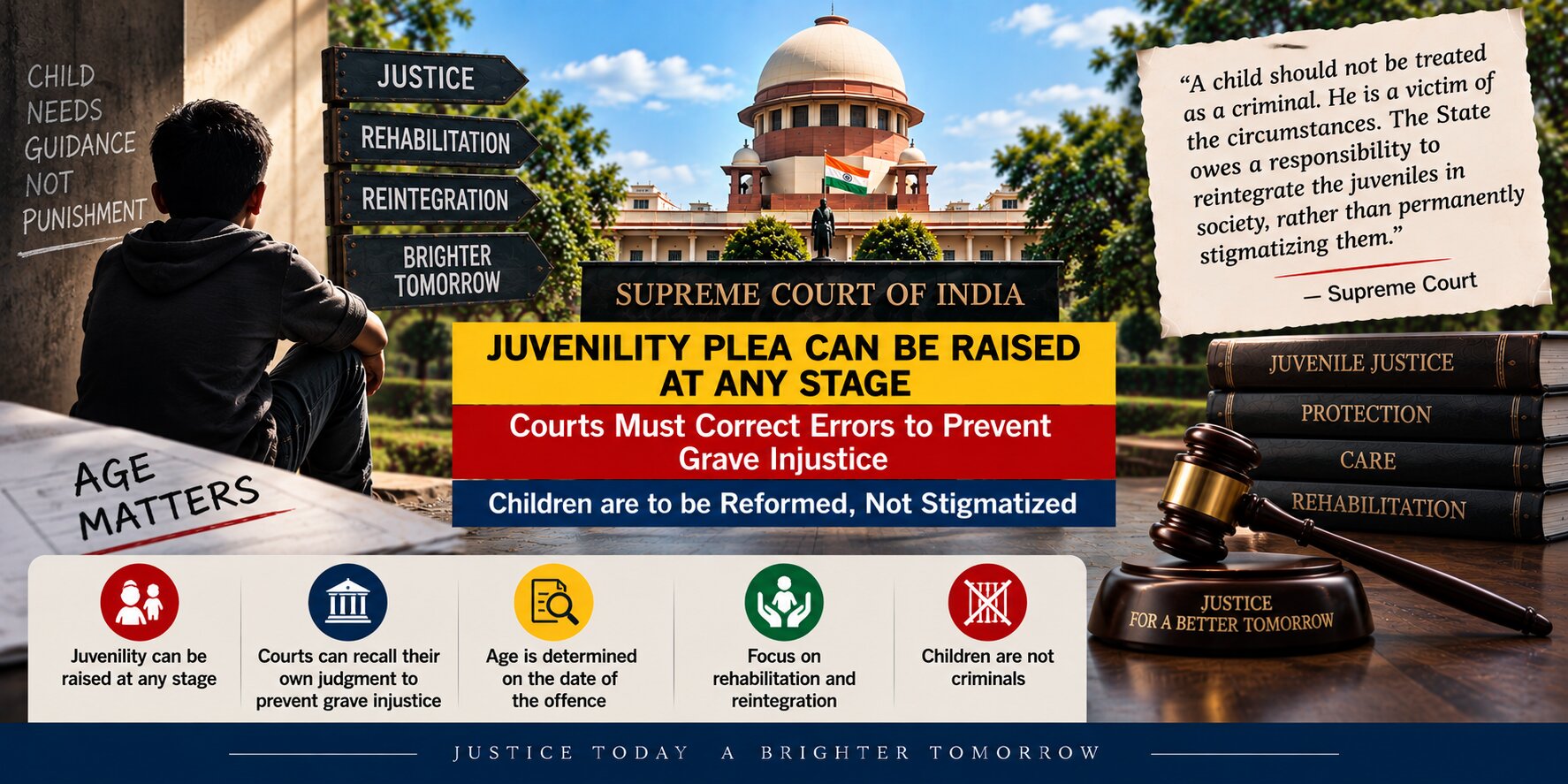
Section 482 CrPC can be invoked in exceptional circumstances to recall a High Court judgment where an error of the Court has resulted in grave prejudice and intervention is necessary to secure the ends of justice.
Judgement Details
Court
Supreme Court of India
Date of Decision
3 September 2026
Judges
Justice Prashant Kumar Mishra and Justice Shree Chandrashekhar
Citation
Acts / Provisions
Facts of the Case
-
The case arose from the death of Bhuri and her infant daughter, whose bodies were found on a railway track in Morena in 2004.
-
The appellant, Mahavir, was the brother-in-law of the deceased and was prosecuted along with other family members for offences including murder, dowry death and destruction of evidence.
-
Several prosecution witnesses, including the deceased's relatives, turned hostile and did not support the allegations of dowry harassment or demand.
-
The Trial Court acquitted the accused of murder and dowry death but convicted them under Section 201 Part II IPC and sentenced them to three years' rigorous imprisonment.
-
The Madhya Pradesh High Court upheld the conviction in 2017, and the appellant's SLP was dismissed as withdrawn in 2018.
-
Subsequently, the appellant claimed that he was a juvenile, aged about 17 years and 2 months, on the date of the offence.
-
The High Court directed an inquiry by the Juvenile Justice Board. On the basis of school records and birth certificate, the Board determined his date of birth as 01.07.1987, establishing that he was a juvenile on 13.09.2004.
-
Despite the finding, the High Court refused to recall its earlier judgment, holding that its inherent jurisdiction under Section 482 CrPC could not be used to reopen a judgment that had attained finality.
-
The appellant challenged that decision before the Supreme Court.
Issues
-
Whether the High Court's inherent power under Section 482 CrPC can be exercised to recall its own final judgment when a grave injustice has resulted from an error of the Court?
-
Whether a claim of juvenility can be raised at any stage of the criminal proceedings, including after final disposal of the case?
-
Whether the High Court erred in treating the appellant's conviction as having attained finality when his SLP had merely been dismissed as withdrawn without adjudication on merits?
-
Whether the High Court was bound to give effect to the Juvenile Justice Board's finding of juvenility after having itself directed the inquiry?
-
Whether delay in raising a claim of juvenility is fatal when credible documentary evidence establishes that the accused was a child on the date of the offence?
-
Whether the appellant could legally be convicted under Section 201 Part II IPC when the alleged underlying offences of murder and dowry death had not been proved?
Judgement
-
The Supreme Court allowed the appeal and set aside the Madhya Pradesh High Court's order.
-
It found that the High Court had committed an error of record in treating the appellant's SLP as having been decided on merits by the Supreme Court.
-
The Court noted that the appellant's SLP had been dismissed as withdrawn, whereas the SLPs of his parents had been considered on merits.
-
The Supreme Court reaffirmed that Section 482 CrPC preserves the High Court's inherent jurisdiction to prevent abuse of process and secure the ends of justice.
-
The Court held that procedural technicalities cannot prevent a court from correcting a grave injustice caused by its own error.
-
It reaffirmed that juvenility is determined with reference to the date of commission of the offence.
-
A plea of juvenility may be raised at any stage, and delay by itself does not defeat the claim when reliable material establishes juvenility.
-
The High Court, after obtaining an unchallenged finding from the Juvenile Justice Board that the appellant was a juvenile, was under a bound duty to give effect to that finding.
-
The Court further held that the conviction under Section 201 Part II IPC was independently unsustainable because the prosecution had failed to establish the underlying offences of murder and dowry death.
-
The High Court's order and the appellant's conviction were therefore set aside, and he was discharged from his bail bonds.
Held
-
The High Court does not become powerless merely because the matter had previously reached the Supreme Court, particularly where the SLP was withdrawn without adjudication on merits.
-
The determination of juvenility must relate to the date of the offence, not the date of trial or production before the court.
-
A plea of juvenility can be raised at any stage of the proceedings, including after final disposal.
-
Once credible evidence establishes juvenility, the court must give effect to the protective framework of juvenile justice.
-
A conviction under Section 201 IPC requires proof that an underlying offence was committed; where murder and dowry death were not proved, the conviction for causing disappearance of evidence could not stand.
-
The Court emphasized that children in conflict with law should be treated through the framework of rehabilitation and reintegration, rather than permanent criminal stigmatization.
Analysis
-
The judgment reinforces the principle that procedural finality cannot override substantive justice where a serious judicial error has caused prejudice to an accused.
-
The Supreme Court carefully distinguished between a case actually adjudicated by it and an SLP that was merely withdrawn, preventing an incorrect application of the doctrine of finality.
-
The ruling gives significant importance to the statutory protection available to juveniles and confirms that juvenility is a status attached to the date of the offence.
-
The Court's approach demonstrates that Section 482 CrPC is not an appellate power, but its inherent jurisdiction can nevertheless be exercised in exceptional situations to correct a manifest injustice.
-
The decision also clarifies that a genuine juvenility claim cannot be rejected merely because it was raised belatedly, particularly where documentary evidence and a competent JJ Board inquiry conclusively establish the person's age.
-
Independently of the juvenility issue, the Court found the Section 201 conviction legally defective because the prosecution failed to establish the existence of the underlying murder or dowry-death offence.
-
The judgment reflects the parens patriae philosophy of juvenile justice, emphasizing rehabilitation, reintegration and protection of children rather than treating them as ordinary adult offenders.
-
The Court's observation that juvenility pleas are frequently raised only at higher judicial stages highlights the need for trial courts and other stakeholders to identify and address age-related claims at the earliest appropriate stage.