
Shankar Singh v. State of NCT of Delhi, 2026
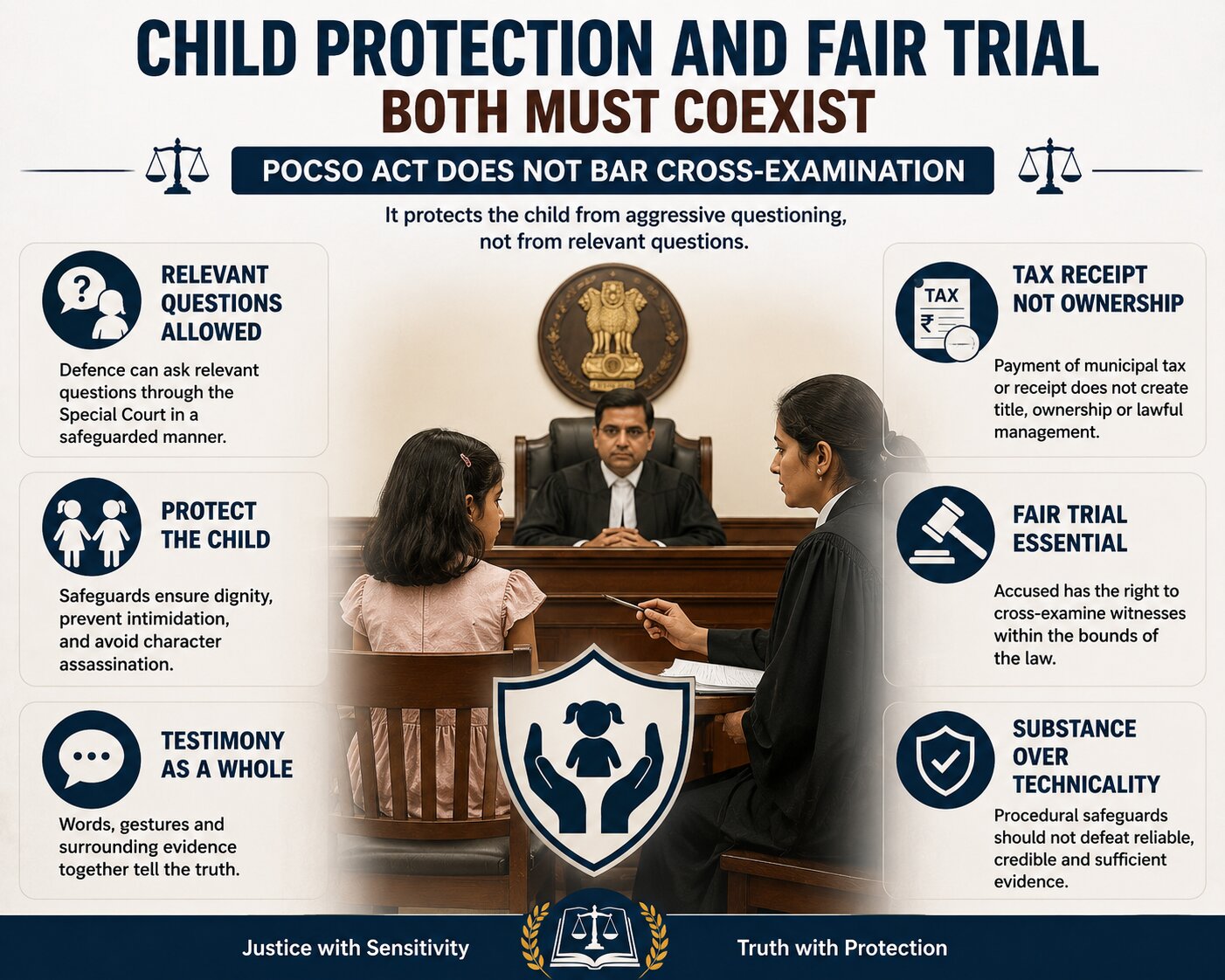
The POCSO Act protects child witnesses from aggressive questioning, intimidation and character assassination; it does not eliminate the accused's right to cross-examine them.
Judgement Details
Court
Delhi High Court
Date of Decision
19 August 2026
Judges
Justice Chandrasekharan Sudha
Citation
Acts / Provisions
Facts of the Case
-
The accused challenged his conviction for offences under the IPC and the POCSO Act.
-
The victim was an 11-year-old minor girl.
-
The prosecution alleged that the accused wrongfully confined the child on several occasions.
-
It was further alleged that the accused committed aggravated penetrative sexual assault against the child.
-
The Trial Court convicted the accused and sentenced him to 12 years' rigorous imprisonment along with a fine of ₹12,000.
-
During the proceedings, the child gave evidence before the Trial Court.
-
The child had used only a small number of words in the Maithili dialect while her statement under Section 164 CrPC was recorded.
-
Her mother translated those words.
-
The defence argued about the evidentiary value of the child's statement and the manner in which the testimony had been recorded.
-
The Trial Court had also prevented the defence from putting certain questions and suggestions to the child because of her young age and its assessment that her mental age was approximately five years.
-
The proposed defence questions included suggestions that the incident had not occurred and that the child had not raised an alarm or informed anyone.
-
The High Court found that the Trial Court had adopted an incorrect procedure by completely preventing the defence from putting those suggestions.
-
The High Court nevertheless found that the child's overall testimony, including her gestures recorded by the Trial Court, together with the other evidence, sufficiently supported the prosecution case.
-
The High Court therefore had to balance two important principles: the child's protection and dignity during trial and the accused's right to effectively cross-examine the prosecution witness.
Issues
-
Whether the POCSO Act prohibits the defence from cross-examining a child witness in a criminal trial?
-
Whether the safeguards under the POCSO Act permit a Trial Court to completely prevent the defence from putting relevant questions or suggestions to a child witness because of the child's age or mental maturity?
-
Whether the procedure prescribed under Section 33(2) of the POCSO Act requires the defence questions to be communicated to the Special Court, which must then put the questions to the child in an appropriate manner?
-
Whether the failure to administer an oath to a minor witness or interpreter automatically renders the child's statement inadmissible or unreliable?
-
Whether a child's testimony can be relied upon when the child uses very few words but her testimony, gestures and surrounding evidence collectively establish the prosecution case?
-
Whether non-examination of every witness to the alleged incident requires an adverse inference against the prosecution when the evidence actually produced is cogent, credible and sufficient to establish guilt beyond reasonable doubt?
-
Whether the procedural error committed by the Trial Court in restricting cross-examination requires the accused's conviction to be set aside when the remaining evidence independently establishes guilt?
Judgement
-
The Delhi High Court dismissed the appeal and upheld the conviction.
-
The Court made it clear that the POCSO Act does not prohibit the defence from cross-examining a child witness.
-
The purpose of the statutory safeguards is to protect the child from aggressive questioning, intimidation, humiliation and character assassination.
-
The Court emphasised that protecting a child does not mean eliminating the accused's right to put relevant questions to the prosecution witness.
-
The Court found that the Trial Court had adopted an incorrect procedure when it completely disallowed certain defence questions because of the child's age and perceived mental capacity.
-
The Court explained that Section 33(2) POCSO provides the appropriate mechanism: questions proposed by the defence are to be communicated to the Special Court, which then puts them to the child in a manner consistent with the statutory safeguards.
-
The Trial Court therefore should not have simply prevented the defence from putting the proposed suggestions.
-
Despite this procedural error, the High Court found that the error did not justify overturning the conviction.
-
The Court found sufficient material indicating the accused's overt acts.
-
The child's testimony was required to be assessed as a whole, rather than merely by counting the words she used.
-
The Court also considered the gestures made by the child during testimony, which had been recorded by the Trial Court.
-
The Court held that the absence of an oath administered to the child or interpreter did not automatically invalidate the evidence.
-
The Court found that the POCSO safeguards are intended to facilitate and protect child witnesses and should not be converted into technical grounds for rejecting otherwise reliable substantive evidence where no prejudice has been demonstrated.
-
The Court also rejected the argument that failure to examine every possible witness necessarily required an adverse inference against the prosecution.
-
Where the evidence actually produced is credible and sufficient to establish guilt beyond reasonable doubt, the prosecution is not required to produce every conceivable witness.
-
The conviction and sentence were therefore upheld.
Held
-
The Court held that the POCSO Act does not bar cross-examination of a child witness.
-
The Court held that the statutory safeguards protect the child from aggressive questioning and character assassination but do not extinguish the defence's right to ask relevant questions.
-
The Court held that Section 33(2) POCSO provides the appropriate procedure for putting defence questions to a child through the Special Court.
-
The Court held that the Trial Court erred by completely preventing the defence from putting relevant suggestions to the child.
-
The Court held that failure to administer an oath to the minor or interpreter does not automatically render the evidence inadmissible or unreliable.
-
The Court held that a child's testimony must be assessed in its entirety, including relevant gestures and surrounding evidence, rather than solely by the number of words spoken.
-
The Court held that non-examination of every witness does not automatically justify an adverse inference where the evidence actually produced is cogent and sufficient.
-
Despite finding a procedural error in the manner of cross-examination, the Court upheld the conviction, finding the remaining evidence sufficient to establish guilt.
Analysis
-
Child protection and fair trial must coexist: The judgment is important because it rejects the idea that protecting a child witness requires eliminating cross-examination. The two principles must operate simultaneously.
-
POCSO is protective, not prohibitory: The Act regulates how a child is questioned rather than giving the prosecution's child witness complete immunity from questioning.
-
Section 33(2) provides the solution: Instead of banning difficult or potentially sensitive questions, the Special Court must control their manner of delivery. This allows the defence to test the evidence while protecting the child from direct or aggressive questioning.
-
Trial Court's error: The Trial Court went too far by completely disallowing certain defence suggestions merely because the child was considered too young to understand them. The High Court expressly identified this as the incorrect procedure.
-
Right of defence remains important: Cross-examination is an important component of a criminal trial because it allows the accused to test the reliability, consistency and accuracy of prosecution evidence.
-
Protection from character assassination: The right to cross-examine is not unlimited. Questions designed merely to humiliate, intimidate or attack the child's character can and should be controlled by the Special Court.
-
Child's communication may be non-verbal: The Court recognised that a very young child may not always be capable of expressing traumatic experiences through sophisticated verbal testimony. Relevant gestures and conduct recorded during testimony can form part of the evidentiary assessment.
-
Evidence must be considered holistically: The Court refused to assess the child's testimony merely by focusing on the limited number of words she used. Her testimony had to be read alongside her gestures and the other evidence on record.
-
Technical objections should not automatically defeat substantive evidence: The Court held that procedural safeguards under POCSO should not become technical traps where no demonstrated prejudice has occurred and the substantive evidence remains reliable.
-
Oath is not automatically decisive: The absence of an oath administered to the child or interpreter did not, by itself, compel rejection of the evidence. The court must examine the reliability and evidentiary value of the testimony in its entirety.
-
Every witness need not be examined: Criminal prosecution does not fail merely because every person who might have witnessed some aspect of an incident was not examined. The crucial question is whether the evidence actually produced proves the case beyond reasonable doubt.
-
Procedural error did not cause reversal: Although the High Court found the Trial Court's approach to cross-examination incorrect, it did not find that this error caused sufficient prejudice to undermine the conviction.
-
Important balance: The ruling establishes a useful middle path: protect the child, but do not disable the defence.