
Sayara Khatoon @ Shajara Khatoon & Anr. v. State of Bihar & Ors., 2026
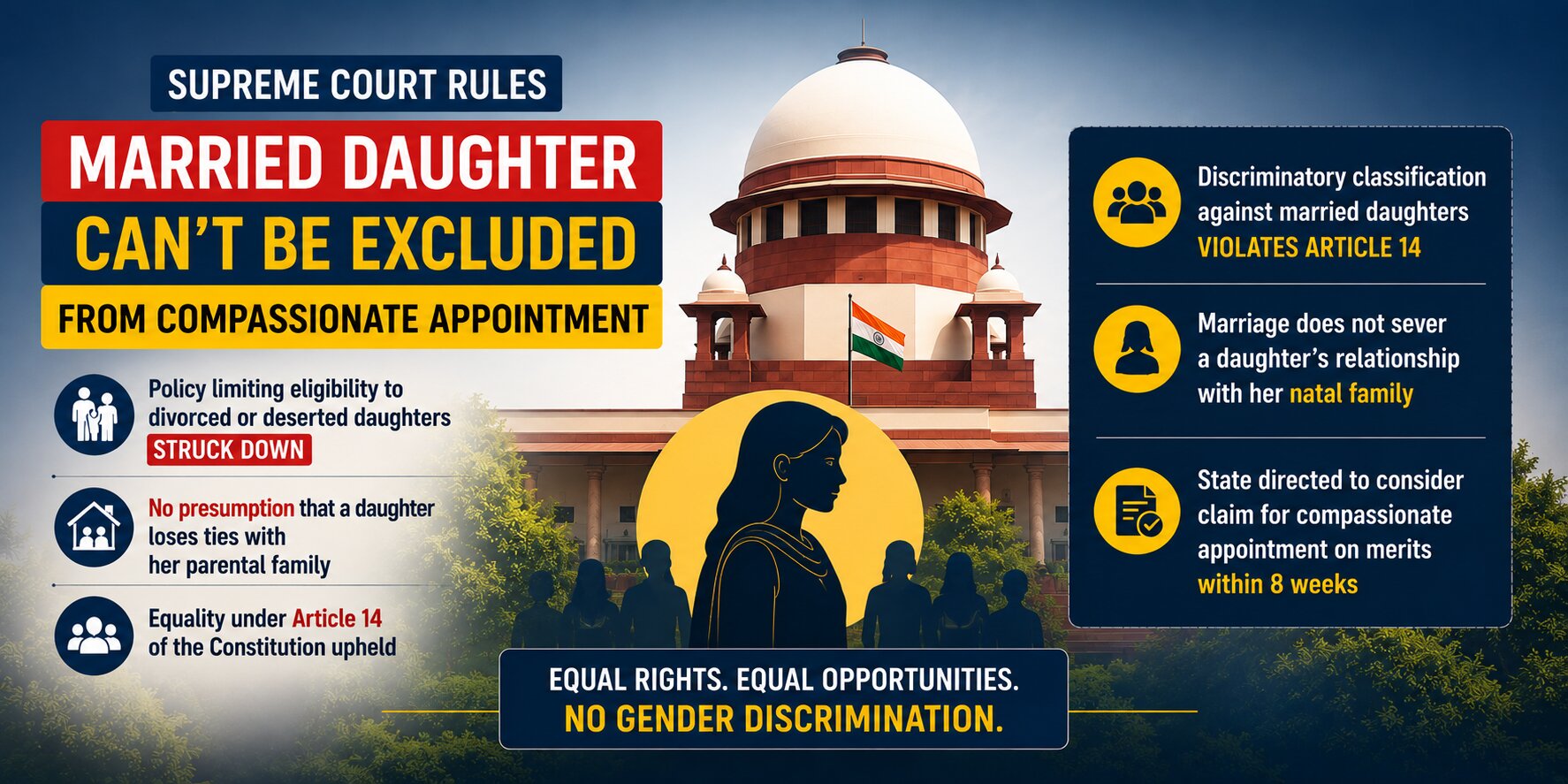
The judgment strengthens the constitutional mandate of equality under Article 14 by striking down gender-based exclusion.
Judgement Details
Court
Supreme Court of India
Date of Decision
31 July 2026
Judges
Justice M.M. Sundresh & Justice Prasanna B. Varale
Citation
Acts / Provisions
Facts of the Case
-
The appellant’s father, a Government employee, died while in service in the State of Bihar.
-
The appellant applied for compassionate appointment under the State policy.
-
The application was rejected on two grounds:
-
An alleged objection raised by the appellant’s maternal uncle
-
The 2014 policy restriction, which limited eligibility of married daughters only to those who were divorced or deserted
-
-
The appellant contended that the maternal uncle had already issued a No Objection Certificate (NOC), removing any objection.
-
She further stated that although her marriage was not legally dissolved, she was living with her parental family and was supported by them.
-
The Patna High Court upheld the rejection of her claim.
-
The appellant challenged the High Court’s decision before the Supreme Court of India.
Issues
-
Whether restricting compassionate appointment only to divorced or deserted married daughters while excluding other married daughters violates Article 14 of the Constitution of India?
-
Whether a married daughter can be presumed in law to have severed all ties with her parental family after marriage?
-
Whether the State can reject a claim for compassionate appointment by adopting a hyper-technical interpretation of the policy?
-
Whether the appellant’s claim for compassionate appointment requires reconsideration on merits?
Judgement
-
The Supreme Court held that the policy restricting eligibility only to divorced or deserted daughters is unconstitutional.
-
The classification was found to be violative of Article 14.
-
The Court reaffirmed that any discrimination between a son and a daughter is constitutionally impermissible.
-
It rejected the State’s argument that a married daughter is presumed to leave her parental home after marriage.
-
The Court held that there is no legal presumption that marriage severs a daughter’s relationship with her natal family.
-
It observed that such assumptions are based on gender stereotypes, which are incompatible with constitutional values.
-
The Court held that a hyper-technical approach cannot justify denial of compassionate appointment.
-
The objection raised by the maternal uncle was found to have ceased after issuance of the NOC.
-
The Supreme Court set aside the judgment of the Patna High Court and the rejection order.
Held
-
Restricting compassionate appointment only to divorced or deserted daughters is unconstitutional.
-
Married daughters cannot be excluded solely on the basis of marital status.
-
There is no presumption that a daughter loses her connection with her parental family after marriage.
Analysis
-
It reinforces that classification based solely on marital status is arbitrary and unconstitutional.
-
The Court rejected entrenched patriarchal assumptions regarding a daughter’s identity after marriage.
-
It recognised the evolving social reality where daughters continue to maintain strong ties with their natal families.
-
The ruling aligns with the principle of substantive equality, ensuring equal treatment of women in public employment.
-
The Court emphasised that welfare schemes like compassionate appointment must be interpreted in line with constitutional morality.
-
It discouraged reliance on hyper-technical interpretations that defeat the purpose of social welfare policies.
-
The decision is likely to influence similar policies across States, ensuring non-discriminatory eligibility criteria.
-
The judgment marks a significant step toward eliminating gender stereotypes in administrative decision-making.