
Savita Arun Zambre v. Manjari Projects Private Limited, 2026
An assignment made before institution of a suit cannot, by itself, be used as a ground for adding the assignee as a co-plaintiff under Order I Rule 10 CPC.
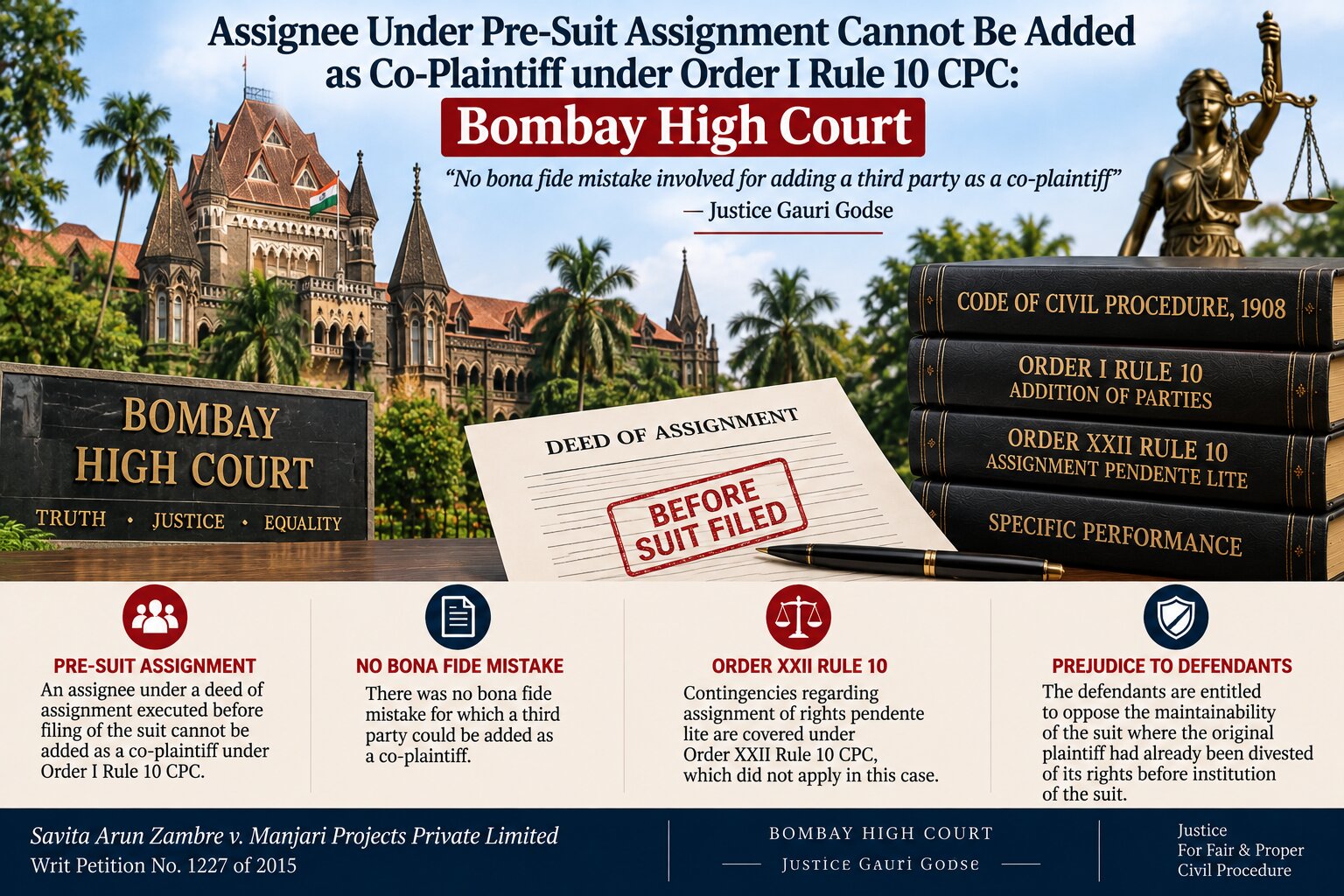
Judgement Details
Court
Bombay High Court
Date of Decision
10 September 2026
Judges
Justice Gauri Godse
Citation
Acts / Provisions
Facts of the Case
-
The original plaintiff, Manjari Projects Private Limited, instituted a suit seeking specific performance of a development agreement dated 15 December 2006 and a supplementary agreement dated 22 August 2007.
-
The agreements had been executed by the defendants in favour of the original plaintiff.
-
The suit also challenged a notice dated 17 April 2009 terminating the two agreements.
-
Before filing the suit, the original plaintiff had executed a deed of assignment transferring its rights under the development agreement and power of attorney to a third party.
-
Despite having assigned its rights before institution of the suit, the original plaintiff instituted the suit in its own name.
-
The third party subsequently sought to be added as a co-plaintiff under Order I Rule 10 CPC.
-
The trial court permitted the impleadment application.
-
The original defendants challenged that order before the Bombay High Court.
-
The defendants argued that the assignment had taken place before the suit was filed, and therefore it could not constitute a basis for adding the assignee as a co-plaintiff under Order I Rule 10 CPC.
-
They further contended that the original plaintiff had already divested itself of its rights before instituting the suit.
-
The High Court examined whether the circumstances fell within the statutory situation contemplated by Order I Rule 10 CPC, particularly where a suit has been instituted in the name of the wrong plaintiff due to a bona fide mistake.
-
The Court also considered the distinction between a pre-suit assignment and an assignment occurring during the pendency of litigation.
Issues
-
Whether an assignee under a deed of assignment executed before institution of the suit can be added as a co-plaintiff under Order I Rule 10 CPC merely because the original plaintiff's rights were assigned?
-
Whether the original plaintiff's divestment of its rights before filing the suit constitutes a bona fide mistake within the meaning of Order I Rule 10 CPC?
-
Whether an assignment made before institution of the suit can be treated as a transfer pendente lite attracting Order XXII Rule 10 CPC?
-
Whether the assignee can be treated as a necessary party merely because it allegedly purchased or acquired an interest in the litigation?
-
Whether permitting the assignee to be added as a co-plaintiff would cause prejudice to the original defendants?
Judgement
-
The Bombay High Court allowed the defendants' writ petition and quashed and set aside the trial court's order permitting the third party to be added as a co-plaintiff.
-
The Court noted that there was no dispute that the deed of assignment was executed before the suit was instituted.
-
The assignment had already transferred the original plaintiff's rights under the development agreement and power of attorney to the third party.
-
Consequently, the original plaintiff had been divested of its rights before filing the suit.
-
The Court held that the assignment itself could not be relied upon to add the assignee as a co-plaintiff under Order I Rule 10 CPC.
-
Order I Rule 10 contemplates circumstances where a suit has been instituted in the name of the wrong person through a bona fide mistake and substitution or addition is necessary for determining the real dispute.
-
The Court found no bona fide mistake in the circumstances before it.
-
The Court distinguished such a pre-suit assignment from a transfer of interest occurring during the pendency of the litigation, which is addressed by Order XXII Rule 10 CPC.
-
Since the assignment had occurred before the institution of the suit, there was no question of the third party having acquired the interest pendente lite.
-
The trial court's reasoning that the third party had “purchased the litigation” and therefore became a necessary party was held to be erroneous.
-
The Court observed that there was no question of the third party “stepping into the shoes” of the plaintiff through a litigation purchase because the plaintiff had already assigned its rights before the suit was filed.
-
The Court also recognised the serious prejudice that could be caused to the defendants if the impleadment were permitted.
-
Accordingly, the High Court quashed and set aside the trial court's impleadment order.
Held
-
Order I Rule 10 requires circumstances demonstrating that the suit was instituted in the name of the wrong person through a bona fide mistake.
-
Where the original plaintiff had already consciously transferred or assigned its rights before filing the suit, the situation does not automatically constitute a bona fide mistake.
-
Order XXII Rule 10 CPC concerns assignment or devolution of interest during the pendency of a suit and does not govern a pre-suit assignment in the same manner.
-
An assignee who acquired the rights before institution of the suit cannot be treated as having purchased the litigation merely because the assignee subsequently seeks to participate in the pending proceedings.
-
The court must consider the prejudice to the existing defendants when deciding whether an additional party should be brought into the proceedings.
-
The power under Order I Rule 10 CPC cannot be used to cure the consequences of a pre-existing assignment where the statutory requirements for addition or substitution are not satisfied.
Analysis
-
The decision emphasises the importance of distinguishing between a pre-litigation assignment and an assignment occurring after litigation has commenced.
-
Order I Rule 10 CPC is primarily concerned with ensuring that the correct parties are before the court and that the real controversy can effectively be adjudicated. It is not an unrestricted mechanism for introducing an assignee whenever the original plaintiff's interest has been transferred.
-
The Court's emphasis on bona fide mistake is crucial. If the plaintiff had already assigned away its rights before filing the suit, the problem cannot automatically be characterised as an innocent procedural mistake.
-
The ruling prevents a party from using impleadment provisions to retrospectively regularise a suit that was instituted by a person who had already divested himself of the relevant rights.
-
The Court also correctly distinguished Order XXII Rule 10 CPC, which deals with devolution or assignment of an interest during the pendency of proceedings. A pre-suit assignment presents a fundamentally different procedural situation.
-
The trial court's description of the assignee as having “purchased the litigation” was rejected because the assignee had obtained the substantive rights before the litigation itself was instituted.
-
The judgment therefore reinforces the principle that procedural provisions cannot be applied mechanically without examining when the underlying transfer of rights occurred.
-
The decision also protects defendants from being subjected to a materially different litigation after the institution of the suit through an impleadment application that lacks the statutory foundation.
-
At the same time, the judgment does not suggest that an assignee can never participate in litigation. The procedural route and applicable provision depend upon when the assignment occurred and what interest was transferred.
-
Overall, the ruling provides useful guidance on the interaction between assignment of contractual rights, Order I Rule 10 CPC and Order XXII Rule 10 CPC, while emphasising that the timing of the assignment is legally significant.