
Satendra Siwal v. State of U.P. Through Principal Secretary, Home, Lucknow & Others, 2026
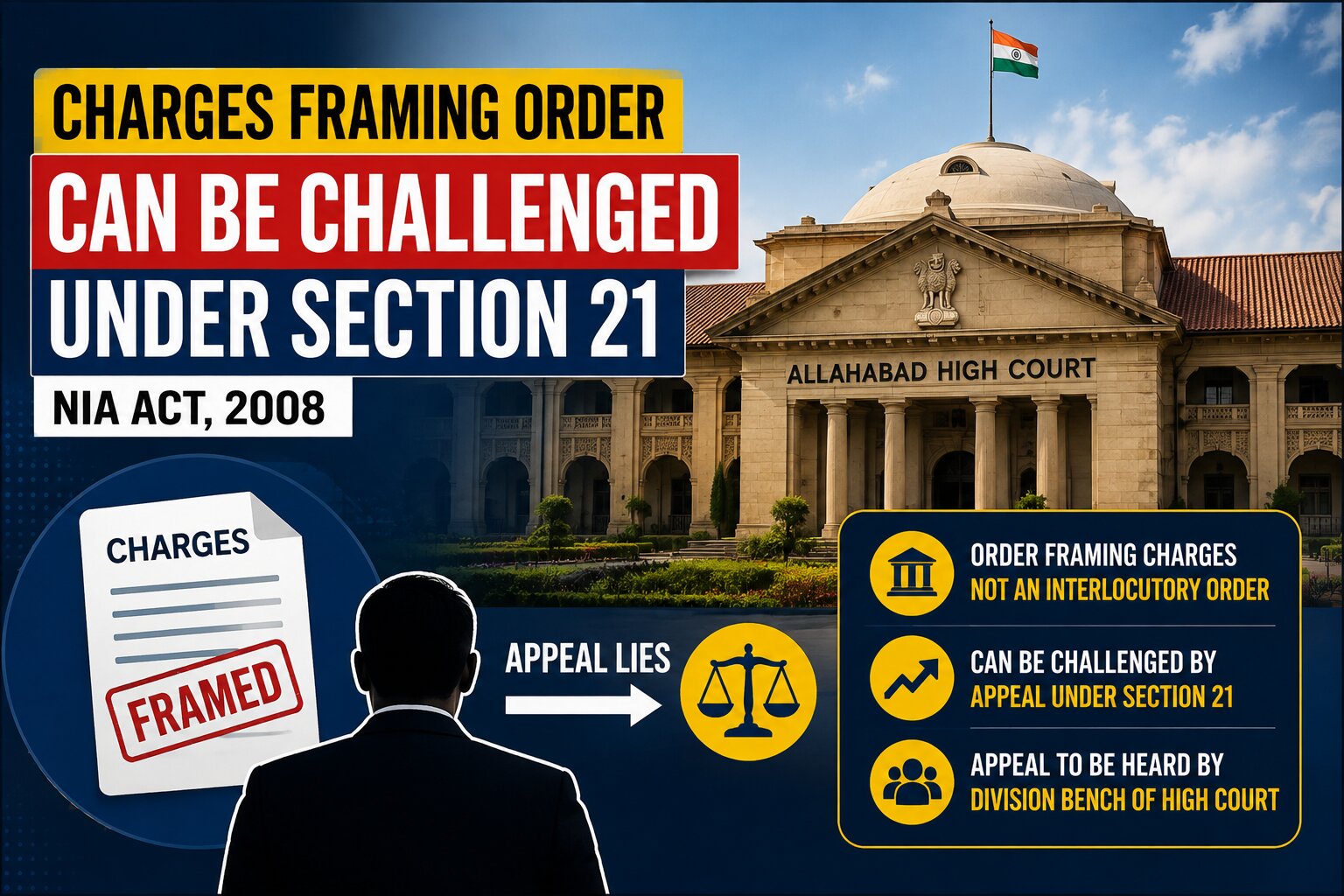
An order framing charges by an NIA Special Court is not an interlocutory order within the meaning of Section 21 of the NIA Act.
Judgement Details
Court
Allahabad High Court
Date of Decision
19 August 2026
Judges
Justice Subhash Vidyarthi
Citation
Acts / Provisions
Facts of the Case
-
The petitioner approached the Allahabad High Court under Article 227 of the Constitution.
-
The challenge was directed against an order passed by the Special Judge, NIA, Lucknow.
-
The underlying criminal case involved allegations under Section 121-A IPC and Sections 3, 5 and 9 of the Official Secrets Act, 1923.
-
The petitioner specifically challenged the order framing charge under Section 121-A IPC.
-
The State raised a preliminary objection concerning the maintainability of the Article 227 petition.
-
The State argued that the petitioner had an alternative and specific statutory remedy under Section 21 of the NIA Act.
-
According to the State, an order framing charge was not an interlocutory order and could therefore be challenged through an appeal under Section 21.
-
The petitioner opposed this argument and relied upon the Supreme Court's judgment in V.C. Shukla v. State.
-
The petitioner argued that an order framing charge was an interlocutory order and therefore could not be challenged under Section 21 of the NIA Act.
-
Reliance was also placed upon the Delhi High Court's decision in Syed Shahid Yousuf v. NIA, which had treated an order framing charges as interlocutory for the purposes of Section 21 of the NIA Act.
-
The petitioner consequently argued that the Article 227 petition was maintainable because no statutory appeal was available.
-
The Allahabad High Court was therefore required to determine the character of an order framing charges for the purposes of Section 21 of the NIA Act.
Issues
-
Whether an order framing charges passed by a Special Court under the NIA Act is an interlocutory order within the meaning of Section 21 of the NIA Act?
-
Whether the decision of the Supreme Court in V.C. Shukla v. State, holding an order framing charges to be interlocutory, governs the interpretation of the expression “interlocutory order” under Section 21 of the NIA Act?
-
Whether the subsequent decisions of the Supreme Court in Asian Resurfacing of Road Agency (P) Ltd. v. CBI and Sanjay Kumar Rai v. State of U.P. establish that an order framing charges is neither purely interlocutory nor final?
-
Whether the petitioner could invoke the supervisory jurisdiction of the High Court under Article 227 when a statutory remedy of appeal under Section 21 of the NIA Act was available?
-
Whether entertaining an Article 227 petition against an order framing charges despite the availability of a statutory appeal would amount to a breach of judicial discipline?
Judgement
-
The Allahabad High Court dismissed the Article 227 petition.
-
The Court held that an order framing charges is not an interlocutory order for the purposes of Section 21 of the NIA Act.
-
The Court examined the Supreme Court's decision in V.C. Shukla v. State, in which an order framing charges had been treated as interlocutory under the Special Courts Act, 1979.
-
The Court observed that V.C. Shukla concerned a different statutory framework.
-
The Special Courts Act, 1979 was enacted in a specific historical context and provided for Special Courts presided over by sitting High Court Judges.
-
Appeals under that legislation lay before the Supreme Court.
-
The Special Courts Act was subsequently repealed.
-
The Allahabad High Court contrasted that statutory framework with the NIA Act, under which Special Courts are presided over by Sessions Judges and appeals lie before Division Benches of the High Courts.
-
The Court therefore held that the interpretation of “interlocutory order” under the repealed Special Courts Act could not automatically be applied to Section 21 of the NIA Act.
-
The Court relied upon the subsequent three-Judge Bench decision in Asian Resurfacing of Road Agency (P) Ltd. v. CBI.
-
In Asian Resurfacing, the Supreme Court held that an order framing charge is not purely interlocutory and is also not a final order.
-
The Court also relied upon Sanjay Kumar Rai v. State of U.P., another three-Judge Bench decision, which followed Asian Resurfacing and reiterated that orders framing charges or refusing discharge are neither interlocutory nor final.
-
The High Court relied upon the principle that a later judgment of a larger Bench that has considered and explained an earlier decision would govern the legal position.
-
Consequently, the Court held that the legal position was settled that an order framing charges is not an interlocutory order.
-
The Court further clarified that Section 21 of the NIA Act merely excludes appeals against interlocutory orders.
-
It does not state that an appeal lies only against final orders.
-
Therefore, it was unnecessary to determine whether an order framing charge was technically a final order.
-
Since an order framing charges was not interlocutory, it could be challenged through an appeal under Section 21 of the NIA Act.
-
The High Court declined to exercise Article 227 jurisdiction because the petitioner had an effective statutory appellate remedy.
-
The Court held that entertaining the petition before a Single Judge when the statute provided an appeal before a Division Bench would amount to a “breach of judicial discipline.”
-
The petition was dismissed.
-
However, the petitioner was expressly given liberty to challenge the order framing charges by filing an appeal under Section 21 of the NIA Act before the appropriate Division Bench.
Held
-
The Court held that an order framing charges passed by an NIA Special Court is not an interlocutory order for the purposes of Section 21 of the NIA Act.
-
The Court held that V.C. Shukla cannot be mechanically applied to Section 21 of the NIA Act because that decision concerned a materially different and subsequently repealed statutory framework.
-
The Court held that the later three-Judge Bench decisions in Asian Resurfacing and Sanjay Kumar Rai represent the applicable legal position concerning orders framing charges.
-
The Court held that an order framing charges is neither purely interlocutory nor final in nature.
-
The Court held that such an order can therefore be challenged through an appeal under Section 21 of the NIA Act.
-
The Court held that the availability of the statutory appeal justified refusing to exercise Article 227 jurisdiction.
-
The Article 227 petition was accordingly dismissed, with liberty to the petitioner to pursue the statutory appeal before the Division Bench.
Analysis
-
Central legal question: The judgment resolves a conflict concerning whether an order framing charges can be appealed under Section 21 of the NIA Act.
-
Distinction from V.C. Shukla: The Court correctly emphasised the statutory context in which V.C. Shukla was decided. The Supreme Court's earlier decision concerned the Special Courts Act, 1979 and not the NIA Act. The statutory wording, institutional structure and appellate mechanism were materially different.
-
Importance of later Supreme Court precedent: The Court placed greater reliance upon Asian Resurfacing, a subsequent three-Judge Bench decision that specifically considered the nature of an order framing charges and explained the earlier V.C. Shukla position.
-
Intermediate category of orders: The judgment reinforces the concept that an order need not be classified exclusively as either “interlocutory” or “final.” An order framing charges occupies an intermediate position because it substantially affects the rights of the accused and determines that the accused must face trial.
-
Effect on Section 21 NIA Act: Since Section 21 prohibits appeals only against interlocutory orders, an order that is neither interlocutory nor final is not automatically excluded from the appellate remedy.
-
Article 227 and alternative remedy: The judgment also reinforces the principle that the High Court ordinarily should not exercise its extraordinary supervisory jurisdiction when an effective statutory remedy is available.
-
Judicial discipline: The Court considered it inappropriate for a Single Judge exercising Article 227 jurisdiction to entertain a challenge when Parliament had provided an appeal before a Division Bench. Doing so could effectively bypass the statutory appellate structure.
-
Practical significance for accused persons: The decision provides an important procedural route for an accused challenging an order framing charges passed by an NIA Special Court. Instead of relying upon Article 227 jurisdiction, the accused can pursue the statutory appeal under Section 21.
-
Procedural safeguard: The availability of an appeal before a Division Bench provides a specific statutory mechanism for examining the legality of the charge-framing order.
-
Conflict with Delhi High Court view: The Allahabad High Court expressly differed from the approach taken by the Delhi High Court in Syed Shahid Yousuf v. NIA, where an order framing charges was considered interlocutory for Section 21 purposes.
-
Precedential hierarchy: The judgment illustrates the importance of bench strength and subsequent consideration of precedent. Where a later larger-Bench decision considers and explains an earlier decision, the later decision carries greater precedential force.
-
Broader legal significance: The decision clarifies the scope of appellate remedies under the NIA Act and strengthens the distinction between interlocutory orders and intermediate orders in criminal proceedings.