
Samar Paul v. The State of West Bengal and Anr., 2026
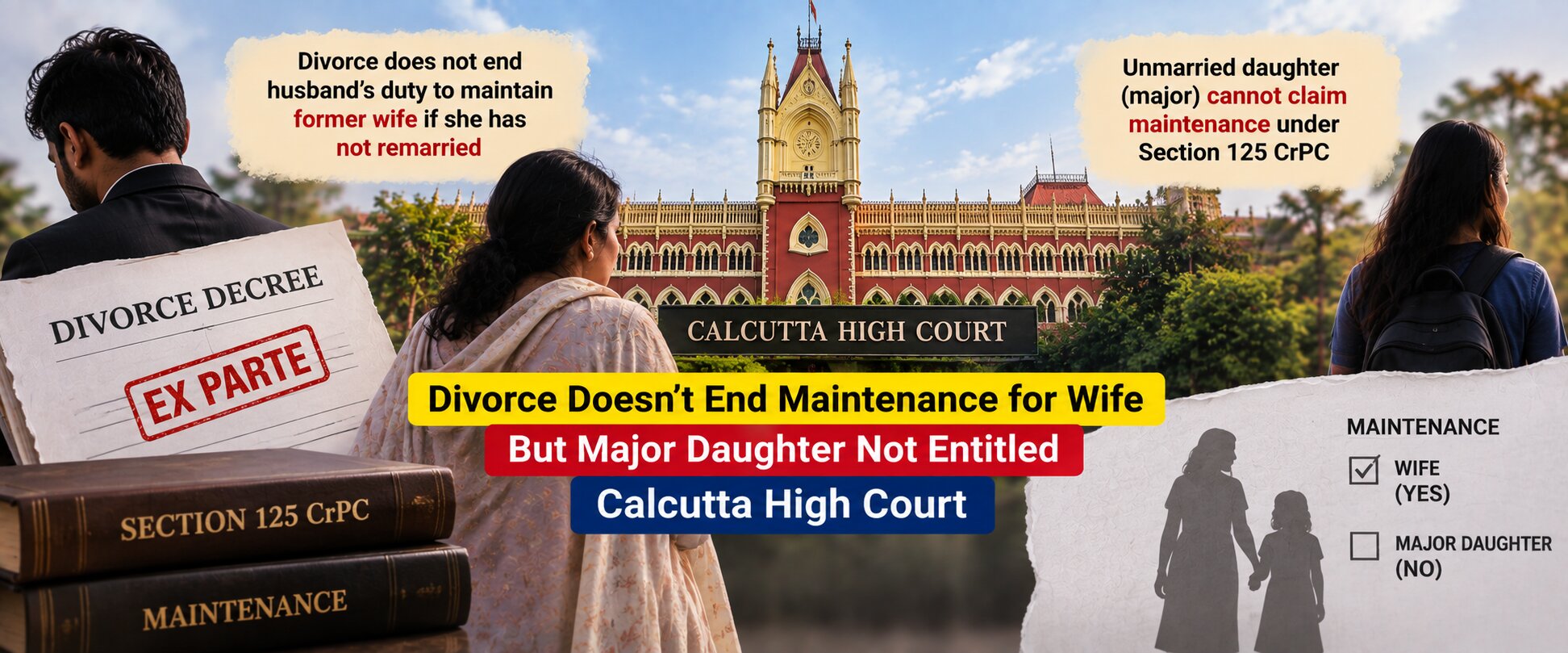
A divorce decree does not automatically terminate the former wife's statutory right to maintenance under Section 125 CrPC.
Judgement Details
Court
Calcutta High Court
Date of Decision
10 September 2026
Judges
Justice Uday Kumar
Citation
Acts / Provisions
Facts of the Case
- The parties were married on 11 February 1995.
-
The couple had two children: a son born in 1996 and a daughter, Sangita Paul, born on 15 October 1999.
-
The marital relationship subsequently deteriorated and resulted in several civil and criminal proceedings.
-
Following an incident on 15 July 2018, the wife lodged an FIR alleging physical assault and acid-related violence against the husband.
-
The husband subsequently instituted matrimonial proceedings seeking dissolution of marriage.
-
The matrimonial proceedings proceeded ex parte against the wife.
-
The matrimonial court ultimately passed an ex parte decree of divorce on 20 June 2022.
-
The wife thereafter filed an application under Order IX Rule 13 CPC seeking to set aside the ex parte divorce decree.
-
That application remained pending.
-
Meanwhile, the wife had initiated proceedings under Section 125 CrPC seeking maintenance.
-
An interim maintenance order dated 15 October 2019 directed payment of ₹3,500 per month, comprising ₹1,500 for the wife and ₹2,000 for the daughter.
-
The husband challenged the continuation of the maintenance proceedings after the divorce decree.
-
He argued that dissolution of the marriage had brought the matrimonial relationship to an end and consequently extinguished his obligation to maintain his former wife.
-
The husband also argued that his daughter had already attained majority in October 2017, before the Section 125 proceedings were instituted in 2019.
-
He contended that the daughter was a healthy individual without physical or mental disability and was therefore outside the scope of Section 125(1)(c) CrPC.
-
The wife disputed the husband's position concerning his financial circumstances and alleged that he continued to have sufficient means to maintain her.
-
The husband, on the other hand, claimed that he had lost his livelihood and lacked the financial capacity alleged by the wife.
-
The High Court also considered subsequent execution proceedings, including the issuance of distress warrants for recovery of maintenance arrears.
-
The husband challenged an order dated 6 October 2023, which rejected his contention that the maintenance proceedings had become non-maintainable after divorce.
-
He also challenged the order dated 2 March 2024, which resulted in coercive execution proceedings and distress warrants dated 4 April 2024.
Issues
-
Whether an ex parte decree of divorce obtained by the husband extinguishes his statutory obligation to maintain his divorced wife under Section 125 CrPC when she has not remarried and is unable to maintain herself?
-
Whether the wife's status as a divorced woman prevents her from being treated as a “wife” for the purpose of claiming maintenance under Section 125 CrPC?
-
Whether an unmarried daughter who had attained majority before institution of the Section 125 proceedings and was not suffering from any physical or mental abnormality could claim maintenance under Section 125 CrPC?
-
Whether the High Court could determine disputed questions concerning the parties' income, rental earnings, property-related disputes and financial capacity while exercising jurisdiction under Section 482 CrPC?
-
Whether the coercive execution proceedings and distress warrants for recovery of maintenance arrears could continue without adequate determination of the parties' financial circumstances?
-
Whether the maintenance proceedings concerning the wife and the major daughter were liable to be treated differently on the basis of their respective statutory rights under Section 125 CrPC?
Judgement
-
The Calcutta High Court partly allowed the criminal revision petition filed by Samar Paul.
-
The Court held that the husband's ex parte divorce decree did not, by itself, extinguish his statutory obligation to maintain his former wife.
-
The Court relied upon Explanation (b) to Section 125(1) CrPC, which includes a woman who has been divorced by her husband and has not remarried within the statutory definition of “wife”.
-
The Court relied upon the Supreme Court decisions in Vanamala v. H.M. Ranganatha Bhatta and Rohtash Singh v. Smt. Ramendri in reaching this conclusion.
-
The Court therefore permitted the wife's Section 125 maintenance proceedings to continue, subject to the statutory requirements.
-
The Court declined to resolve disputed questions regarding the parties' income, rental earnings, property disputes and financial capacity in proceedings under Section 482 CrPC.
-
The Court held that such disputed factual matters were appropriately left for determination by the trial court.
-
With regard to the daughter, the Court found that Sangita Paul had attained majority in October 2017, nearly two years before the maintenance proceedings were initiated.
-
The Court also noted that she was not suffering from any physical or mental abnormality or injury preventing her from maintaining herself.
-
Consequently, her claim did not fall within the requirements of Section 125(1)(c) CrPC.
-
The Court relied upon Abhilasha v. Parkash in reaching this conclusion.
-
The Court clarified that an unmarried Hindu daughter may have an independent statutory remedy under Section 20(3) of the Hindu Adoptions and Maintenance Act, 1956, but that separate remedy cannot be used to enlarge the scope of Section 125 CrPC.
-
The Court therefore set aside the maintenance order insofar as it related to the major daughter.
-
The High Court also examined the coercive execution proceedings and distress warrants in light of the principles laid down by the Supreme Court in Rajnesh v. Neha.
-
Considering the conflicting claims concerning the husband's financial position, the Court held that execution proceedings should not operate as a blind or punitive mechanism.
-
The coercive execution proceedings and distress warrants were consequently stayed.
-
The stay was made subject to the husband depositing 50% of the genuine accumulated arrears payable to the wife, excluding the daughter's share, before the trial court within four weeks.
-
The trial Magistrate was directed to endeavour to dispose of the main maintenance proceeding expeditiously through a reasoned final order.
-
The revision petition was therefore partly allowed.
Held
-
A divorced woman who has not remarried can continue to fall within the statutory definition of “wife” for Section 125 purposes, subject to the applicable conditions.
-
The husband's obtaining an ex parte decree of divorce did not by itself extinguish his maintenance obligation towards the former wife.
-
A daughter who had already attained majority before filing the Section 125 petition cannot claim maintenance under Section 125(1)(c) merely because she is unmarried.
-
A major child can claim maintenance under Section 125(1)(c) only where the statutory condition concerning physical or mental abnormality or injury is satisfied.
-
The daughter's inclusion in the maintenance order was therefore held to be without jurisdiction under Section 125 CrPC.
-
The daughter's potential remedy under Section 20(3) of the Hindu Adoptions and Maintenance Act, 1956 remains distinct from the limited remedy under Section 125 CrPC.
-
Disputed questions concerning income and financial capacity should ordinarily be determined through appropriate proceedings and not through assumptions in the exercise of Section 482 jurisdiction.
-
Coercive execution of maintenance orders should not become a punitive or mechanical process where material factual disputes regarding liability and financial capacity remain.
-
The wife's maintenance proceedings were allowed to continue, while the maintenance claim concerning the major daughter was set aside.
Analysis
-
The judgment reinforces the important principle that divorce and maintenance are legally distinct questions under Section 125 CrPC.
-
The Court made clear that dissolution of marriage does not automatically erase the statutory protection available to a divorced woman who has not remarried.
-
The decision is significant because it prevents a husband from relying solely upon the existence of a divorce decree to avoid a maintenance proceeding.
-
The Court's reliance on Explanation (b) to Section 125(1) demonstrates that the statutory definition of “wife” expressly extends to certain divorced women.
-
The judgment also illustrates that the maintenance entitlement of a wife and a major daughter must be separately examined under Section 125 CrPC.
-
Unlike the former wife, an unmarried daughter who has attained majority does not automatically remain entitled to maintenance under Section 125.
-
The Court followed Abhilasha v. Parkash in recognising the limited circumstances in which a major child can claim maintenance under Section 125.
-
The decision also preserves the distinction between Section 125 CrPC and the independent maintenance remedy available to an unmarried Hindu daughter under the Hindu Adoptions and Maintenance Act, 1956.
-
The Court refused to decide complex factual disputes relating to income, property, rental earnings and financial capacity while exercising its inherent jurisdiction.
-
This reflects the principle that Section 482 CrPC is not ordinarily a substitute for a full-fledged factual inquiry.
-
The Court's treatment of the execution proceedings is also significant because maintenance orders must be enforced effectively, but execution should not become mechanically punitive.
-
By directing deposit of 50% of the genuine accumulated arrears payable to the wife, the Court attempted to balance the wife's right to receive maintenance with the husband's objections regarding the amount and his financial circumstances.
-
The judgment therefore attempts to maintain a balance between protection of economically vulnerable spouses, statutory maintenance rights and procedural fairness to the person liable to pay maintenance.
-
The case is particularly useful for understanding the relationship between divorce, Section 125 maintenance, majority of children, personal law and execution of maintenance orders.