
S v. S, 2026
The Court held that a marriage requires mutual adjustment, compassion and cooperation rather than unilateral demands by either spouse.
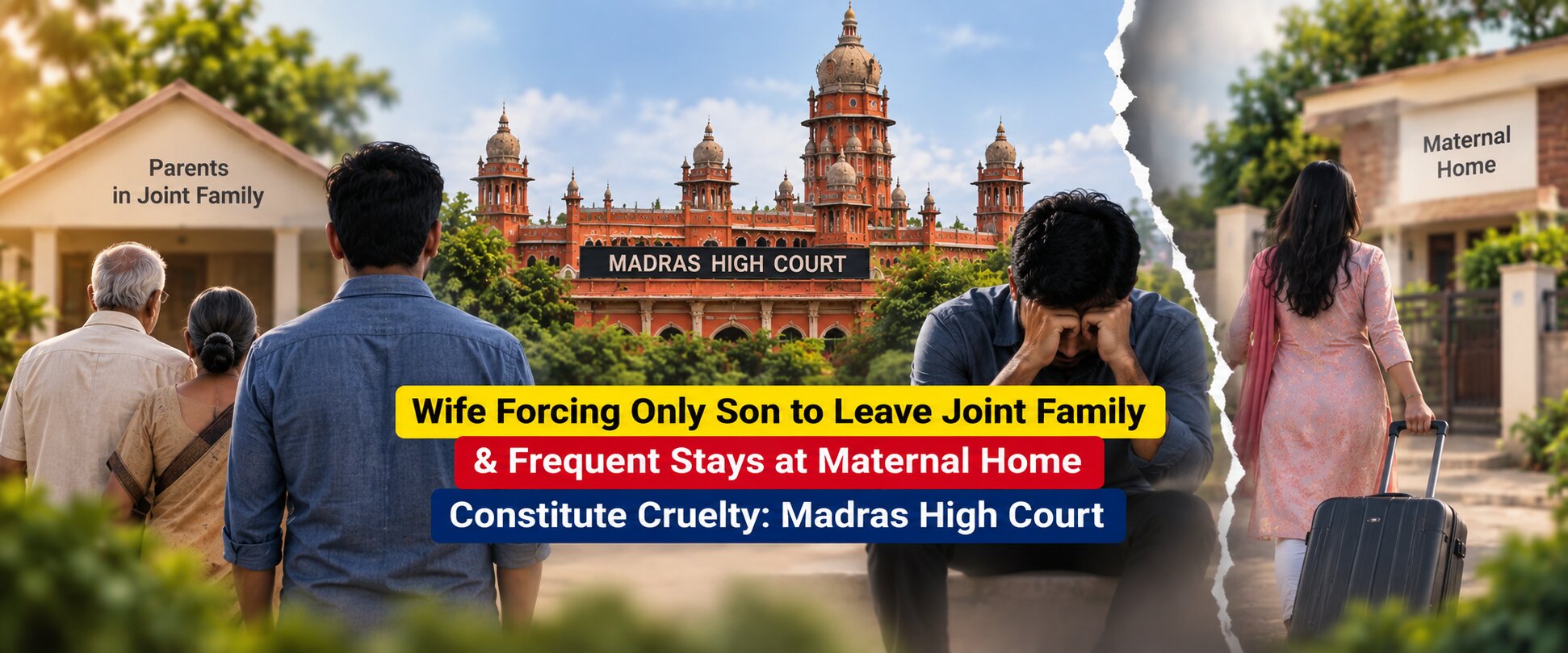
Judgement Details
Court
Madras High Court
Date of Decision
10 September 2026
Judges
Justice P. T. Asha and Justice N. Mala
Citation
Acts / Provisions
Facts of the Case
-
The parties were married in June 2019.
-
The husband claimed that the wife did not immediately accompany him to the matrimonial home after the marriage.
-
According to the husband, she came to the matrimonial home only after being persuaded by him and his parents.
-
Approximately two months after the marriage, the wife allegedly went to her maternal home and remained there for nearly four months.
-
The husband and his parents allegedly requested her to return, but she refused and allegedly used abusive and inappropriate language.
-
The husband stated that he tolerated her conduct in the interest of family honour.
-
The wife subsequently insisted that the husband establish a separate residence away from his parents.
-
The husband argued that the wife knew that he was the only son of his parents and that he had responsibilities towards them in their old age.
-
A separate residence was eventually established, but according to the husband, the wife stayed there for only about one month.
-
She allegedly thereafter insisted that they shift to another residence near her parents' house.
-
The husband further alleged that following a quarrel over a telephone call, the wife left the residence and did not return.
-
The husband consequently approached the Family Court seeking divorce on the ground of cruelty.
-
The wife contested the allegations and stated that the couple had shifted to a separate residence because of problems allegedly created by the husband's parents concerning dowry.
-
She also alleged that the husband failed to visit the couple's newborn daughter.
-
The wife contended that the divorce petition had been filed to deprive her of maintenance and enable the husband to remarry.
-
During the Family Court proceedings, the wife did not subject herself to cross-examination and did not adduce evidence in support of her allegations.
-
The Family Court granted divorce to the husband on the ground of cruelty.
-
The wife challenged that decision before the Madras High Court.
Issues
-
Whether the wife's insistence that the husband, being the only son of his parents, establish a separate residence amounted to cruelty towards the husband?
-
Whether the wife's repeated and prolonged stays at her maternal home without sufficient justification constituted matrimonial cruelty?
-
Whether the conduct alleged and established before the Family Court was sufficient to justify dissolution of the marriage on the ground of cruelty?
-
Whether the High Court should interfere with the Family Court's finding granting divorce to the husband on the ground of cruelty?
-
Whether the wife's failure to participate effectively in the Family Court proceedings and to subject herself to cross-examination affected the evidentiary value of her allegations?
Judgement
-
The Madras High Court dismissed the wife's appeal and refused to interfere with the Family Court's order granting divorce to the husband.
-
The Court held that the wife was aware that the husband was the only son of his parents and had responsibilities towards them.
-
In the Court's view, her unjustified pressure on the husband to establish a separate residence amounted to cruelty.
-
The Court emphasised that the relationship between husband and wife is reciprocal and cannot operate according to the unilateral dictates of either spouse.
-
The Court observed that a matrimonial relationship requires compassion, mutual adjustment and love.
-
The Court also considered the wife's repeated departures to her maternal home without valid justification.
-
According to the Court, frequent and unjustified separation could create a sense of insecurity in the other spouse and, in the circumstances of the case, constituted cruelty.
-
The Court took note of the wife's conduct during the Family Court proceedings, particularly her failure to subject herself to cross-examination and her failure to adduce evidence.
-
The Court found no sufficient ground to overturn the factual conclusions reached by the Family Court.
-
The appeal was therefore found to be without merit and was dismissed.
Held
-
The wife's unjustified insistence on separate residence, despite knowing that the husband was the only son responsible for his elderly parents, was held to constitute matrimonial cruelty in the circumstances of the case.
-
The wife's frequent and prolonged stays at her maternal home without valid reasons were also considered relevant circumstances amounting to cruelty.
-
The Family Court's order granting divorce on the ground of cruelty was upheld.
-
The wife's appeal was dismissed.
-
The High Court declined to interfere with the findings of the Family Court.
Analysis
-
The judgment illustrates that matrimonial cruelty is assessed on the basis of the overall conduct of the spouses and the circumstances of the particular marriage.
-
The Court did not treat the demand for separate residence in isolation; it considered the fact that the husband was the only son and that this responsibility was allegedly known to the wife before marriage.
-
The judgment reflects the principle that matrimonial obligations involve mutual adjustment and accommodation.
-
The Court also considered the repeated and allegedly unjustified physical separation between the spouses as part of the overall pattern of conduct.
-
The decision highlights that temporary separation may, depending on its frequency, duration and justification, become relevant to a finding of cruelty.
-
The Court's reasoning was based on the cumulative effect of the conduct rather than on a single isolated disagreement.
-
The wife's failure to participate effectively in the Family Court proceedings was significant because she did not enter the witness box for cross-examination and did not lead evidence to substantiate her allegations.
-
The case also demonstrates the importance of evidence in matrimonial disputes, particularly where one spouse makes allegations of dowry-related harassment or other misconduct.
-
The judgment does not establish that every demand for a separate residence or every visit to a maternal home automatically constitutes cruelty.
-
Rather, the Court's conclusion was based on the specific facts and circumstances established in this case.
-
The decision reinforces the idea that courts must examine matrimonial conduct in its entire factual and evidentiary context while determining whether the legal threshold for cruelty has been met.