
Ranku v. State of Madhya Pradesh, 2026
The judgment adopts a practical interpretation of criminal procedure by rejecting unnecessary procedural formalities.
Judgement Details
Court
Madhya Pradesh High Court
Date of Decision
28 July 2026
Judges
Justice Milind Ramesh Phadke
Citation
Acts / Provisions
Facts of the Case
-
petitioner was convicted of murder and sentenced to life imprisonment on 28 February 2007.
-
During the pendency of his criminal appeal, the High Court suspended his sentence under Section 389 CrPC, and he was released on interim bail.
-
On 22 March 2013, the suspension of sentence was extended for another three months.
-
Before the suspension period expired, the petitioner was convicted in another murder case.
-
He surrendered before the Trial Court in the second case on 12 April 2013 and was taken into judicial custody.
-
From that date onwards, the petitioner remained continuously incarcerated without any break.
-
Years later, after disposal of his first appeal, he sought a custody certificate for approaching the Supreme Court.
-
He discovered that prison authorities had not counted the period from 12 April 2013 to 8 August 2018 towards the sentence in the first case.
-
The authorities treated the custody exclusively as relating to the second conviction.
-
The petitioner challenged the exclusion of this period before the High Court.
Issues
-
Whether a convict already in judicial custody in another criminal case is required to formally surrender again after the expiry of a temporary suspension of sentence in an earlier case?
-
Whether failure of prison authorities to maintain proper custody records can deprive a prisoner of credit for the period actually spent in incarceration?
-
Whether continuous judicial custody in another case is sufficient to satisfy the requirement of surrender after suspension of sentence?
-
Whether the disputed period of incarceration ought to be counted towards the sentence in the earlier conviction?
Judgement
-
The Madhya Pradesh High Court allowed the writ petition.
-
The Court held that a convict who is already in lawful judicial custody in another criminal case is not required to perform a fresh or formal act of surrender after the expiry of suspension of sentence.
-
It observed that the concept of surrender presupposes that the convict is at liberty, and once he is already confined in prison, the requirement of another surrender becomes meaningless.
-
The Bench held that the law does not require the performance of empty or futile formalities.
-
The Court clarified that once the petitioner surrendered in the second case and remained continuously incarcerated, the benefit of suspension of sentence in the first case became inconsequential with respect to the fact of custody.
-
It distinguished between judicial custody and the execution of sentences, observing that while commencement and execution of sentences are governed by statutory provisions, judicial custody refers to lawful confinement.
-
The Court held that Rules 288 and 290 of the M.P./C.G. Jail Manual impose a duty upon jail authorities to correctly maintain custody records where multiple convictions exist.
-
It found that the omission to record custody in relation to the first case was merely an administrative lapse.
-
The Court ruled that such administrative errors cannot prejudice a prisoner's statutory or constitutional rights.
-
The State authorities were directed to rectify the custody records and include the disputed period while calculating the petitioner's sentence.
Held
-
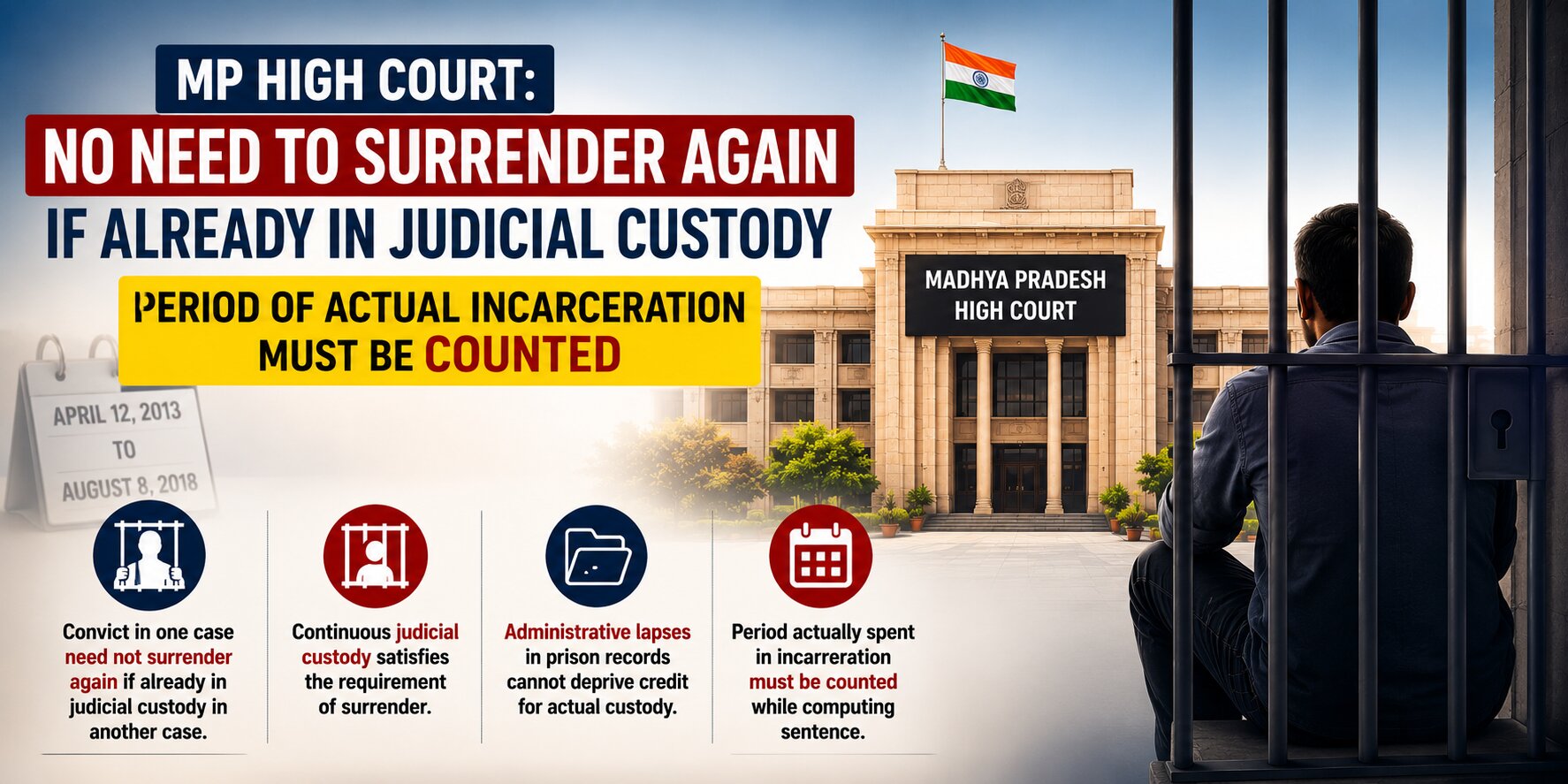
A convict already in judicial custody in another case need not formally surrender again after suspension of sentence expires.
-
Continuous lawful incarceration satisfies the requirement of surrender.
-
Administrative lapses in prison records cannot deprive a prisoner of credit for the actual period spent in custody.
-
The disputed period of incarceration must be counted towards the petitioner's sentence.
Analysis
-
It reinforces that the purpose of surrender is to restore judicial control over a convict who is at liberty, not one who is already lawfully imprisoned.
-
The Court emphasized that prison administration must accurately maintain custody records to safeguard prisoners' legal rights.
-
The ruling distinguishes the concepts of judicial custody and execution of sentence, providing important clarification for prison administration.
-
The decision protects prisoners from suffering adverse consequences due to administrative negligence.
-
By invoking constitutional principles, the Court affirmed that procedural lapses by State authorities cannot curtail an individual's liberty or statutory entitlements.
-
The judgment promotes fairness in sentence computation and ensures that actual incarceration receives due legal recognition.
-
The ruling will guide prison authorities and courts in cases involving multiple convictions and overlapping custody periods.