
Ranbir Singh & Others v. Haryana State through Collector, Fatehabad, 2026
The judgment strongly reinforces the constitutional protection of the right to property under Article 300-A by holding the Government to a higher standard than private individuals.
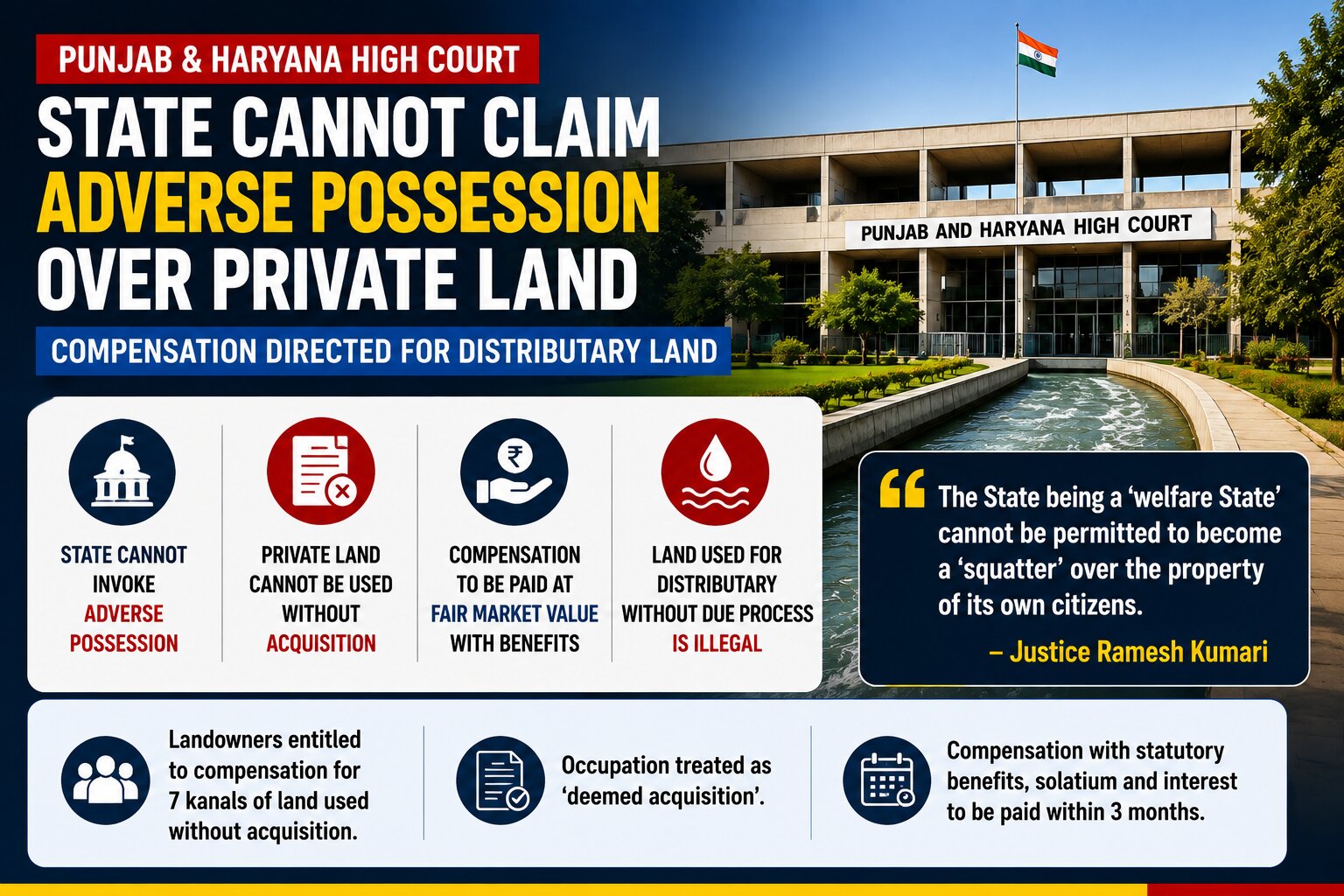
Judgement Details
Court
Punjab and Haryana High Court
Date of Decision
3 July 2026
Judges
Justice Ramesh Kumari
Citation
Acts / Provisions
Facts of the Case
-
Appellants were owners of approximately 119 kanals of agricultural land situated in Village Banmandori, District Fatehabad.
-
Out of the total land, about 7 kanals was being used by the Haryana Government for construction and operation of an irrigation distributary.
-
The landowners alleged that the Government neither acquired the land under any acquisition law nor paid compensation before occupying it.
-
Subsequently, the distributary was converted into a pucca (cement-lined) distributary without following any legal acquisition procedure.
-
The landowners filed a civil suit seeking possession and appropriate relief against the State.
-
The State defended the suit by contending that the distributary had existed since 1960 and that its possession had remained open, continuous and hostile for decades.
-
The State asserted that it had perfected its title over the land by invoking the doctrine of adverse possession.
-
Both the Trial Court and the First Appellate Court accepted the State's plea and dismissed the suit by holding that the State had become owner through adverse possession and that the suit was barred by limitation.
-
Aggrieved by the concurrent findings, the landowners preferred a Regular Second Appeal before the High Court.
Issues
-
Whether the State can acquire ownership over private land by invoking the doctrine of adverse possession?
-
Whether the State can use private land for a public purpose without acquiring it in accordance with law and without paying compensation?
-
Whether the plaintiffs' suit was barred by limitation under Article 65 of the Limitation Act, 1963?
-
Whether the landowners were entitled to compensation by treating the occupation as a case of deemed acquisition?
Judgement
-
The High Court allowed the appeal and set aside the judgments of the Trial Court and the First Appellate Court.
-
The Court held that the State, being a welfare State, cannot invoke the doctrine of adverse possession to deprive citizens of their property.
-
It observed that the Government cannot become a "squatter" over private property by remaining in unauthorized possession for a long period.
-
The Court held that private land cannot be taken for construction or improvement of an irrigation distributary without following the due process of law.
-
The Bench emphasized that the constitutional right to property under Article 300-A cannot be defeated merely because the Government has remained in possession for several years.
-
It rejected the State's contention that it had perfected title through adverse possession.
-
The Court held that the lower courts had committed a legal error by accepting the State's plea of adverse possession and by dismissing the suit on the ground of limitation.
-
It observed that where the Government illegally occupies private property without acquisition, the owners cannot be deprived of their constitutional right merely because time has elapsed.
-
Recognizing that the distributary was serving a public purpose and had existed for decades, the Court declined to direct restoration of possession.
-
Instead, it treated the occupation as a case of deemed acquisition.
-
The State was directed to pay fair market compensation for the 7 kanals of land together with all statutory benefits including solatium and interest within three months.
Held
-
The State cannot claim ownership of private property by invoking adverse possession.
-
Illegal occupation of private land without acquisition violates Article 300-A of the Constitution.
-
The findings of the Trial Court and the First Appellate Court were set aside.
-
The occupation of the land was treated as deemed acquisition.
-
The landowners were held entitled to fair market compensation along with statutory benefits, solatium, and interest.
Analysis
-
The Court emphasized that a welfare State cannot rely upon a doctrine traditionally available to private litigants to appropriate the property of its own citizens.
-
By rejecting the plea of adverse possession, the judgment strengthens public confidence in constitutional governance and the rule of law.
-
The ruling recognizes that while public infrastructure projects may serve larger societal interests, they cannot be executed by ignoring the property rights of individuals.
-
Instead of disturbing a long-existing distributary serving public interest, the Court adopted the equitable principle of deemed acquisition, thereby balancing public necessity with private rights.
-
The judgment discourages governmental authorities from bypassing statutory acquisition procedures and encourages strict compliance with due process.
-
The decision is likely to become an important precedent in cases involving unauthorized occupation of private land by Government authorities.
-
It reiterates that constitutional rights cannot be defeated through administrative inaction or prolonged illegal possession by the State.