
Ramrakh Chhipa & Ors. v. Municipal Council, 2026
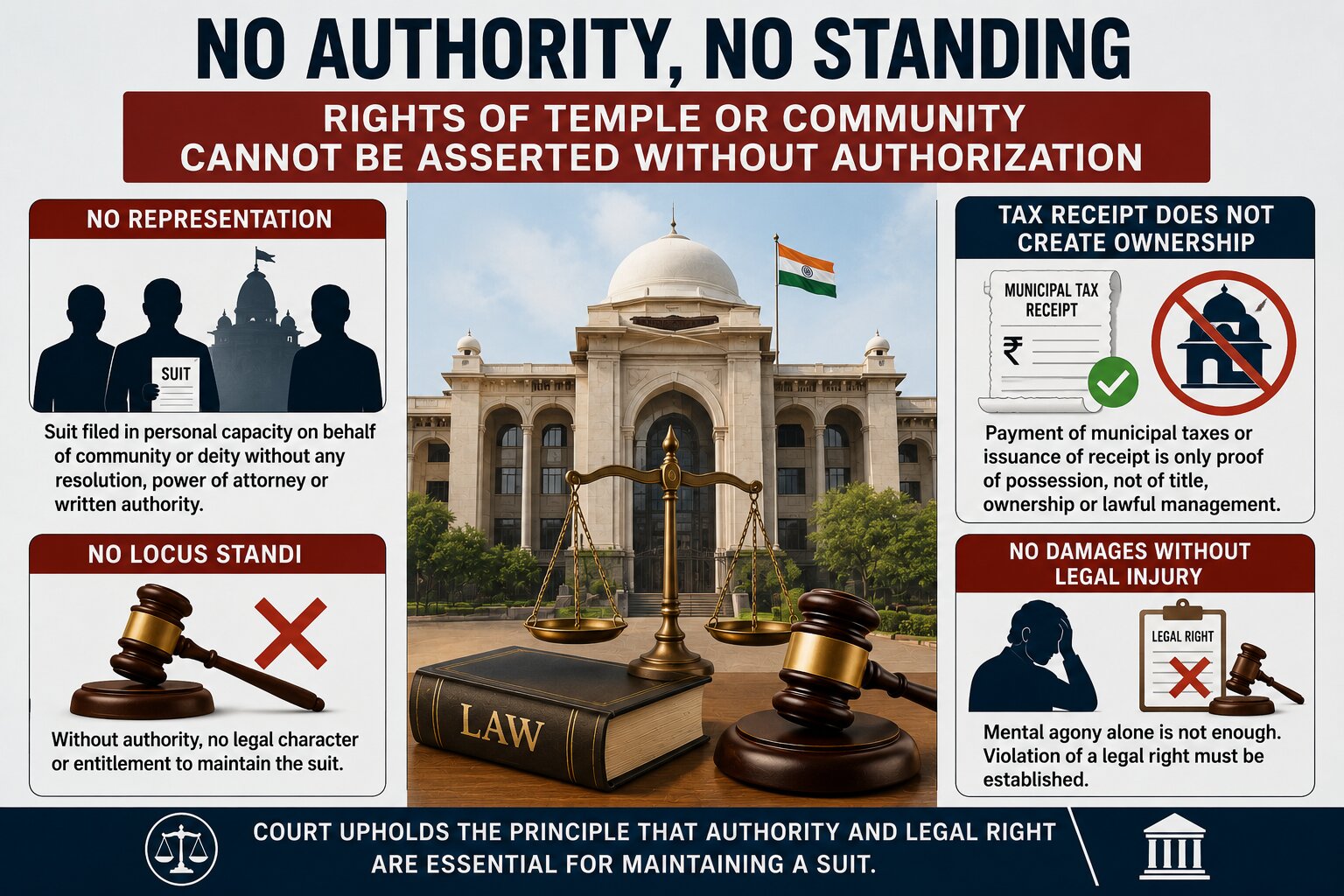
A person cannot assert rights on behalf of a temple, deity or community merely by claiming to represent them; lawful authority must be established.
Judgement Details
Court
Rajasthan High Court
Date of Decision
19 August 2026
Judges
Justice Maneesh Sharma
Citation
Acts / Provisions
Facts of the Case
-
The dispute concerned Temple Shri Laxman Ji Maharaj and property associated with the temple.
-
The appellants claimed that the temple had been established by the Chhipa community.
-
They asserted that the land on which the temple stood belonged to the temple.
-
According to the appellants, municipal records reflected the property in the name of “Ram Laxman Temple.”
-
The appellants alleged that when house tax was deposited in respect of the property, the municipal authority issued a receipt in the name of “Agrawal Panchayat Ghaseti Dhara.”
-
They alleged that the entry was wrongful and malicious and that their representations seeking correction were not acted upon.
-
The appellants further alleged that Agrawal Panchayat Ghaseti Dhara had encroached upon the property and collected rent from tenants associated with the temple without lawful authority.
-
They claimed that these circumstances caused them mental agony.
-
On that basis, they instituted a civil suit seeking compensation of ₹5,000 and mandatory injunction.
-
The Trial Court dismissed the suit.
-
The appellate court also dismissed the challenge to the Trial Court's decision.
-
The appellants therefore approached the Rajasthan High Court in second appeal.
-
Before the High Court, the respondents disputed the appellants' authority to represent the temple or the Chhipa community.
-
It was pointed out that the appellants had not produced any resolution, power of attorney or other written authority authorising them to institute proceedings on behalf of the temple or community.
-
The respondents also argued that payment of municipal tax and issuance of a tax receipt did not create ownership or title in favour of the person named in the receipt.
-
The Court also noted that a dispute relating to the management and trusteeship of the temple was already pending before the competent authority.
Issues
-
Whether persons instituting a civil suit in their personal capacity can assert rights on behalf of a temple, deity or community without producing any resolution, power of attorney or other written authority establishing such entitlement?
-
Whether the appellants had the necessary locus standi to maintain a suit concerning the alleged rights and management of the temple and property belonging to it?
-
Whether payment of municipal taxes or issuance of a municipal tax receipt in a person's name creates or establishes any right, title or ownership over the concerned immovable property?
-
Whether a municipal tax receipt can constitute evidence of lawful management or trusteeship of temple property?
-
Whether a claim for compensation based merely on alleged mental agony can be sustained in the absence of proof that a legally protected right of the claimant was violated?
-
Whether the lower courts committed any legal error warranting interference by the High Court in second appellate jurisdiction?
Judgement
-
The Rajasthan High Court dismissed the second appeal.
-
The Court held that the appellants had no sufficient locus standi to institute the suit in the manner in which it had been filed.
-
The appellants had instituted the proceedings in their personal capacity while attempting to assert rights on behalf of the Chhipa community and the deity.
-
However, they failed to produce any resolution, power of attorney or other written authority demonstrating that they had been authorised by the temple trust or the community.
-
The Court found no material establishing that the appellants had been entrusted with administrative control or lawful management of the temple.
-
Consequently, the appellants could not claim a personal legal entitlement to maintain the proceedings on behalf of the temple or community.
-
The Court also rejected the argument that payment of municipal taxes or the issuance of a municipal receipt established ownership.
-
It held that a tax receipt is essentially a fiscal document reflecting payment made to the municipal authority.
-
Such a receipt does not create, transfer or extinguish title to immovable property.
-
The Court further held that a tax receipt cannot, by itself, establish lawful management or trusteeship of temple property.
-
The Court noted that issues concerning the management and trusteeship of the temple were already pending before the competent authority.
-
The Court also rejected the claim for compensation based upon alleged mental agony.
-
It held that a claim for damages ordinarily requires violation of a legal right resulting in legal injury.
-
Subjective dissatisfaction or mental distress, without proof of infringement of a legally protected right, could not independently sustain a claim for damages.
-
Finding no illegality in the judgments of the courts below, the High Court dismissed the second appeal.
Held
-
The Court held that a person cannot institute proceedings on behalf of a temple, deity or community merely in his personal capacity without establishing the requisite legal authority.
-
The Court held that a resolution, power of attorney or other valid authorisation may be necessary to demonstrate authority to represent a trust or community where such authority is disputed.
-
The Court held that municipal tax receipts do not create or establish ownership or title over immovable property.
-
The Court held that payment of property tax is merely a fiscal transaction and cannot, by itself, establish lawful management or trusteeship.
-
The Court held that a person cannot claim damages merely on the basis of subjective mental agony without demonstrating violation of a legally protected right.
-
The Court held that the lower courts had committed no error warranting interference in second appeal.
-
The second appeal was therefore dismissed.
Analysis
-
Locus standi is fundamental: Before examining the merits of a claim, a court must determine whether the person bringing the action has the legal capacity or authority to maintain it.
-
Personal capacity versus representative capacity: The appellants attempted to assert rights concerning the temple and the wider Chhipa community while filing the suit in their personal capacity. The Court found this fundamental mismatch fatal to their claim.
-
Authority must be demonstrated: Where a person claims to represent a trust, community or religious institution, merely asserting such representation is insufficient. The person must demonstrate the source of that authority.
-
Tax receipt is not title: The Court clearly separated fiscal records from title documents. Payment of municipal tax may demonstrate that someone paid the tax, but it does not establish that the person owns the property.
-
Possession versus ownership: Municipal records or tax payments may have relevance to questions of possession or municipal administration, but they cannot automatically be treated as conclusive proof of ownership or title.
-
No ownership through payment: The judgment reinforces the settled principle that paying taxes cannot create ownership where none otherwise exists.
-
Management and trusteeship are separate questions: A person's payment of taxes or involvement with municipal records cannot, by itself, establish that the person is the lawful trustee or manager of a religious institution.
-
Pending trusteeship dispute: The Court considered it significant that questions concerning the management and trusteeship of the temple were already pending before the competent authority. This further weakened the appellants' attempt to independently assert management-related rights.
-
Mental agony requires legal injury: The Court distinguished between subjective distress and legally compensable injury. Emotional dissatisfaction alone is insufficient for a civil damages claim unless it results from violation of a legally protected right.
-
Civil damages require a legal foundation: The judgment reinforces that a damages claim cannot rest solely on the claimant's perception that an act was unfair or caused mental distress. There must first be an identifiable legal right and its violation.
-
Limited scope of second appeal: The High Court did not substitute its own factual assessment merely because the appellants disagreed with the lower courts. Interference required a demonstrable legal error warranting second appellate intervention.
-
Broader significance: The ruling is particularly relevant to disputes involving temples, religious trusts, community institutions and immovable property, where questions of representation, management and ownership can easily become intertwined.