
Rajesh Kumar Mohapatra & Ors. v. State of Odisha, 2026
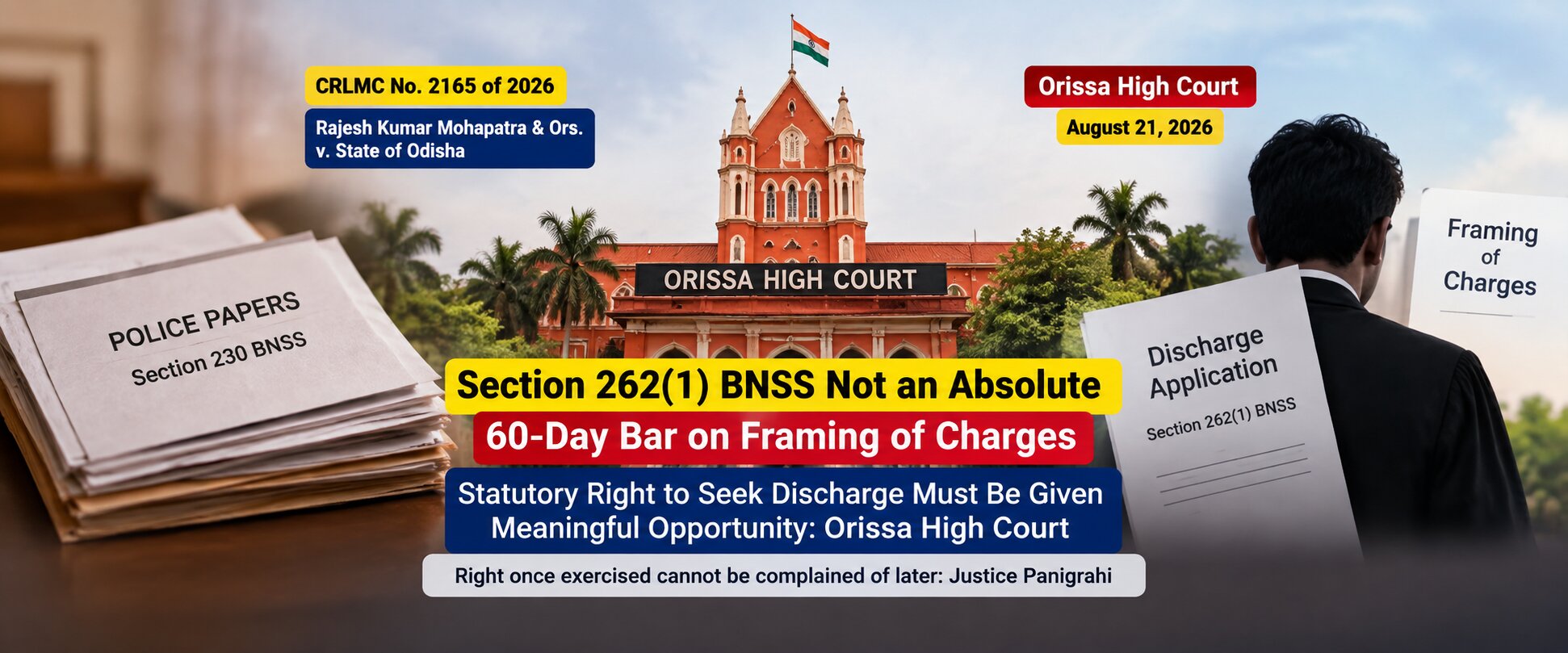
Section 262(1) BNSS does not impose an absolute 60-day moratorium on framing of charges.
Judgement Details
Court
Orissa High Court
Date of Decision
10 September 2026
Judges
Justice Panigrahi
Citation
Acts / Provisions
Facts of the Case
-
The petitioners approached the Orissa High Court in relation to the exercise of their statutory right to seek discharge before framing of charges.
-
The dispute concerned the interpretation of the 60-day period under Section 262(1) of the BNSS.
-
The petitioners sought to rely upon the statutory protection available to an accused before the framing of charges.
-
The Court examined whether the 60-day period under Section 262(1) creates an absolute period during which the trial court cannot frame charges.
-
The Court considered the relationship between the supply of police papers under Section 230 BNSS and the subsequent stage of framing of charge.
-
The Court observed that the statutory right under Section 262(1) had not been extinguished; rather, the right had been exercised, considered and adjudicated upon.
-
The Court therefore found that the petitioners could not seek to revive a procedural opportunity that had already been overtaken by subsequent events.
-
The Court emphasised the need for trial courts to provide accused persons with a reasonable opportunity to file discharge applications after receiving the police papers.
-
The petition was ultimately found to be devoid of merit and was dismissed.
Issues
-
Whether the sixty-day period prescribed under Section 262(1) of the BNSS creates an absolute two-month moratorium against framing of charges?
-
Whether the statutory right of the accused to seek discharge under Section 262(1) of the BNSS is extinguished merely because the charge has subsequently been framed?
-
Whether trial courts should provide a reasonable interval between the supply of police papers under Section 230 BNSS and the framing of charges to enable the accused to effectively exercise the right to seek discharge?
-
Whether the petitioners were entitled to challenge the proceedings after their statutory right under Section 262(1) had already been exercised, examined and adjudicated upon?
Judgement
-
The Orissa High Court dismissed the petition, holding that it was without merit.
-
Justice Panigrahi clarified that the 60-day period under Section 262(1) BNSS cannot be interpreted as a mandatory two-month moratorium preventing courts from framing charges.
-
The Court explained that the provision should not be interpreted in a manner that mechanically prevents the progress of criminal proceedings.
-
At the same time, the Court stressed that the statutory right of an accused to seek discharge must be given meaningful and unhindered effect.
-
The Court observed that the right under Section 262(1) had been exercised, examined and adjudicated upon in the case.
-
Therefore, the petitioners could not seek to resurrect a procedural formality that had already been overtaken by subsequent events.
-
The Court advised trial courts across the State to adopt a balancing approach between procedural efficiency and the accused's statutory rights.
-
Trial courts were encouraged to allow a reasonable interval between supplying police papers under Section 230 and framing charges.
-
The Court specifically cautioned against supplying police papers and framing charges on the same day merely for administrative convenience.
-
The Court emphasised that procedural fairness contributes to the legitimacy and confidence of the criminal justice process.
-
The petition was accordingly dismissed.
Held
-
The statutory right of the accused to seek discharge must nevertheless receive genuine and effective consideration.
-
The right cannot be treated as extinguished where it has already been exercised, examined and adjudicated upon.
-
Trial courts should ordinarily provide a reasonable interval between supplying police papers under Section 230 and framing charges.
-
Procedural convenience should not unnecessarily restrict the accused's statutory opportunity to seek discharge.
-
The petition filed by Rajesh Kumar Mohapatra and others was dismissed as being devoid of merit.
Analysis
-
The judgment adopts a balanced interpretation of Section 262(1) BNSS rather than treating the 60-day period as an automatic prohibition on framing charges.
-
The Court distinguished between a statutory right to seek discharge and an alleged absolute right to delay the framing of charges for a fixed period.
-
The judgment protects the accused's procedural fairness while simultaneously preventing criminal proceedings from being unnecessarily stalled.
-
The Court's observation that a right once exercised cannot simultaneously be claimed to have been foreclosed underscores the importance of examining the actual procedural history of a case.
-
The decision highlights the connection between Section 230 and Section 262(1) BNSS: the accused must receive the police papers and a meaningful opportunity to consider whether to seek discharge.
-
The Court's recommendation regarding a reasonable interval is aimed at preventing administrative convenience from overriding procedural fairness.
-
The judgment reinforces the principle that justice must not only be done but must also appear to be done.
-
The Court recognised that even when a procedural arrangement does not ultimately change the outcome, procedural symmetry and fairness strengthen public confidence in judicial proceedings.
-
The decision is significant for interpreting the procedural safeguards available to accused persons under the BNSS, particularly at the stage between supply of documents and framing of charges.
-
The judgment therefore seeks to maintain an appropriate balance between speedy criminal proceedings and the accused's right to a fair opportunity to seek discharge.