
P. Vanajamma v. P. Mahitha Reddy & Ors., 2026
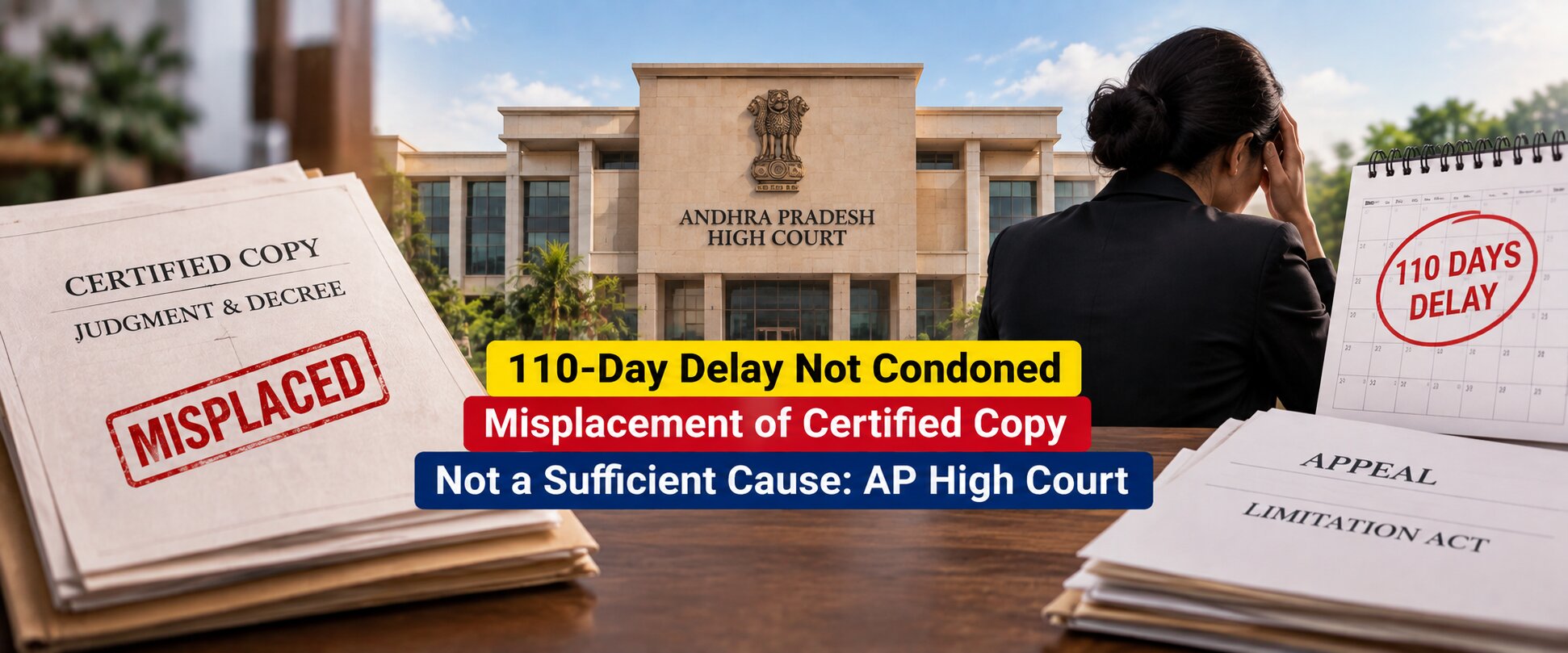
The certified copy filed with the appeal was the same copy originally received by the appellant, undermining the explanation for the delay.
Judgement Details
Court
Andhra Pradesh High Court
Date of Decision
10 September 2026
Judges
Justice Ravi Nath Tilhari and Justice Maheswara Rao Kuncheam
Citation
Acts / Provisions
Facts of the Case
-
The appellant was the plaintiff in a suit seeking specific performance of a contract.
-
The trial court dismissed the suit, holding that the claim was barred by limitation.
-
The appellant subsequently decided to challenge the dismissal before the Andhra Pradesh High Court.
-
The appeal was filed with an application seeking condonation of a 110-day delay.
-
The appellant explained the delay by stating that the certified copy of the trial court's judgment and decree had been misplaced.
-
She claimed that she approached her counsel for another certified copy and received it after approximately four months.
-
The High Court examined the certified copy filed along with the appeal.
-
The Court found that the copy had originally been applied for on 10 April 2025, became ready on 14 May 2025, and was received on 14 May 2025.
-
The Court found no proof that another or additional certified copy had actually been obtained.
-
The copy attached to the appeal was found to be the same certified copy that had originally been applied for and received.
-
The Court therefore found the explanation offered for the delay to be unsupported by evidence.
-
The appellant was consequently held to have failed to demonstrate the required sufficient cause for the 110-day delay.
Issues
-
Whether the appellant had shown sufficient cause under Section 5 of the Limitation Act, 1963 for condoning the 110-day delay in filing the appeal?
-
Whether the alleged misplacement of the certified copy of the trial court's judgment and decree constituted sufficient cause for condonation of the delay?
-
Whether the absence of evidence showing that an additional certified copy had been obtained demonstrated lack of diligence on the part of the appellant?
-
Whether the principle of adopting a liberal approach in condoning delay can override the statutory limitation period where negligence or lack of due diligence is established?
-
Whether the appeal was liable to be dismissed as barred by limitation after rejection of the application for condonation of delay?
Judgement
-
The Andhra Pradesh High Court rejected the application for condonation of the 110-day delay.
-
The Court held that the appellant had failed to establish sufficient cause within the meaning of Section 5 of the Limitation Act.
-
The Court examined the explanation that the certified copy had been misplaced and found that the explanation was not supported by evidence.
-
The Court noted that the certified copy filed with the appeal was the same copy that had been applied for on 10 April 2025 and received on 14 May 2025.
-
There was no convincing evidence establishing that the appellant had obtained a fresh or additional certified copy after allegedly losing the original.
-
The Court therefore concluded that the appellant had not acted diligently in pursuing the appeal.
-
The Bench emphasised that a liberal approach to condonation of delay cannot be used to disregard the statutory limitation period when the party is found to have been negligent.
-
Since the delay was not condoned, the appeal remained barred by limitation.
-
The High Court consequently dismissed the appeal.
Held
-
The appellant failed to demonstrate sufficient cause for the 110-day delay.
-
The alleged loss of the certified copy was not sufficiently established by documentary evidence.
-
The appellant was found to have lacked the required diligence in filing the appeal.
-
A liberal approach to delay condonation cannot override statutory limitation where negligence or lack of due diligence is established.
-
The application under Section 5 of the Limitation Act was rejected.
-
Consequently, the appeal was dismissed as barred by limitation.
Analysis
-
The judgment reinforces the principle that limitation law promotes finality and certainty in litigation.
-
Section 5 gives courts discretion to condone delay, but that discretion is conditional upon the applicant establishing sufficient cause.
-
The Court made clear that a party cannot rely merely on a general or unsupported explanation for failing to file an appeal within time.
-
The alleged misplacement of an important court document was examined against the actual documentary record.
-
The fact that the same certified copy was ultimately filed weakened the appellant's explanation that she had obtained a fresh copy after losing the earlier one.
-
The judgment highlights the importance of due diligence and prompt action by litigants and their legal representatives.
-
The Court also clarified the limits of the frequently invoked liberal approach towards condonation of delay.
-
A liberal approach does not mean that courts can overlook negligence, inaction or absence of credible evidence.
-
The decision demonstrates that the burden lies on the party seeking condonation to establish circumstances that genuinely prevented timely filing.
-
The ruling is particularly relevant to civil appeals, where failure to comply with limitation requirements can result in dismissal of the appeal at the threshold.
-
The judgment balances procedural flexibility with the need to respect statutory limitation periods.
-
The underlying suit concerned specific performance of a contract, but the High Court's immediate determination concerned the appellant's failure to establish sufficient cause for the delay in filing the appeal.