
Mukesh v. State & Anr., 2026
A subsisting first marriage is a significant factor while examining allegations of consent obtained on the promise of marriage.
Judgement Details
Court
Rajasthan High Court
Date of Decision
31 July 2026
Judges
Justice Kuldeep Mathur
Citation
Acts / Provisions
Facts of the Case
-
The complainant was legally married to another person and no decree of divorce had been obtained.
-
After leaving her matrimonial home, she began residing with her parents.
-
Around ten months before lodging the FIR, she came into contact with the petitioner.
-
Both developed a physical relationship, allegedly on the petitioner's promise to marry her.
-
The complainant alleged that the petitioner later called her with her Aadhaar Card for marriage but ultimately refused to marry her.
-
An FIR was registered alleging offences including repeated rape on the false promise of marriage.
-
The petitioner contended that the complainant was a mature woman who was fully aware that her existing marriage was still subsisting.
-
He argued that the relationship remained consensual for nearly ten months and could not subsequently be converted into an offence of rape merely because the relationship failed.
-
The Trial Court framed charges, which were challenged before the Rajasthan High Court.
Issues
-
Whether charges under Section 376(2)(n) IPC could be sustained when the prosecutrix was already legally married and both parties were aware that her first marriage was subsisting?
-
Whether consent for a long-standing physical relationship could be treated as consent obtained solely on a false promise of marriage in such circumstances?
-
Whether a promise of marriage incapable of lawful performance due to an existing marriage could constitute a legally enforceable promise for the purpose of alleging rape?
-
Whether the petitioner was entitled to discharge from the charges framed by the Trial Court?
Judgement
-
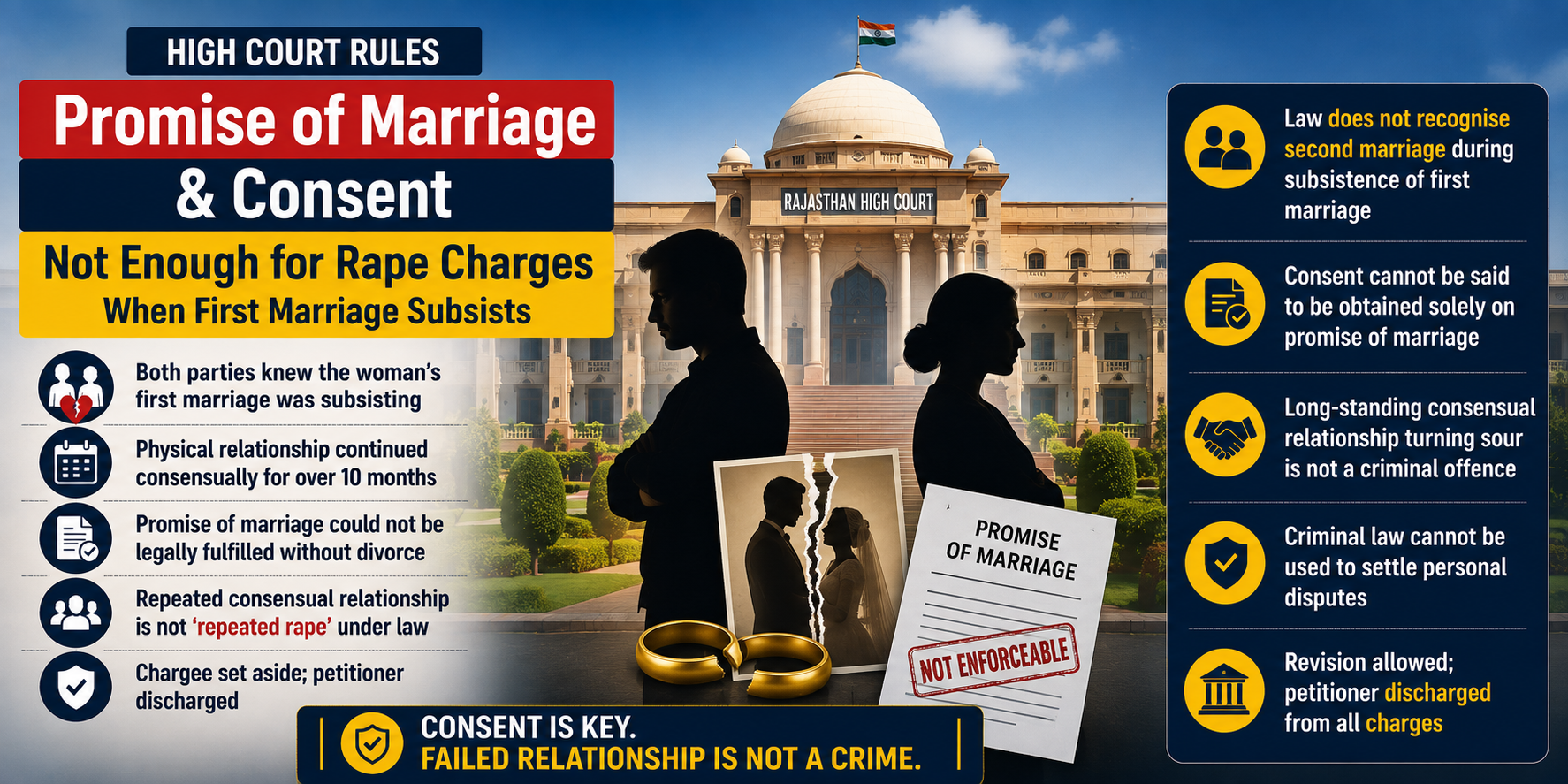
The Rajasthan High Court held that where both parties know that the prosecutrix's first marriage is still subsisting, it is ordinarily difficult to conclude that consent for a physical relationship was obtained solely on a promise of marriage.
-
The Court observed that since no divorce had taken place, any promise of marriage could not have been legally fulfilled at the relevant time.
-
It held that the alleged promise, therefore, could not prima facie be regarded as a legally enforceable promise capable of vitiating consent.
-
The Bench noted that the complainant voluntarily continued the relationship with the petitioner for nearly ten months.
-
It observed that the FIR was lodged only after the relationship deteriorated.
-
The Court clarified that Section 376(2)(n) IPC applies to repeated acts of rape and not to a continuing consensual relationship that later turns sour.
-
Relying upon the Supreme Court's decision in Pramod Kumar Navratna v. State of Chhattisgarh, the Court held that law does not recognise a second marriage during the subsistence of the first marriage.
-
The order framing charges was set aside.
-
The petitioner was discharged from all the charges.
Held
-
A promise of marriage that cannot legally be performed due to an existing valid marriage ordinarily cannot, by itself, invalidate consent.
-
A prolonged consensual relationship does not automatically amount to repeated rape under Section 376(2)(n) IPC.
-
The revision petition was allowed and the petitioner was discharged.
Analysis
-
The judgment distinguishes between consensual relationships and consent obtained through deception.
-
It emphasizes that courts must carefully examine whether the alleged promise of marriage was legally capable of being fulfilled.
-
The decision reiterates that criminal law cannot be invoked merely because a consensual relationship subsequently breaks down.
-
The Court interpreted Section 376(2)(n) IPC to apply only where repeated acts independently satisfy the ingredients of rape.
-
The ruling reinforces the principle that every failed relationship cannot automatically give rise to criminal liability for rape.
-
By relying on the legal impossibility of a second marriage during the subsistence of the first, the Court highlighted the relevance of surrounding circumstances while assessing consent.
-
The judgment provides guidance on the distinction between false promise of marriage and a relationship voluntarily continued by consenting adults.
-
The ruling may influence future cases involving allegations of rape based on promises of marriage where legal impediments to marriage already existed.