
Mahendra Singh v. State of Chhattisgarh, 2026
It clarifies that Section 299 CrPC is an exception to the general rule requiring evidence to be recorded in the presence of the accused.
Judgement Details
Court
Supreme Court of India
Date of Decision
31 July 2026
Judges
Justice J.B. Pardiwala & Justice K. Vinod Chandran
Citation
Acts / Provisions
Facts of the Case
-
The appellant and another accused were charged with murder in 1999.
-
The prosecution alleged that the appellant strangled the deceased, while the co-accused instigated the offence and restrained intervention.
-
The appellant absconded before trial, whereas the co-accused faced trial alone.
-
During the co-accused’s trial, an eyewitness (PW-1) deposed before the court.
-
The co-accused was ultimately acquitted.
-
The appellant remained absconding for nearly 18 years and was arrested in 2017.
-
By the time the appellant’s trial commenced, PW-1 had died.
-
The Trial Court relied on PW-1’s earlier deposition and convicted the appellant.
-
The High Court affirmed the conviction.
-
The appellant challenged the conviction before the Supreme Court.
Issues
-
Whether the testimony of a witness recorded during the trial of a co-accused can be used against an absconding accused in a subsequent trial without passing an order under Section 299 CrPC (Section 335 BNSS)?
-
Whether recording a formal order establishing that the accused was absconding and that there was no immediate prospect of arrest is mandatory before invoking Section 299 CrPC?
-
Whether the appellant's conviction based solely on the earlier testimony of a deceased witness was legally sustainable?
-
Whether failure to establish the jurisdictional requirements under Section 299 CrPC vitiates the subsequent conviction?
Judgement
-
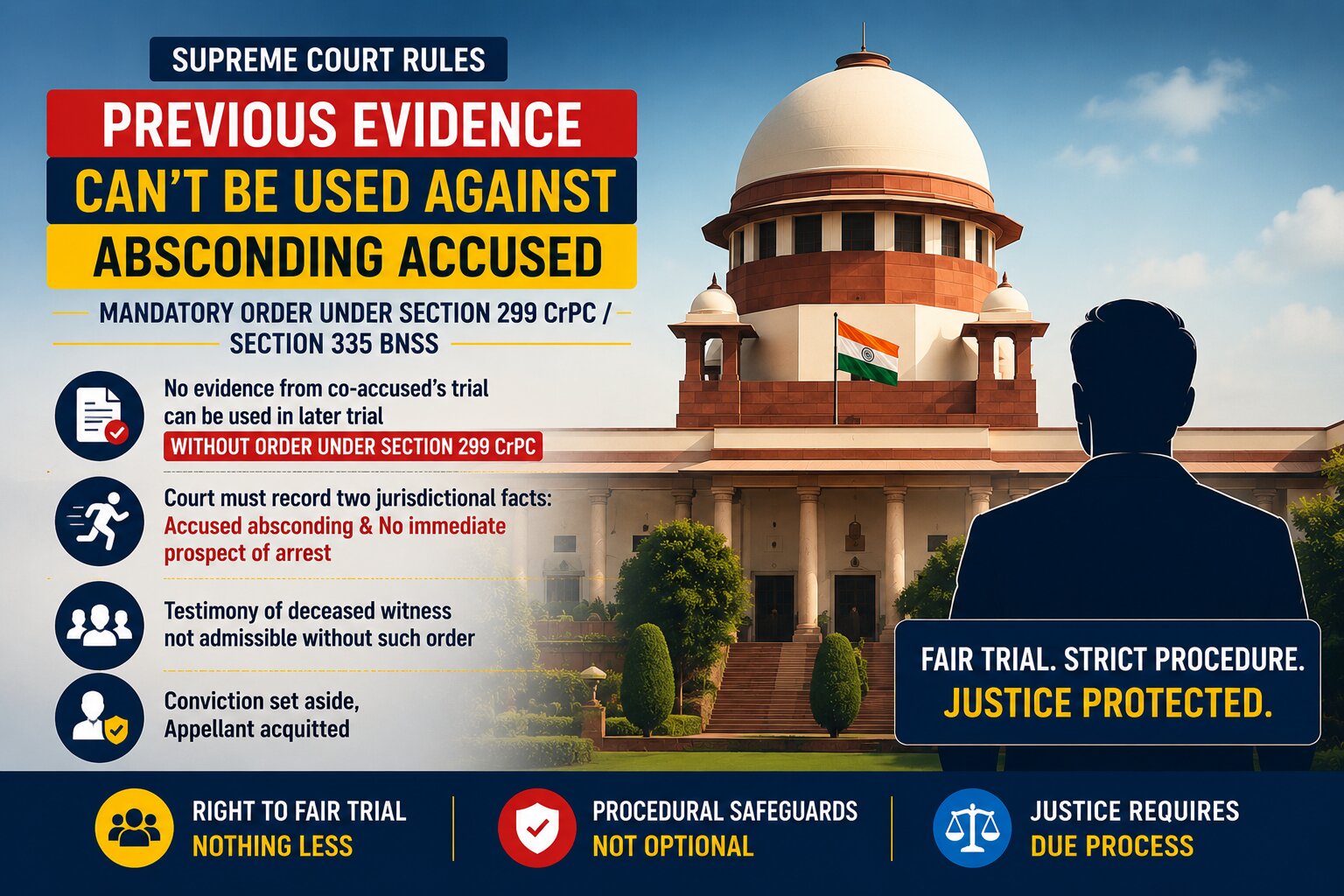
The Supreme Court held that evidence recorded in a previous trial cannot automatically be used against an absconding accused in a later trial.
-
The Court ruled that before invoking Section 299 CrPC (Section 335 BNSS), the trial court must pass a formal order recording satisfaction of two jurisdictional facts:
-
The accused was absconding; and
-
There was no immediate prospect of arrest.
-
-
The Bench emphasized that these jurisdictional facts must be proved on record and cannot be presumed.
-
The Court found that no order under Section 299 CrPC was passed in the 1999 proceedings.
-
Consequently, the deposition of PW-1 (deceased witness) recorded earlier became inadmissible against the appellant.
-
Since the conviction was substantially based on this inadmissible evidence, it could not be sustained.
-
The Supreme Court set aside the judgments of the Trial Court and High Court.
-
The appellant was acquitted of all charges.
-
The Court noted a divergence from State of West Bengal v. Kader Khan (2026 LiveLaw (SC) 692), where a formal order under Section 299 was held not mandatory if jurisdictional facts existed.
Held
-
Evidence recorded in an earlier trial cannot be used against an absconding accused unless strict compliance with Section 299 CrPC / Section 335 BNSS is ensured.
-
A judicial order recording satisfaction of jurisdictional facts is mandatory.
-
Absence of such an order renders the earlier testimony inadmissible.
-
The conviction of the appellant was set aside and he was acquitted.
Analysis
-
The judgment strongly reinforces procedural safeguards in criminal trials involving absconding accused.
-
The Court insisted on strict statutory compliance, preventing dilution of fair trial rights.
-
It protects the accused’s right to cross-examine witnesses, a core component of fair trial under Article 21.
-
The ruling rejects any assumption of jurisdictional facts and mandates judicial satisfaction on record.
-
By requiring a formal order, the Court strengthens procedural fairness and evidentiary discipline.
-
The decision creates a conflict with the coordinate Bench ruling in Kader Khan, indicating the need for authoritative clarification.
-
It will significantly impact cases involving absconding accused and use of prior recorded testimony.
-
The judgment balances effective prosecution with constitutional guarantees of due process and fair trial.