
Kathi Chinna Venkatasubbaiah v. G. Venkata Subba Reddy, 2026
The judgment reinforces the liberal interpretation of Section 152 CPC to prevent injustice arising from accidental clerical mistakes.
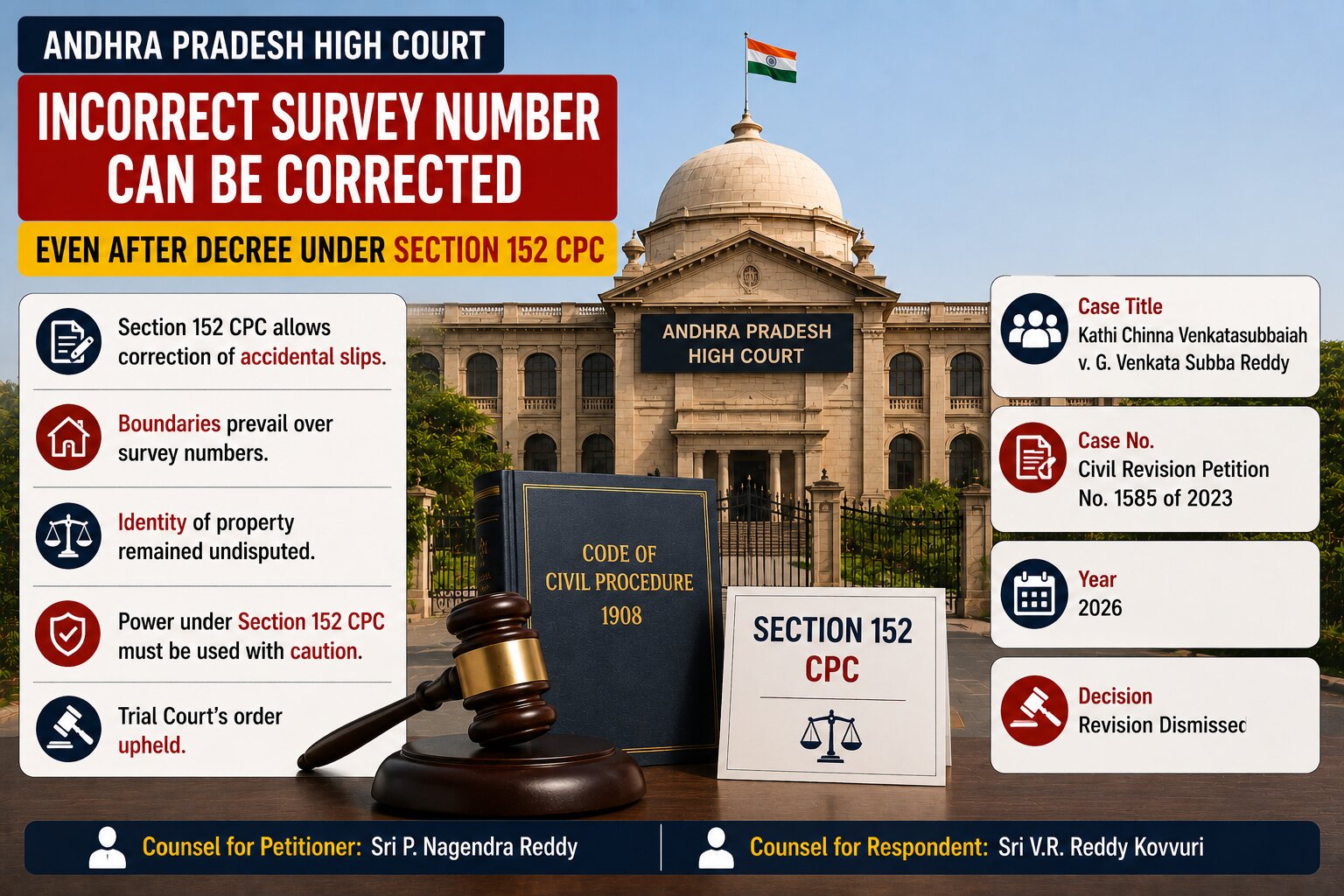
Judgement Details
Court
Andhra Pradesh High Court
Date of Decision
30 July 2026
Judges
Justice Subba Reddy Satti
Citation
Acts / Provisions
Facts of the Case
-
The dispute arose from a suit for specific performance based on an agreement of sale.
-
The suit was decreed in favour of the plaintiff in 2010.
-
During execution proceedings, it was discovered that the survey number mentioned in the agreement of sale, plaint, and decree was Survey No. 175/2, whereas the correct survey number was Survey No. 175/5.
-
The boundaries of the property, however, remained correctly described throughout the proceedings.
-
The decree-holder initially sought correction of the survey number during execution proceedings, but the application was dismissed.
-
Thereafter, the decree-holder filed an application under Section 152 CPC seeking correction of the accidental mistake in the plaint and decree.
-
The Trial Court allowed the application.
-
The defendant challenged the order before the Andhra Pradesh High Court through a Civil Revision Petition.
Issues
-
Whether an incorrect survey number in a plaint and decree can be corrected under Section 152 CPC after the decree has been passed?
-
Whether an incorrect survey number constitutes an accidental slip or omission within the meaning of Section 152 CPC?
-
Whether correction of the survey number was permissible when the identity and boundaries of the property remained undisputed?
-
Whether the Trial Court rightly exercised its jurisdiction under Section 152 CPC?
Judgement
-
The Andhra Pradesh High Court upheld the Trial Court's order permitting correction of the survey number under Section 152 CPC.
-
The Court held that Section 152 CPC empowers courts to correct accidental slips or omissions even after a decree has been passed.
-
It observed that courts have long recognised the power to correct mistakes occurring not only in decrees but also in pleadings and documents forming the basis of the suit.
-
The Court reiterated the settled principle that boundaries prevail over survey numbers and extent while identifying immovable property.
-
It found that there was no dispute regarding the identity of the property because the property boundaries remained unchanged throughout the litigation.
-
The Court noted that the incorrect survey number originated in the agreement of sale and continued in the plaint and decree due to an accidental error.
-
It held that the mistake came to light only during execution proceedings and did not alter the nature, extent, or identity of the property.
-
The Court cautioned that powers under Section 152 CPC should be exercised carefully and only where the mistake is genuinely accidental.
-
Finding no jurisdictional error in the Trial Court's order, the High Court dismissed the Civil Revision Petition.
Held
-
An incorrect survey number resulting from an accidental slip may be corrected under Section 152 CPC even after the decree has been passed.
-
Such correction is permissible where the identity of the property remains undisputed.
-
Boundaries ordinarily prevail over survey numbers and extent in identifying immovable property.
-
The Civil Revision Petition was dismissed.
Analysis
-
It distinguishes genuine accidental errors from substantive alterations that would affect the rights of the parties.
-
The Court reaffirmed the well-established principle that property boundaries are the primary means of identification, while survey numbers are secondary.
-
The decision promotes substantive justice by ensuring that technical mistakes do not frustrate execution of valid decrees.
-
The ruling also cautions subordinate courts against permitting corrections that alter the identity, nature, or extent of the property.
-
By allowing correction of the survey number, the Court ensured that procedural errors do not defeat substantive rights established by a decree.
-
The judgment provides valuable guidance for courts dealing with execution proceedings involving clerical mistakes in property descriptions.
-
The decision balances the need for finality of decrees with the necessity of correcting genuine accidental errors in the interest of justice.