
K. Ranganayakulu v. State of Telangana & Ors., 2026
The judgment clarifies that criminal liability under the Negotiable Instruments Act depends upon the actual responsibility entrusted to the individual rather than merely the designation held.
Judgement Details
Court
Supreme Court of India
Date of Decision
8 July 2026
Judges
Justice Prashant Kumar Mishra & Justice N.V. Anjaria
Citation
Acts / Provisions
Facts of the Case
-
The appellant was the Treasurer of a Non-Governmental Organisation (NGO) known as TIMES.
-
The NGO entered into a Memorandum of Understanding (MoU) with the respondent electricity distribution company.
-
Under the terms of the MoU, the appellant was specifically authorised to sign and issue cheques, make payments through RTGS/online transactions, and discharge the financial obligations of the NGO.
-
Pursuant to the arrangement, the appellant issued cheques on behalf of the NGO.
-
The cheques were dishonoured, leading to prosecution under Section 138 of the Negotiable Instruments Act, 1881.
-
The appellant contended that he was merely an authorised signatory and could not be held personally liable for the acts of the NGO.
-
He relied upon the Supreme Court decision in Shri Gurudatta Sugars Marketing Pvt. Ltd. v. Prithviraj Sayajirao Deshmukh to argue that designation as an authorised signatory alone does not attract criminal liability.
-
The matter ultimately reached the Supreme Court.
Issues
-
Whether an authorised signatory entrusted with signing cheques and making payments on behalf of a company or society can be treated as a "drawer" under Section 138 of the Negotiable Instruments Act, 1881?
-
Whether the appellant incurred personal liability under Sections 138 and 141 of the Negotiable Instruments Act despite acting on behalf of the NGO?
-
Whether the decision in Shri Gurudatta Sugars Marketing Pvt. Ltd. v. Prithviraj Sayajirao Deshmukh was applicable to the facts of the present case?
-
Whether the sentence imposed upon the appellant required modification?
Judgement
-
The Supreme Court upheld the appellant's conviction under the Negotiable Instruments Act.
-
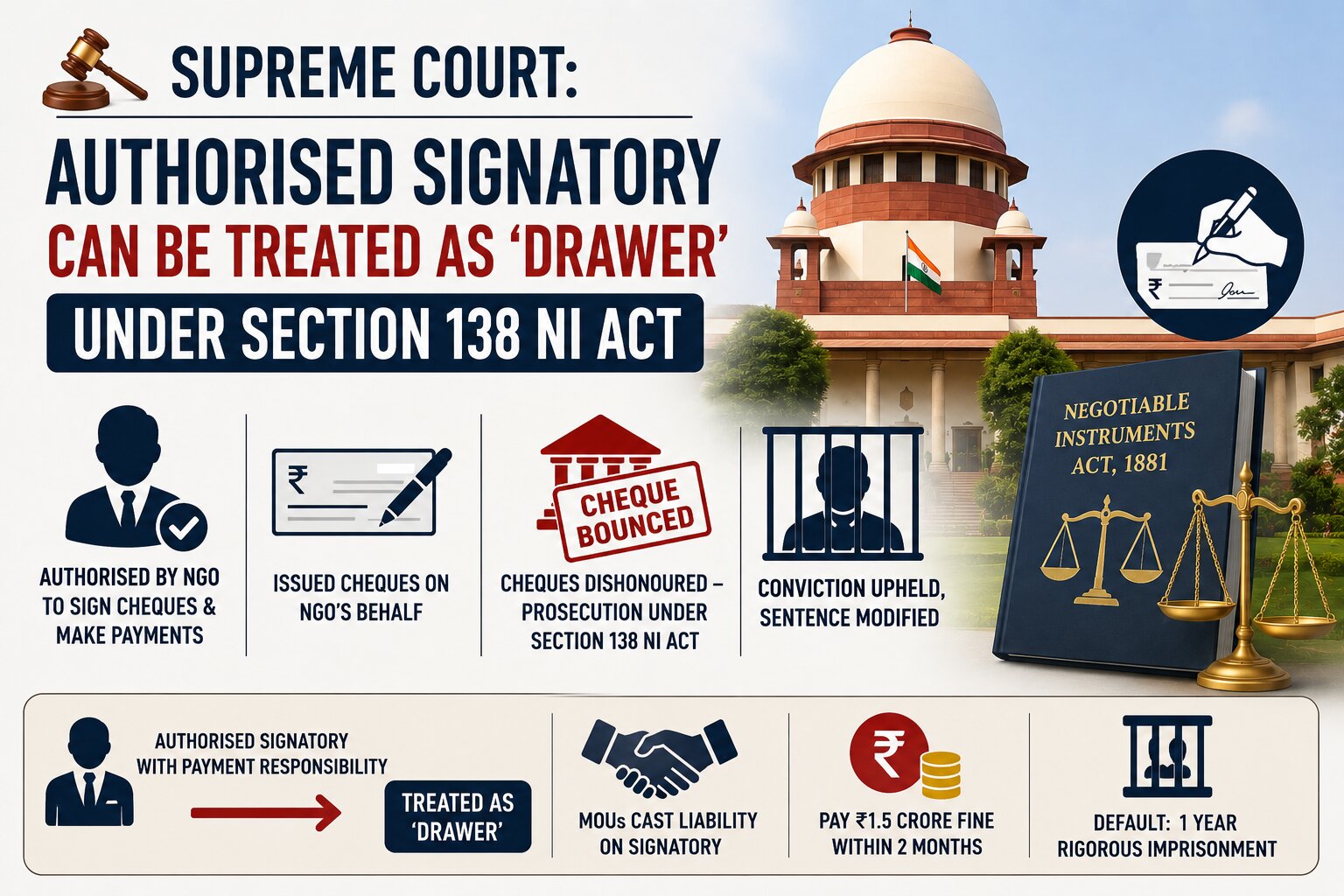
The Court held that where an organisation specifically authorises an individual to sign cheques, issue negotiable instruments, and make payments on its behalf, such person may be treated as the drawer of the cheque.
-
The Bench observed that the appellant was not merely a nominal office bearer but was the designated individual responsible for executing the financial obligations under the MoU.
-
The Court found that the MoU imposed responsibility for issuing cheques and making payments exclusively upon the appellant and not upon any other office bearer of the NGO.
-
It held that once the NGO projected the appellant as its authorised representative for financial transactions, he became responsible for the legal consequences arising from dishonour of the cheques.
-
The Court rejected the appellant's reliance upon Shri Gurudatta Sugars Marketing Pvt. Ltd., holding that the decision did not apply because the facts of the present case satisfied the requirements of Section 141 of the Negotiable Instruments Act.
-
The Bench clarified that an authorised signatory may, in appropriate circumstances, fall within the expression "drawer" for the purposes of liability under Section 138.
-
While affirming the conviction, the Court took note of the appellant's position as only the Treasurer of the NGO.
-
Considering the circumstances, the Court modified the sentence and directed the appellant to pay ₹1.5 crore to Southern Power Distribution Company of Telangana Limited (TSSPDCL) within two months.
-
It further directed that failure to deposit the amount within the stipulated period would result in one year of rigorous imprisonment.
-
The appeal was partly allowed only to the extent of modifying the sentence.
Held
-
An authorised signatory entrusted with signing cheques and making payments on behalf of an organisation may be treated as a drawer under Section 138 of the Negotiable Instruments Act.
-
Liability under Sections 138 and 141 depends upon the role and responsibility assigned to the individual.
-
The appellant's conviction was upheld.
-
The sentence was modified by substituting imprisonment with payment of ₹1.5 crore, subject to default imprisonme
Analysis
-
The Court distinguished between a person who merely signs a cheque mechanically and one who is specifically authorised to manage the financial affairs and payment obligations of an organisation.
-
By recognising the appellant as the drawer, the Court expanded the practical understanding of liability under Section 138 in situations where an authorised signatory effectively represents the organisation.
-
The ruling harmonises Sections 138 and 141 by emphasising that authorised signatories may incur direct liability when they satisfy the statutory requirements.
-
The judgment distinguishes earlier precedent by applying the principle that each case must be decided based on the factual allocation of responsibility within the organisation.
-
The Court also adopted a balanced sentencing approach by considering the appellant's status as Treasurer while ensuring that the complainant received substantial monetary compensation.
-
The decision strengthens accountability of persons entrusted with financial management in companies, societies, and NGOs.
-
The ruling will serve as an important precedent in cheque dishonour cases involving authorised signatories and office bearers of juristic entities.