
Jasir Bilal Wani @ Danish v. National Investigation Agency, 2026
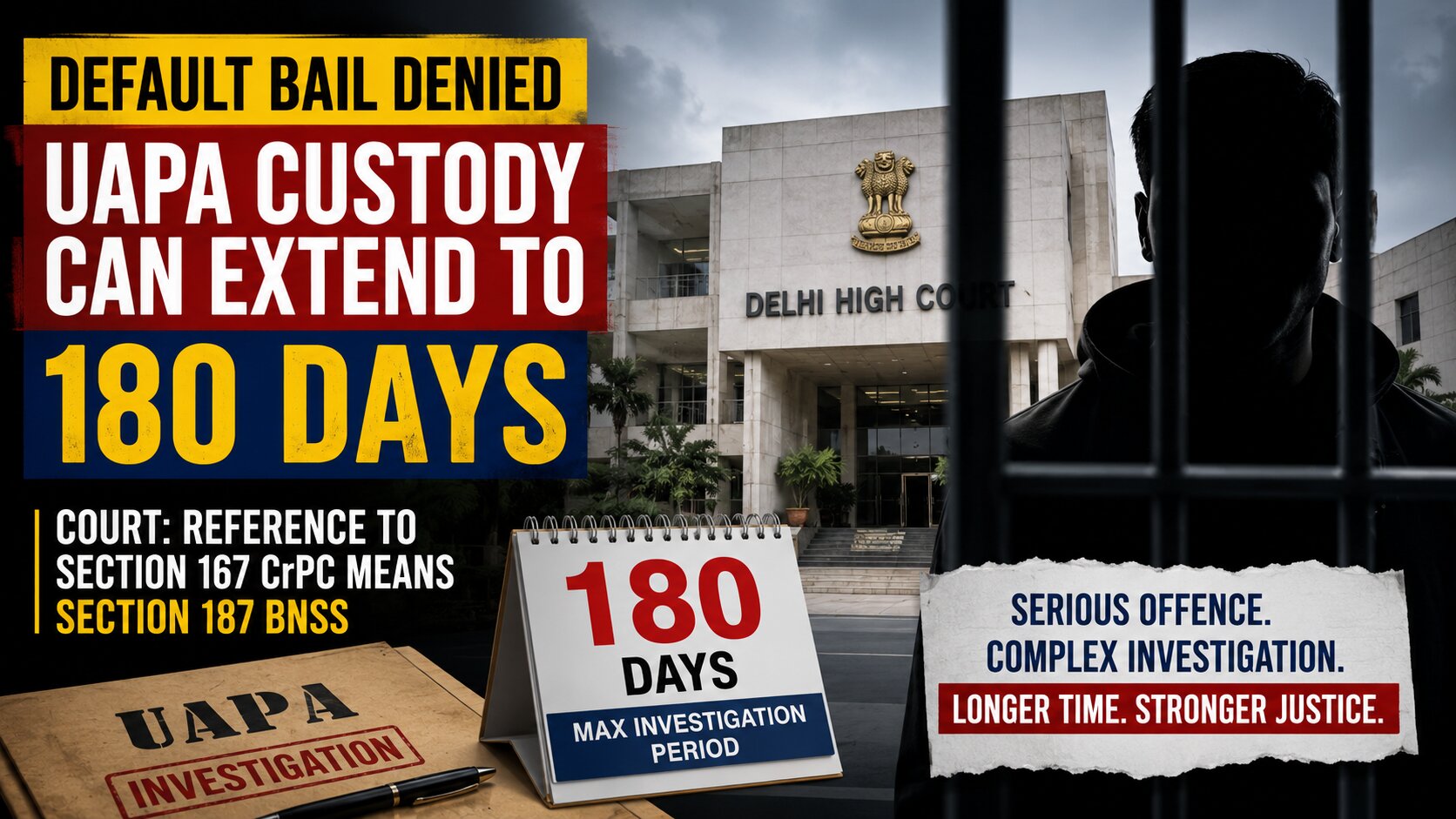
The Delhi High Court held that the reference to Section 167 CrPC in Section 43D(2) UAPA must, after the enactment of the BNSS, be read as a reference to Section 187 BNSS.
Judgement Details
Court
High Court of Delhi
Date of Decision
19 August 2026
Judges
Justice Prathiba M. Singh and Justice Vikas Mahajan
Citation
Acts / Provisions
Facts of the Case
-
The case arose from the car explosion near the Red Fort in Delhi on 10 November 2025, in which 15 people were killed.
-
The National Investigation Agency investigated the alleged terrorist conspiracy arising from the incident.
-
Jasir Bilal Wani @ Danish was one of the accused arrested in connection with the investigation.
-
The prosecution invoked provisions of the UAPA, making the special detention regime under Section 43D(2) applicable.
-
Under the first proviso to Section 43D(2) UAPA, the ordinary 90-day investigation period can, subject to statutory requirements and judicial satisfaction, be extended up to 180 days.
-
The appellant argued that after the BNSS came into force, Section 167 CrPC could no longer be treated as the operative procedural provision referred to by Section 43D(2) UAPA.
-
According to the appellant, Section 43D(2) UAPA specifically referred to Section 167 CrPC, and not Section 187 BNSS.
-
On this basis, it was argued that the appellant was entitled to default bail after 90 days because Section 43D(2) had not expressly been amended to substitute Section 187 BNSS for Section 167 CrPC.
-
The appellant therefore challenged the applicability of the extension of detention from 90 days to 180 days.
-
The central controversy before the Division Bench was whether the reference to Section 167 CrPC in Section 43D(2) UAPA should, after enactment of the BNSS, be read as a reference to Section 187 BNSS.
-
The Trial Court had granted the first extension of custody on 13 February 2026.
-
The first extension order was not challenged by the appellant at that time.
-
The appellant challenged the extension only after a subsequent extension was granted and his application for default bail was rejected.
-
The High Court also noted that the charge-sheet had subsequently been filed on 14 May 2026.
-
The Court therefore considered both the statutory interpretation question and the effect of the appellant's failure to challenge the first extension order.
Issues
-
Whether the reference to Section 167 CrPC contained in Section 43D(2) UAPA, after the enactment and commencement of the BNSS, should be construed as a reference to Section 187 BNSS?
-
Whether the first proviso to Section 43D(2) UAPA permitting extension of the investigation and detention period up to 180 days continues to apply after the repeal of the CrPC and enactment of the BNSS?
-
Whether an accused prosecuted under the UAPA after the commencement of the BNSS becomes entitled to default bail upon expiry of 90 days merely because Section 43D(2) UAPA continues expressly to refer to Section 167 CrPC?
-
Whether Section 8 of the General Clauses Act, 1897, read with the doctrine of legislation by reference, requires the reference to Section 167 CrPC in Section 43D(2) UAPA to be construed as a reference to Section 187 BNSS?
-
Whether the appellant, having failed to challenge the first order extending his detention when it was passed, could subsequently challenge that extension and claim default bail on the basis that the detention period could not have been extended beyond 90 days?
Judgement
-
The Delhi High Court dismissed the appeal and denied default bail to Jasir Bilal Wani @ Danish.
-
The Court held that the reference to Section 167 CrPC in Section 43D(2) UAPA must be construed as a reference to Section 187 BNSS after the enactment of the BNSS.
-
The Court applied the doctrine of legislation by reference to determine the effect of the change in criminal-procedure legislation.
-
The Bench observed that Section 167 CrPC had not been bodily incorporated into Section 43D(2) UAPA.
-
Instead, Section 43D(2) UAPA referred to Section 167 CrPC and modified certain periods contained in that provision for UAPA proceedings.
-
The Court therefore treated the reference as one capable of adapting to the corresponding provision under the new procedural statute.
-
The Court relied upon Section 8 of the General Clauses Act, 1897, which provides for references to a repealed and re-enacted provision to be construed as references to the corresponding new provision unless a contrary legislative intention appears.
-
The Court found no contrary intention in the BNSS indicating that Parliament intended to eliminate the special 180-day investigation period under the UAPA.
-
The Court emphasised that the legislative purpose behind Section 43D(2) UAPA was to provide a longer investigation period in cases involving serious terrorist offences.
-
The enactment of the BNSS could not, in the Court's view, be interpreted in a manner that defeated that legislative purpose.
-
Accordingly, the first proviso to Section 43D(2) UAPA remained applicable and the investigation period could be extended to 180 days.
-
The Court further noted that the first extension order had been passed on 13 February 2026, after the BNSS had already come into force.
-
The appellant did not challenge that order when it was passed.
-
The Court held that the first extension order had therefore attained finality and that the appellant's acquiescence prevented him from subsequently challenging it as the basis for a default-bail claim.
-
The Court also noted that the charge-sheet had already been filed on 14 May 2026.
-
In these circumstances, the Court concluded that the appellant could not successfully contend that he had acquired a right to default bail after 90 days.
-
The appeal was consequently dismissed.
Held
-
The Court held that the reference to Section 167 CrPC in Section 43D(2) UAPA is to be construed as a reference to Section 187 BNSS following the enactment of the BNSS.
-
The Court held that the first proviso to Section 43D(2) UAPA remains operative and permits extension of the investigation/detention period up to 180 days, subject to fulfilment of the statutory requirements.
-
The Court held that the enactment of the BNSS does not reduce the special UAPA detention period from 180 days to 90 days.
-
The Court held that Section 8 of the General Clauses Act, 1897, read with the doctrine of legislation by reference, enables the statutory reference to Section 167 CrPC to operate as a reference to Section 187 BNSS.
-
The Court held that the appellant could not subsequently challenge the first extension order after failing to challenge it when it was granted.
-
The Court held that the appellant was not entitled to default bail after 90 days.
-
The appeal seeking default bail was therefore dismissed.
Analysis
-
Central interpretative issue: The judgment addresses a significant transitional problem created by the replacement of the CrPC by the BNSS. Section 43D(2) UAPA continued to use the expression “Section 167” even though the corresponding general criminal-procedure provision had become Section 187 BNSS.
-
Legislation by reference: The Court's principal interpretative device was the doctrine of legislation by reference. The Court distinguished between a provision that incorporates another statute bodily and a provision that merely refers to another statutory provision.
-
Section 167 was not bodily incorporated: This distinction was crucial. The Court reasoned that Section 43D(2) UAPA did not reproduce the contents of Section 167 CrPC. Instead, it referred to Section 167 while modifying the relevant periods for UAPA proceedings. Consequently, the reference could adapt to the corresponding provision under the new procedural law.
-
Section 8 of the General Clauses Act: The Court relied on Section 8 as the mechanism ensuring continuity when legislation is repealed and replaced. The provision prevents statutory schemes from becoming unworkable merely because the numbering or structure of the corresponding provision has changed.
-
Preservation of legislative intention: The Court placed considerable emphasis on legislative purpose. Section 43D(2) UAPA creates a special detention regime because terrorism investigations can be unusually complex. The Court reasoned that merely because Parliament replaced the CrPC with the BNSS, it could not be presumed that Parliament intended to eliminate the 180-day investigation period applicable to UAPA cases.
-
90 days versus 180 days: The practical consequence is significant. For a UAPA accused falling within the statutory scheme of Section 43D(2), the commencement of the BNSS does not automatically create a right to default bail after 90 days. The permissible investigation period can still extend to 180 days when the statutory requirements for extension are fulfilled.
-
Transitional interpretation: The ruling illustrates how courts may interpret old statutory references following comprehensive legislative replacement. Rather than requiring every existing statute to be individually amended immediately, the Court used Section 8 of the General Clauses Act to preserve continuity.
-
Default bail: Default bail is ordinarily a statutory consequence of the prosecution's failure to complete investigation within the prescribed period. The judgment demonstrates that determining when that period expires requires identifying the correct statutory framework applicable to the accused.
-
Acquiescence and finality: The Court gave independent importance to the appellant's failure to challenge the first extension order. Since the order was passed after the BNSS had already commenced and was not challenged at that time, the Court considered it to have attained finality.
-
Effect of subsequent filing of charge-sheet: The Court also noted that the charge-sheet had already been filed on 14 May 2026. This further weakened the appellant's attempt to obtain default bail based upon the alleged expiry of the 90-day period.
-
Significance for UAPA prosecutions: The ruling is particularly important for accused persons facing UAPA charges because it confirms that the special 180-day investigation framework under Section 43D(2) remains effective despite the transition from CrPC to BNSS.
-
Legislative purpose versus strict textualism: The judgment demonstrates a purposive approach. A strictly textual interpretation might focus on the fact that Section 43D(2) expressly names Section 167 CrPC. The Court instead examined the statutory scheme, Section 8 of the General Clauses Act and the legislative purpose to preserve continuity.
-
Important limitation: The judgment does not mean that every UAPA accused can automatically be detained for 180 days. The statutory requirements for obtaining an extension must still be satisfied, and the extension must be granted through the prescribed judicial process.