
Himanshu Chordia v. State of Rajasthan & Anr., 2026
The Court distinguished between a prima facie assessment at the interim stage and a final adjudication after trial.
Judgement Details
Court
Supreme Court of India
Date of Decision
30 July 2026
Judges
Justice Sanjay Karol & Justice Vipul M. Pancholi
Citation
Acts / Provisions
Facts of the Case
-
The appellant and the respondent-wife were married in 2014.
-
Due to matrimonial disputes, the wife left the matrimonial home in 2020 along with the child and certain valuables.
-
The wife filed an application under Section 125 CrPC seeking maintenance.
-
The husband filed an application under Section 125(4) CrPC, alleging that the wife was living in an adulterous relationship and was therefore not entitled to maintenance.
-
The husband produced photographs and other material to prima facie support the allegation of adultery.
-
The Trial Court dismissed the husband's application, observing that the issue of adultery could only be decided after recording evidence during the final hearing.
-
The High Court affirmed the Trial Court's view.
-
Aggrieved by the rejection of his application, the husband approached the Supreme Court.
Issues
-
Whether an application under Section 125(4) CrPC alleging adultery can be decided at the interim stage of maintenance proceedings?
-
Whether interim maintenance can be denied if the husband prima facie establishes that the wife is living in adultery?
-
Whether the Trial Court and High Court erred in postponing consideration of the husband's application until final adjudication?
-
Whether the matter required remand to the Trial Court for consideration on merits?
Judgement
-
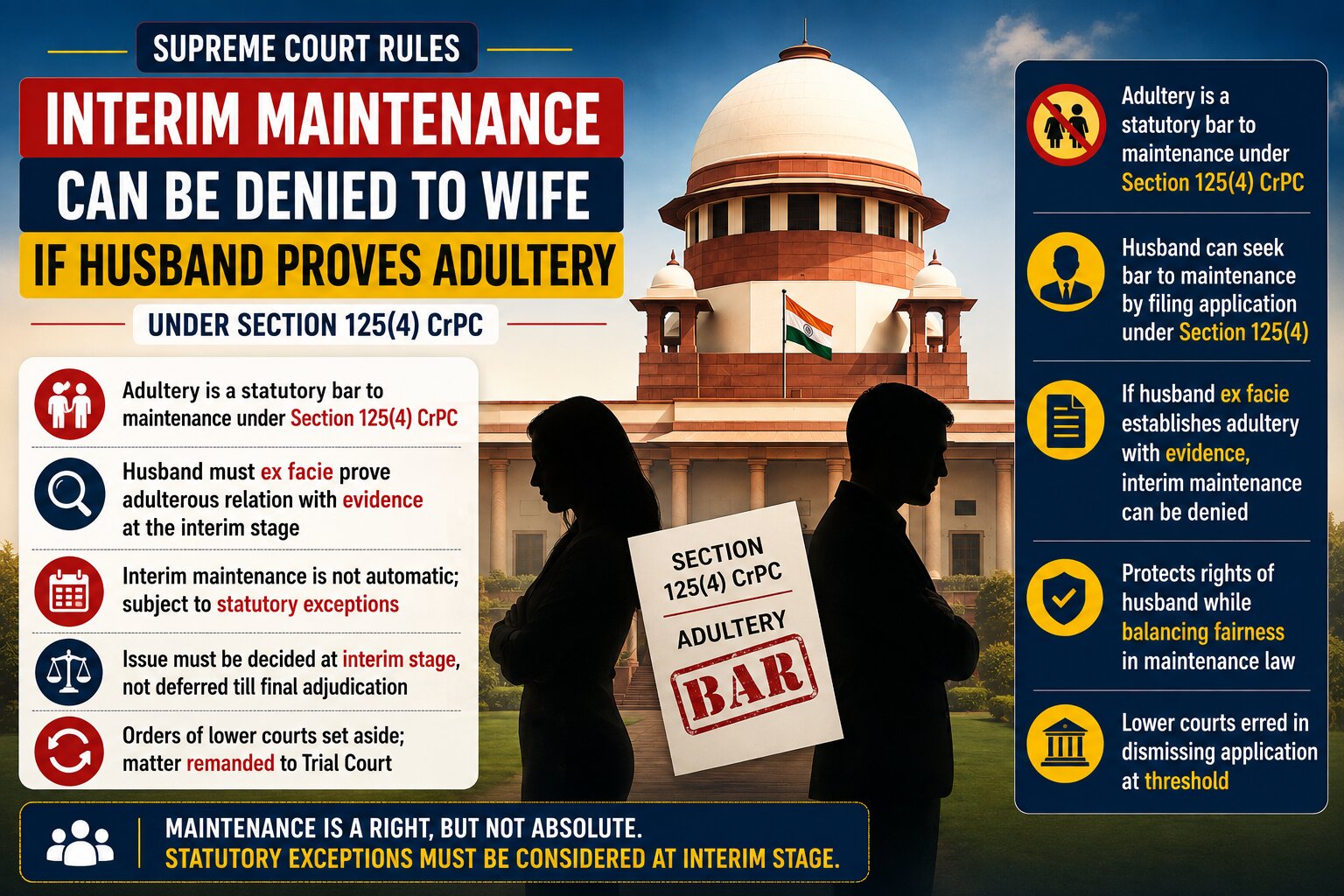
The Supreme Court held that an application under Section 125(4) CrPC cannot be rejected merely because the main maintenance petition is pending.
-
The Court observed that if the husband is able to prima facie (ex facie) establish that the wife is living in adultery, interim maintenance may be denied.
-
It held that postponing consideration of the issue until the final stage would defeat the purpose of Section 125(4) CrPC.
-
The Bench found that the Trial Court and the High Court committed an error in dismissing the husband's application at the threshold.
-
The Court clarified that only a prima facie satisfaction is required at the interim stage and not a final determination of guilt.
-
The Supreme Court set aside the orders of the Trial Court and the High Court.
-
The matter was remanded to the Trial Court for fresh consideration of the husband's application on its merits.
Held
-
Interim maintenance may be denied where the husband prima facie establishes that the wife is living in adultery.
-
Courts must consider an application under Section 125(4) CrPC at the interim stage instead of deferring it to final adjudication.
-
The orders of the Trial Court and High Court were set aside.
-
The matter was remanded to the Trial Court for a fresh decision on merits.
Analysis
-
The judgment clarifies the scope of Section 125(4) CrPC in proceedings relating to interim maintenance.
-
It held that statutory disqualifications under Section 125(4) should not become ineffective merely because the proceedings are at an interim stage.
-
The decision reinforces that interim maintenance is not automatic and remains subject to statutory exceptions.
-
The ruling ensures that courts examine credible evidence produced by either party before granting interim relief.
-
At the same time, the Court did not hold that every allegation of adultery is sufficient; it emphasized that the husband must first establish the allegation prima facie through evidence.
-
The judgment provides guidance to subordinate courts on balancing speedy maintenance proceedings with statutory safeguards.
-
The ruling is likely to influence future maintenance proceedings where allegations under Section 125(4) CrPC are raised.