
Harjindra Singh & Ors. v. State of Uttar Pradesh, 2026
The judgment reiterates the settled principle that oral evidence is substantive evidence, while documentary or electronic evidence may serve a corroborative role depending on the facts of the case.
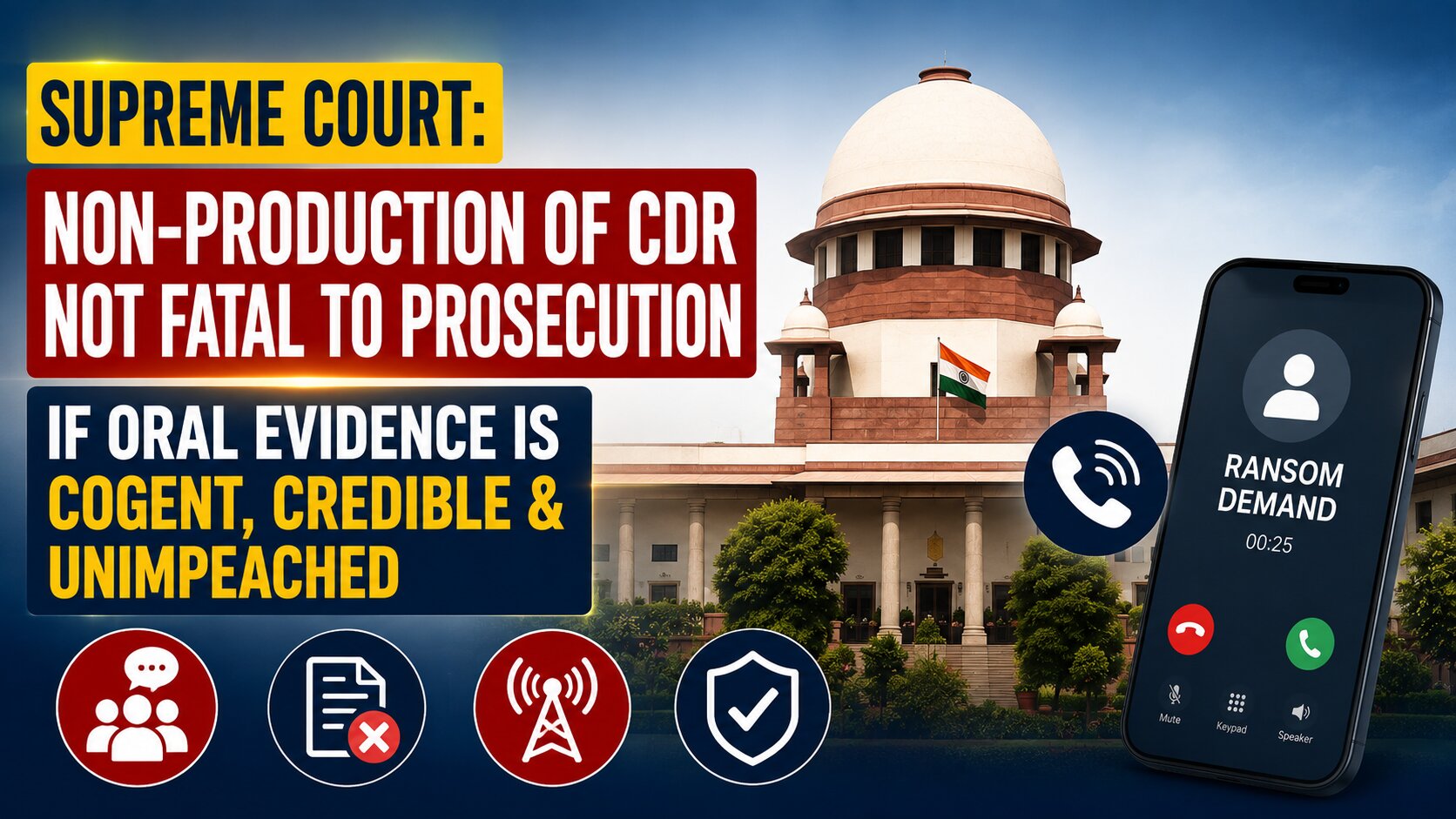
Judgement Details
Court
Supreme Court of India
Date of Decision
3 July 2026
Judges
Justice Pankaj Mithal & Justice Prasanna B. Varale
Citation
Acts / Provisions
Facts of the Case
-
FIR was registered in 2003 alleging kidnapping for ransom.
-
The prosecution alleged that the accused kidnapped the victim and demanded ₹5 lakh as ransom through a landline telephone call.
-
During the trial, the prosecution relied upon the testimonies of the victim's father, family members, and the Investigating Officer to establish the ransom demand.
-
The accused argued that the prosecution failed to produce the Call Detail Record (CDR) relating to the alleged ransom call.
-
It was further contended that the absence of a Section 65B certificate rendered the prosecution's case regarding the ransom demand unreliable.
-
The Trial Court convicted the accused.
-
The conviction was affirmed by the High Court.
-
Aggrieved by the judgment, the accused approached the Supreme Court.
Issues
-
Whether non-production of the Call Detail Record (CDR) is fatal to the prosecution's case in proving a ransom demand?
-
Whether absence of a certificate under Section 65B of the Indian Evidence Act necessarily renders the prosecution's case unsustainable?
-
Whether credible and consistent oral evidence can establish the demand for ransom in the absence of electronic records?
-
Whether the conviction of the accused required interference?
Judgement
-
The Supreme Court dismissed the appeal and upheld the conviction of the accused.
-
The Court held that non-production of the Call Detail Record (CDR) is not by itself fatal where other reliable evidence establishes the prosecution case.
-
It observed that the absence of a Section 65B certificate does not automatically defeat the prosecution when the electronic record itself is not the sole basis for proving the fact in issue.
-
The Bench found that the testimonies of PW-1 (father of the victim), PW-2, PW-3, and the Investigating Officer (PW-7) consistently established that a ransom demand of ₹5 lakh had been made through a landline telephone.
-
The Court noted that the Investigating Officer had recorded statements regarding the ransom call immediately during the investigation, lending further credibility to the prosecution case.
-
It observed that considering the incident occurred in 2003, non-availability of CDRs from a rural telephone exchange could not be treated as fatal to the prosecution.
-
The Court emphasized that the criminal justice system cannot be defeated merely because electronic records are unavailable when credible oral evidence remains trustworthy and unimpeached.
-
Finding no infirmity in the concurrent findings of the Trial Court and the High Court, the Supreme Court affirmed the conviction.
Held
-
Non-production of a Call Detail Record (CDR) does not automatically invalidate the prosecution's case.
-
Credible, consistent, and unimpeached oral evidence can independently establish a ransom demand.
-
Absence of a Section 65B certificate is not decisive where the prosecution relies primarily on substantive oral evidence.
-
The conviction of the accused was upheld and the appeal was dismissed.
Analysis
-
The Court recognized the practical limitations relating to the availability of telecommunications records from the year 2003, particularly in rural areas.
-
The ruling clarifies that the absence of electronic evidence cannot automatically result in acquittal when other reliable evidence proves the prosecution's case beyond reasonable doubt.
-
The decision emphasizes a balanced approach to appreciation of evidence by evaluating the totality of the material placed before the Court.
-
The judgment prevents undue technicalities from frustrating the administration of criminal justice where trustworthy witness testimony is available.
-
The ruling also demonstrates that compliance with Section 65B becomes material only when the prosecution seeks to rely upon electronic records themselves as substantive evidence.
-
The decision strengthens the principle that courts must assess the overall evidentiary value rather than insist upon every possible form of corroboration.
-
The judgment will guide future criminal trials involving older offences where technological records may no longer be available.