
Hari Narayan Tiwari v. State Information Commission, U.P. & Ors., 2026
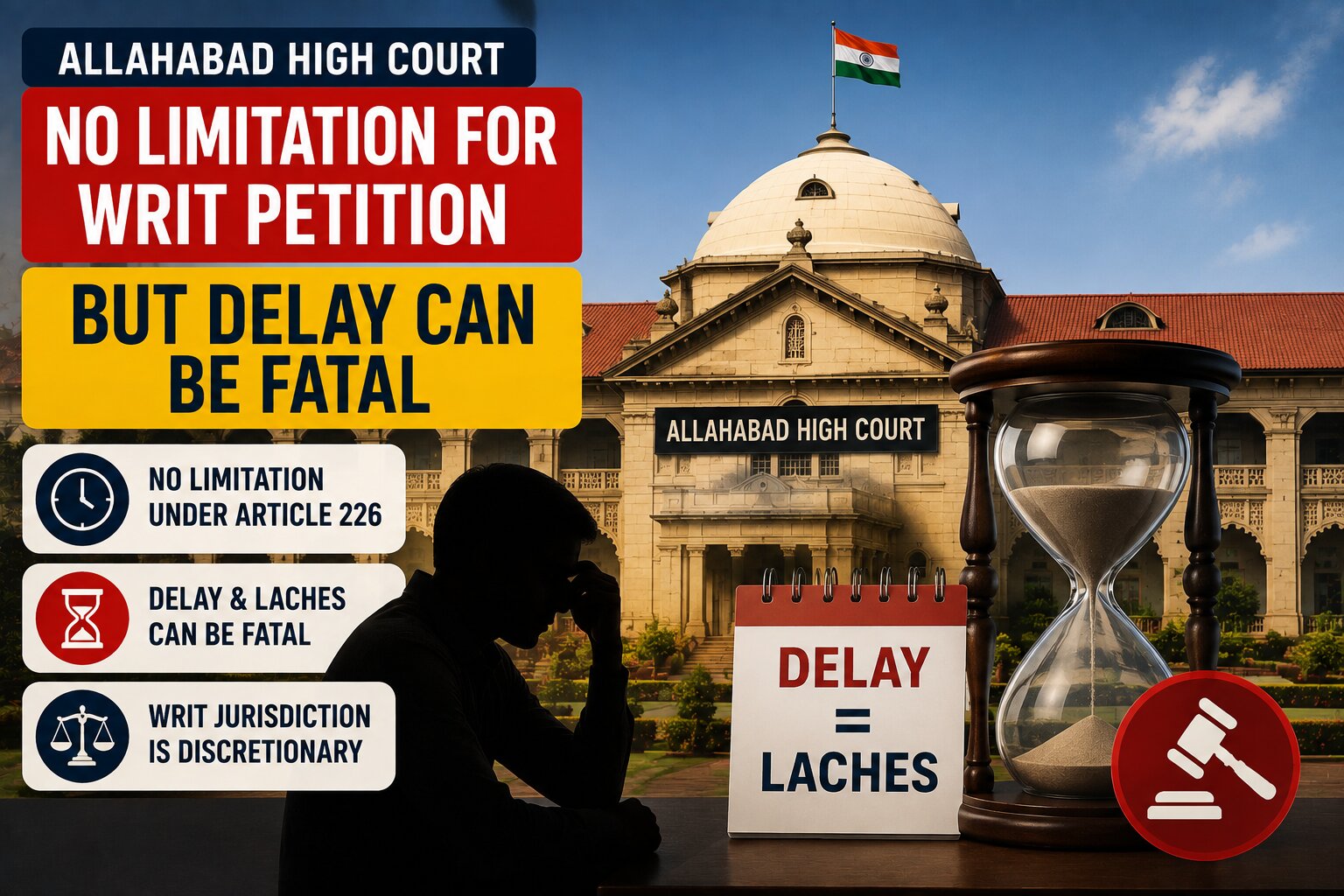
The judgment reaffirms that Article 226 confers discretionary and equitable jurisdiction, not an absolute right to relief.
Judgement Details
Court
Allahabad High Court
Date of Decision
30 July 2026
Judges
Justice Shekhar B. Saraf & Justice Abdhesh Kumar Chaudhary
Citation
Acts / Provisions
Facts of the Case
-
The petitioner challenged an order passed by the Uttar Pradesh State Information Commission in 2023.
-
Instead of approaching the High Court promptly, the petitioner filed the writ petition after nearly three years.
-
No explanation or justification for the delay was provided in the writ petition.
-
The respondents opposed the petition on the ground of unexplained delay and laches.
-
The matter came before the Allahabad High Court to determine whether such a delayed writ petition deserved to be entertained under Article 226.
Issues
-
Whether a writ petition under Article 226 of the Constitution can be dismissed solely on the ground of unexplained delay and laches despite the absence of a statutory limitation period?
-
Whether the petitioner had approached the High Court within a reasonable time for invoking its extraordinary writ jurisdiction?
-
Whether the absence of any explanation for the delay justified refusal of discretionary relief under Article 226?
Judgement
-
The Allahabad High Court held that although Article 226 does not prescribe any limitation period, a writ petition must nevertheless be filed within a reasonable time.
-
The Court reiterated that the jurisdiction under Article 226 is extraordinary, equitable, and discretionary.
-
It observed that unexplained delay and laches constitute sufficient grounds for refusing relief even in the absence of any statutory limitation.
-
The Bench relied upon the Supreme Court decisions in Tridip Kumar Dingal and Karnataka Power Corporation Ltd. v. K. Thangappan.
-
The Court found that the petitioner approached the High Court nearly three years after the impugned order.
-
It noted that no explanation whatsoever had been offered for such delay.
-
The Court held that constitutional courts cannot ignore unreasonable delay merely because no limitation period has been prescribed.
-
Accordingly, the writ petition was dismissed on the ground of delay and laches.
Held
-
There is no statutory limitation period for filing a writ petition under Article 226.
-
However, the writ jurisdiction must be invoked within a reasonable time.
-
Unexplained delay and laches are valid grounds for declining discretionary relief.
-
The writ petition was dismissed as not maintainable due to inordinate and unexplained delay.
Analysis
-
It emphasizes that the absence of a statutory limitation period does not permit litigants to approach constitutional courts at their convenience.
-
The Court reinforced the well-established doctrine of delay and laches, which protects judicial discipline and prevents stale claims.
-
The ruling highlights that courts must examine both the length of delay and the adequacy of the explanation offered.
-
The decision balances protection of constitutional rights with the need for finality and certainty in legal proceedings.
-
By relying on Supreme Court precedents, the Court maintained consistency in the exercise of writ jurisdiction.
-
The judgment serves as a reminder that equitable relief under Article 226 is available only to litigants who approach the Court with reasonable diligence.
-
The ruling will guide future litigants to promptly challenge administrative or quasi-judicial orders instead of delaying legal proceedings without sufficient cause.