
Bhag Singh (Dead) through Mahant Kashmir Singh v. Basant Kaur (Dead) through LRs & Ors., 2026
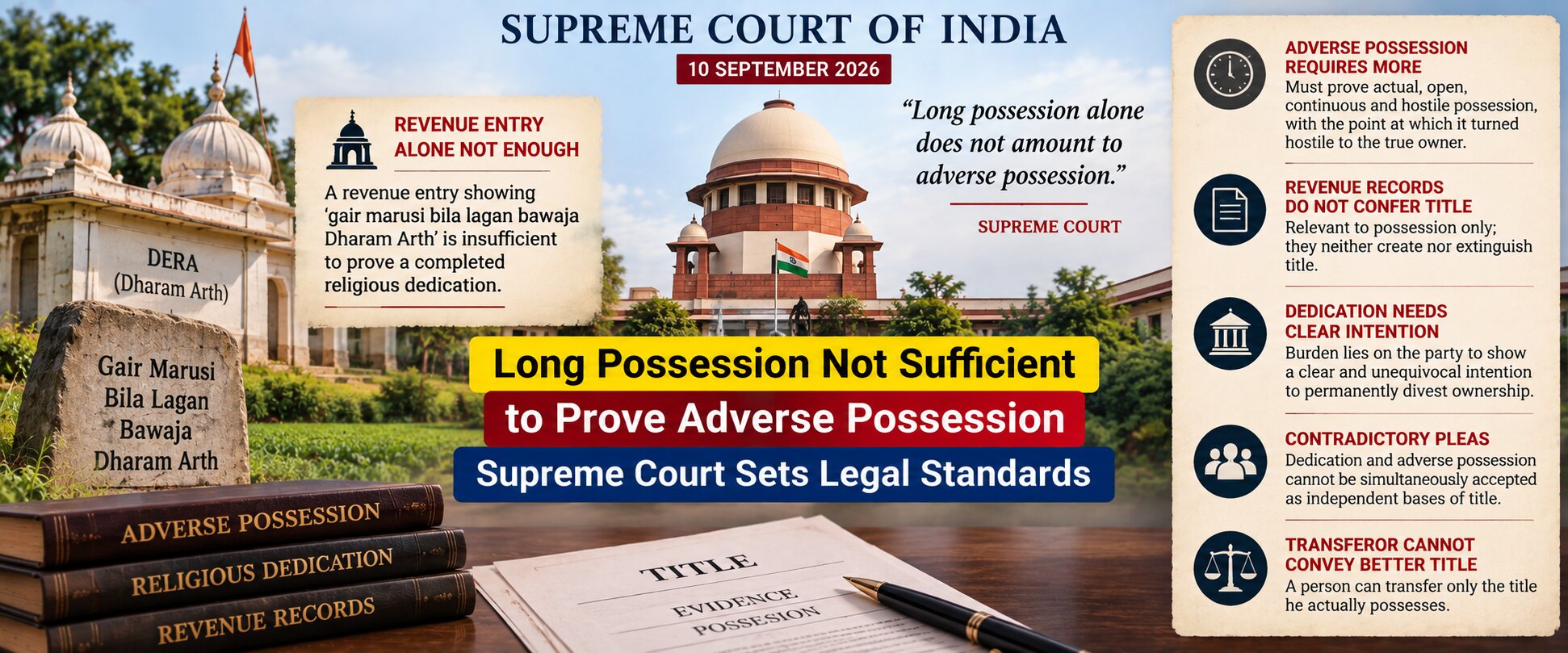
Long possession alone does not constitute adverse possession.
Judgement Details
Court
Supreme Court of India
Date of Decision
10 September 2026
Judges
Justice Prashant Kumar Mishra and Justice Shree Chandrashekhar
Citation
Acts / Provisions
Facts of the Case
-
The dispute concerned agricultural land and originated from a civil suit instituted in 1981.
-
The respondents relied upon a registered sale deed of 1965, which contained a recital regarding delivery of possession.
-
The appellants, associated with a Dera, claimed that the property had already been dedicated to the Dera for Dharam Arth purposes.
-
Revenue records had described possession as “gair marusi bila lagan bawaja Dharam Arth”, indicating possession without payment of rent for religious purposes.
-
The appellants contended that successive Mahants of the Dera had remained in possession of the property over a long period.
-
They argued that the revenue entries demonstrated a completed religious dedication of the property.
-
In the alternative, the appellants claimed that the Dera had acquired title through adverse possession because of its continuous possession for several decades.
-
The trial court accepted the appellants' case and held that the property had been dedicated to the Dera.
-
The trial court also accepted that possession had continued through successive Mahants.
-
The first appellate court affirmed the trial court's findings and held that the dedication could be completed through delivery of possession, without necessarily requiring a separate registered instrument.
-
The Punjab and Haryana High Court subsequently reversed these findings.
-
The High Court held that the revenue entries did not conclusively establish either a completed dedication or adverse possession.
-
It also noted the absence of sufficient evidence showing continuous possession through successive Mahants and the absence of evidence establishing hostile assertion of title.
-
The Dera thereafter approached the Supreme Court challenging the High Court's judgment.
-
The appellants argued that revenue records dating back to 1945–46 consistently recorded possession for Dharam Arth purposes and therefore supported their claim of dedication.
-
They alternatively argued that more than four decades of continuous possession had resulted in acquisition of title through adverse possession.
-
The respondents argued that revenue entries could not be treated as conclusive proof of ownership or dedication.
-
They further contended that the plea of adverse possession was legally defective because there were no specific pleadings identifying when and how possession became hostile to the true owners.
-
The respondents also challenged the appellants' reliance on the 1965 sale deed, pointing out that the vendors had allegedly owned only a half share and could not transfer a larger interest than they themselves possessed.
Issues
-
Whether long and uninterrupted possession of immovable property, by itself, is sufficient to establish title by adverse possession without pleading and proving when such possession became hostile to the true owner?
-
Whether a revenue entry describing possession as “gair marusi bila lagan bawaja Dharam Arth” is by itself sufficient to establish a completed religious dedication of the property?
-
Whether the burden of proving a religious dedication lies upon the party asserting that the owner intended to permanently divest himself of ownership?
-
Whether a party can simultaneously rely upon dedication and adverse possession as independent sources of title when the two doctrines proceed on fundamentally different legal premises?
-
Whether revenue records such as Jamabandis and Khasra Girdawaris can create or extinguish title to immovable property?
-
Whether a sale deed can legally transfer a larger interest in property than the interest actually possessed by the transferors?
-
Whether the High Court was justified in interfering with the concurrent findings of the trial court and the first appellate court where those findings were based on a misapplication of the legal principles governing dedication and adverse possession?
Judgement
-
The Supreme Court affirmed the findings of the Punjab and Haryana High Court and decreed the suit in favour of the respondents/plaintiffs.
-
The Court held that mere long possession is not sufficient to establish adverse possession.
-
A person claiming adverse possession must establish possession that is actual, open, continuous and hostile to the true owner's title.
-
The Court emphasised that the claimant must identify the point at which possession allegedly became hostile.
-
The absence of pleadings identifying the commencement of hostile possession was considered a fundamental defect rather than a mere technical deficiency.
-
The Court held that without establishing when hostile possession began, the statutory limitation period for adverse possession cannot properly be determined.
-
The Court relied upon T. Anjanappa v. Somalingappa while explaining the essential requirements of adverse possession.
-
The Court also held that revenue records do not themselves confer title.
-
Jamabandis and Khasra Girdawaris may constitute relevant evidence regarding the nature and continuity of possession, but they are not conclusive proof of ownership.
-
The Court held that the entry referring to Dharam Arth could not, by itself, establish that the property had been irrevocably dedicated to the Dera.
-
A party claiming dedication must demonstrate a clear and unequivocal intention of the owner to permanently divest ownership.
-
The Court observed that while a formal deed is not invariably essential for every dedication, the underlying intention to dedicate must nevertheless be established through convincing evidence.
-
The Court also found an internal inconsistency in the appellants' case because they simultaneously relied upon dedication and adverse possession.
-
If the property had already vested in the Dera through completed dedication, there would ordinarily be no basis for subsequently claiming that the Dera acquired the same title through adverse possession.
-
The Court accepted the principle that a transferor cannot convey a better title than what he himself possesses.
-
However, the fact that the vendors under the 1965 sale deed may have possessed only a limited share did not automatically establish title in favour of the appellants.
-
The Supreme Court held that concurrent findings of fact are not immune from interference where they are affected by misapplication of law or failure to apply essential legal requirements.
-
The High Court was therefore justified in examining whether the legal ingredients of dedication and adverse possession had actually been established.
-
The Supreme Court ultimately affirmed the High Court's conclusion and decreed the suit in favour of the respondents.
Held
-
A claim of adverse possession requires proof of actual, open, continuous and hostile possession.
-
The claimant must plead and establish the date or point from which possession became hostile to the true owner.
-
Without establishing the commencement of hostile possession, the statutory limitation period for adverse possession cannot properly begin to run.
-
A revenue entry describing possession as “gair marusi bila lagan bawaja Dharam Arth” is not, by itself, conclusive proof of a completed religious dedication.
-
The party asserting dedication bears the burden of proving a clear and unequivocal intention to permanently divest ownership.
-
Revenue records are evidence of possession, not conclusive evidence of title.
-
Dedication and adverse possession are based on different and potentially contradictory legal premises and cannot casually be treated as simultaneous independent sources of title.
-
A person cannot transfer a better title than the title actually possessed by the transferor.
-
Concurrent findings may be interfered with where they suffer from misapplication of law or failure to consider essential legal ingredients.
-
The Supreme Court therefore affirmed the High Court's findings and decreed the suit in favour of the respondents/plaintiffs.
Analysis
-
The judgment reinforces the fundamental distinction between long possession and adverse possession.
-
The Court made it clear that the mere passage of time does not automatically convert possession into ownership.
-
Hostility towards the true owner's title is a central requirement of adverse possession.
-
The claimant must demonstrate an open and unequivocal assertion inconsistent with the rights of the true owner.
-
The requirement of pleading the commencement of hostile possession is important because the limitation period depends upon identifying when adverse possession actually began.
-
The ruling prevents parties from using vague claims of possession extending over several decades as a substitute for proving the statutory ingredients of adverse possession.
-
The Court's treatment of revenue records reinforces the established principle that fiscal records are not documents of title.
-
Revenue entries may support a claim concerning possession, cultivation or continuity of occupation, but ownership must be established through substantive evidence of title.
-
The judgment also provides important guidance on religious dedication of property.
-
An entry showing that property was being used or possessed for religious purposes does not necessarily prove that the original owner intended to permanently surrender ownership.
-
The Court therefore required evidence demonstrating the owner's clear and unequivocal intention to dedicate the property.
-
A particularly important aspect of the judgment is the Court's identification of the contradiction between dedication and adverse possession.
-
Dedication proceeds on the basis that the owner has voluntarily transferred or vested the property for a religious purpose, whereas adverse possession assumes that the title initially belonged to someone else and was subsequently extinguished through hostile possession.
-
Accepting both pleas simultaneously without reconciling their different legal foundations can therefore result in an internally inconsistent claim of title.
-
The judgment also clarifies the scope of High Court interference with concurrent findings of fact.
-
Concurrent findings are entitled to respect, but they do not become immune from judicial scrutiny when the lower courts have misapplied the law or ignored essential legal ingredients.
-
The decision is significant for property-law disputes because it emphasises that claims of title, dedication and adverse possession must each satisfy their own distinct legal requirements.
-
Overall, the ruling cautions that longevity of possession is not equivalent to ownership, and that legal title cannot be established merely through the continued appearance of a person's name or possession in revenue records.