
Pila Pahan @ Peela Pahan and Others v. State of Jharkhand and Another, 2026
Prisoners Must Be Freed Promptly, No Delay After Bail.
Judgement Details
Court
Supreme Court of India
Date of Decision
30 May 2026
Judges
Chief Justice of India Surya Kant and Justice Joymalya Bagchi
Citation
Acts / Provisions
Facts of the Case
-
he Supreme Court was considering broader issues relating to delays in delivery of judgments and implementation of judicial orders.
-
The Court noticed that prisoners often continue to remain in jail even after obtaining orders granting bail, suspension of sentence, or acquittal.
-
Such delays were frequently caused by administrative inefficiencies in communication between courts, prison authorities, and trial courts.
-
The Court also examined delays in pronouncement of reserved judgments by High Courts.
-
To address these concerns, the Court framed comprehensive guidelines for High Courts and subordinate courts.
-
The Court simultaneously fixed a three-month timeline for delivery of reserved judgments by High Courts.
-
The judgment focused on ensuring that judicial orders affecting personal liberty are implemented without unnecessary delay.
Issues
-
Whether delays in pronouncement and communication of bail orders result in unjustified deprivation of personal liberty?
-
Whether courts should establish a mechanism to ensure immediate communication of orders granting bail, suspension of sentence, or acquittal?
-
Whether prisoners should continue to remain in custody after judicial orders directing their release have been passed?
-
Whether timelines should be prescribed for pronouncement and uploading of bail orders?
-
Whether accountability mechanisms are required to ensure compliance with release orders?
Judgement
-
The Supreme Court emphasized that personal liberty cannot be defeated by administrative delays after a court has ordered release.
-
The Court directed that once a bail application is heard, the order should preferably be pronounced and uploaded on the same day.
-
If the matter is reserved, the Court stated that the order should ordinarily be pronounced on the next day and uploaded immediately.
-
The Court directed that orders granting regular bail, suspending a sentence, or acquitting a convict must be communicated to jail authorities and the trial court on the very day they are pronounced.
-
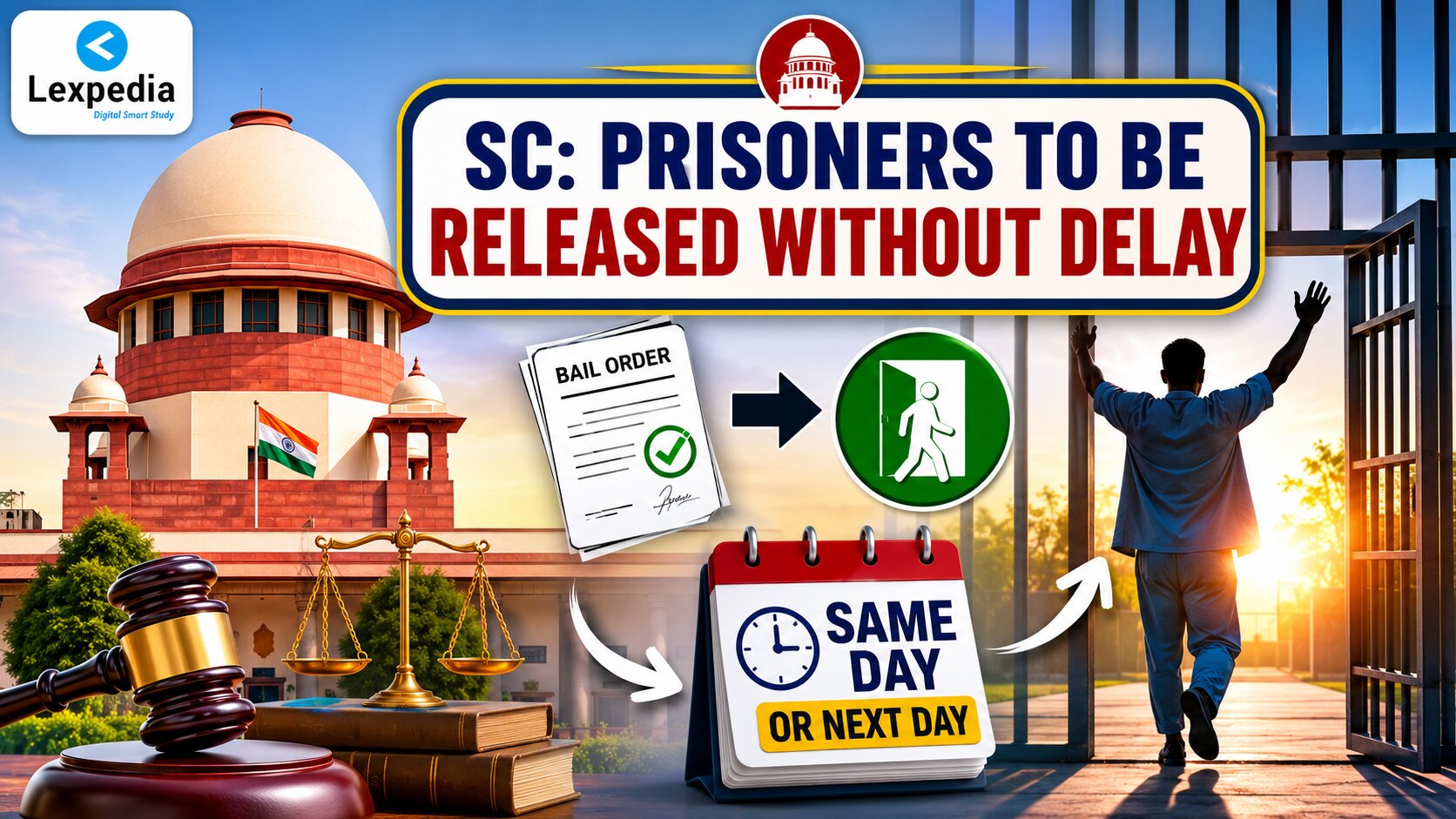
The Court further directed that prisoners should be released on the same day or at the latest on the next day.
-
The only exceptions recognized were situations where:
-
The person is required in another criminal case.
-
Bail conditions have not yet been fulfilled.
-
Other legal or procedural requirements remain pending.
-
-
The Court introduced an accountability mechanism requiring the Trial Court to report compliance to the Bench that passed the order.
-
The Bench also directed High Courts to ensure that reserved judgments are delivered within three months.
Held
-
Bail, sentence suspension, and acquittal orders should be pronounced and uploaded without delay.
-
Such orders must be communicated to jail authorities and trial courts on the date of pronouncement.
-
Undertrials and convicts should ordinarily be released on the same day or the next day.
-
Trial courts must report compliance regarding implementation of release orders.
-
High Courts should deliver reserved judgments within three months.
Analysis
-
The judgment is a major step toward protecting the fundamental right to personal liberty under Article 21.
-
The Court recognized that liberty is not protected merely by passing an order; effective implementation of that order is equally important.
-
The ruling addresses a long-standing problem where prisoners remain incarcerated despite obtaining favorable judicial orders.
-
By prescribing timelines for pronouncement, uploading, and communication of orders, the Court reduced procedural bottlenecks.
-
The accountability mechanism requiring compliance reports ensures that release orders do not remain merely on paper.
-
The decision reflects a rights-based approach that prioritizes the liberty of individuals over bureaucratic formalities.
-
The judgment also strengthens judicial efficiency by fixing a three-month deadline for reserved judgments.
-
The directions are likely to significantly reduce unnecessary incarceration and improve coordination between courts and prison authorities.
-
The ruling will have a nationwide impact on criminal justice administration and prison management.