
Pazhanathal (Dead) Through LRs. & Ors. v. Alamathal (Dead) Through LRs., 2026
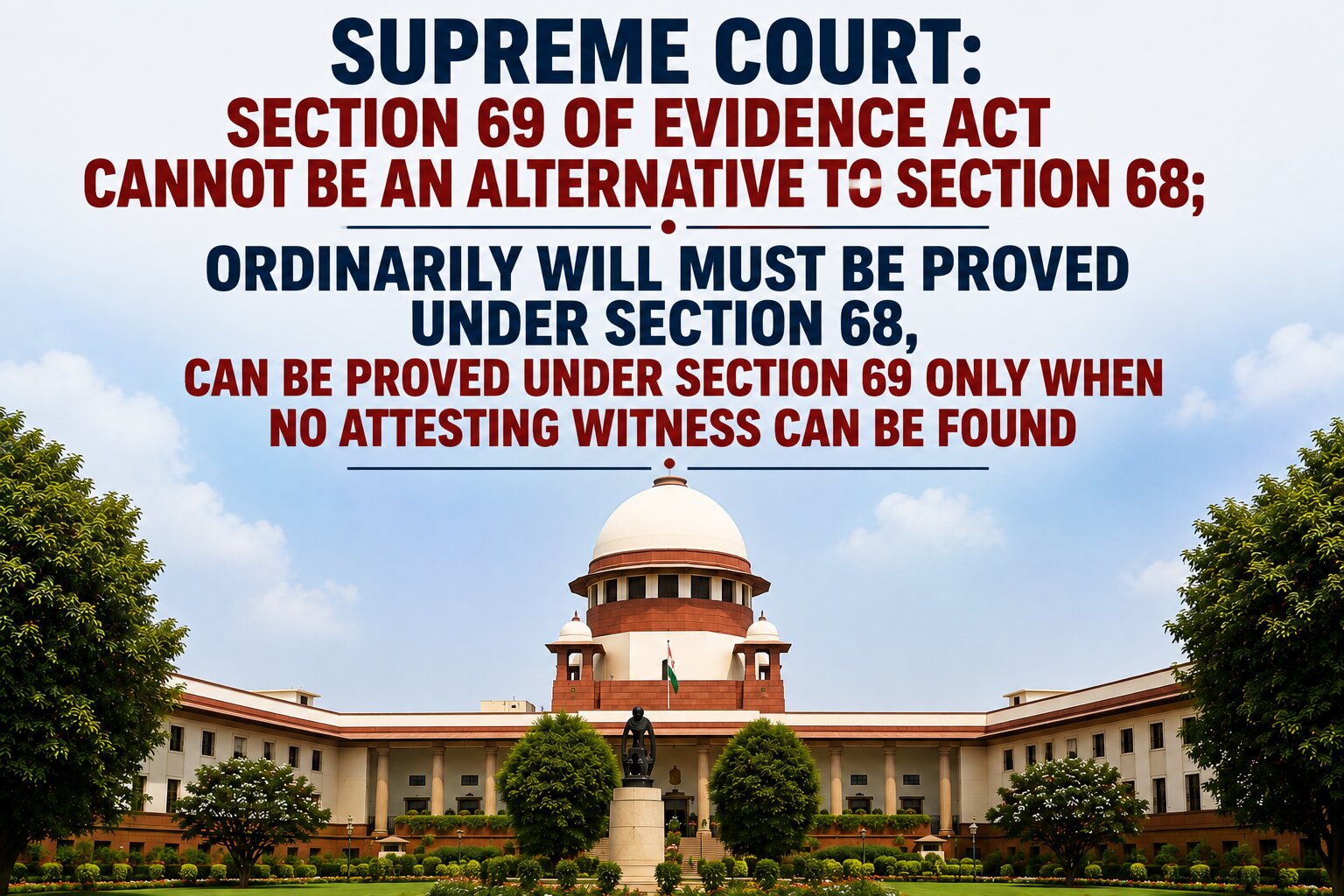
Section 69 applies only when proof through the attesting witnesses under Section 68 has become impossible.
Judgement Details
Court
Supreme Court of India
Date of Decision
18 August 2026
Judges
Justice Sanjay Karol and Justice Nongmeikapam Kotiswar Singh
Citation
Acts / Provisions
Facts of the Case
-
The dispute concerned a registered Will allegedly executed in 1976 by Arukkaniammal.
-
The Will purportedly bequeathed agricultural properties to the branch of Alamathal.
-
Two persons, Marappa Gounder and Avanashi Gounder, were named as attesting witnesses.
-
Neither attesting witness was examined before the Court.
-
The death of Marappa Gounder was established through evidence given by his son.
-
However, the respondents failed to satisfactorily establish that Avanashi Gounder was dead or otherwise unavailable.
-
The Trial Court held that the Will could not be proved under Section 69 because the statutory requirements had not been fulfilled.
-
The Madras High Court reversed this finding and accepted the Will by directly applying Section 69.
-
The matter reached the Supreme Court.
Issues
-
Whether Section 69 of the Indian Evidence Act can be invoked as an alternative to the ordinary mode of proving a Will prescribed under Section 68?
-
Whether a Will can be proved under Section 69 without first establishing that neither of the attesting witnesses can be found?
-
Whether the respondents satisfactorily established the death or unavailability of both attesting witnesses so as to invoke Section 69?
-
Whether the Madras High Court was justified in bypassing the requirement of Section 68 and directly applying Section 69?
Judgement
-
The Supreme Court allowed the appeal.
-
The Court set aside the Madras High Court's judgment.
-
The Trial Court's decision was restored.
-
The Court held that Section 68 is the ordinary statutory method for proving a Will.
-
Section 69 is an exceptional mechanism, not an alternative that a propounder may freely choose.
-
Before Section 69 can be invoked, the propounder must establish that the attesting witnesses cannot be found.
-
The death of Marappa Gounder was proved.
-
However, the death or unavailability of Avanashi Gounder was not satisfactorily established.
-
Therefore, the statutory gateway from Section 68 to Section 69 had not been crossed.
-
The respondents could not bypass Section 68 and directly rely upon Section 69.
Held
-
Section 69 cannot be freely chosen instead of Section 68.
-
The propounder must first establish the death or unavailability of the attesting witnesses.
-
Since the respondents failed to establish the unavailability of one attesting witness, the Will could not be proved under Section 69.
-
The High Court therefore erred in law by directly applying Section 69.
-
The Trial Court's judgment was restored.
Analysis
-
Section 68 is the rule: A Will ordinarily has to be proved through the statutory mechanism prescribed under Section 68.
-
Section 69 is an exception: It becomes available only when the normal method of proving the Will has become impossible.
-
No free choice: A propounder cannot select Section 69 simply because it provides an easier evidentiary route.
-
Burden of establishing unavailability: Before invoking Section 69, the party relying on the Will must establish that the required attesting witnesses cannot be produced.
-
Incomplete proof is insufficient: Establishing the death of only one attesting witness was insufficient where the other witness's status remained uncertain.
-
Importance of statutory sequence: The judgment reinforces that procedural and evidentiary provisions must be applied in the sequence contemplated by the statute.
-
Significance for Will disputes: The ruling provides important guidance on the evidentiary burden involved when attesting witnesses to an old Will are unavailable.