NLSIU Students Oppose CJI Surya Kant, BCI Chief at Convocation Amid NALSAR Row; CJI Says He Never Accepted NALSAR Invite
Lexpedia News · 18 August 2026 · 23 min read
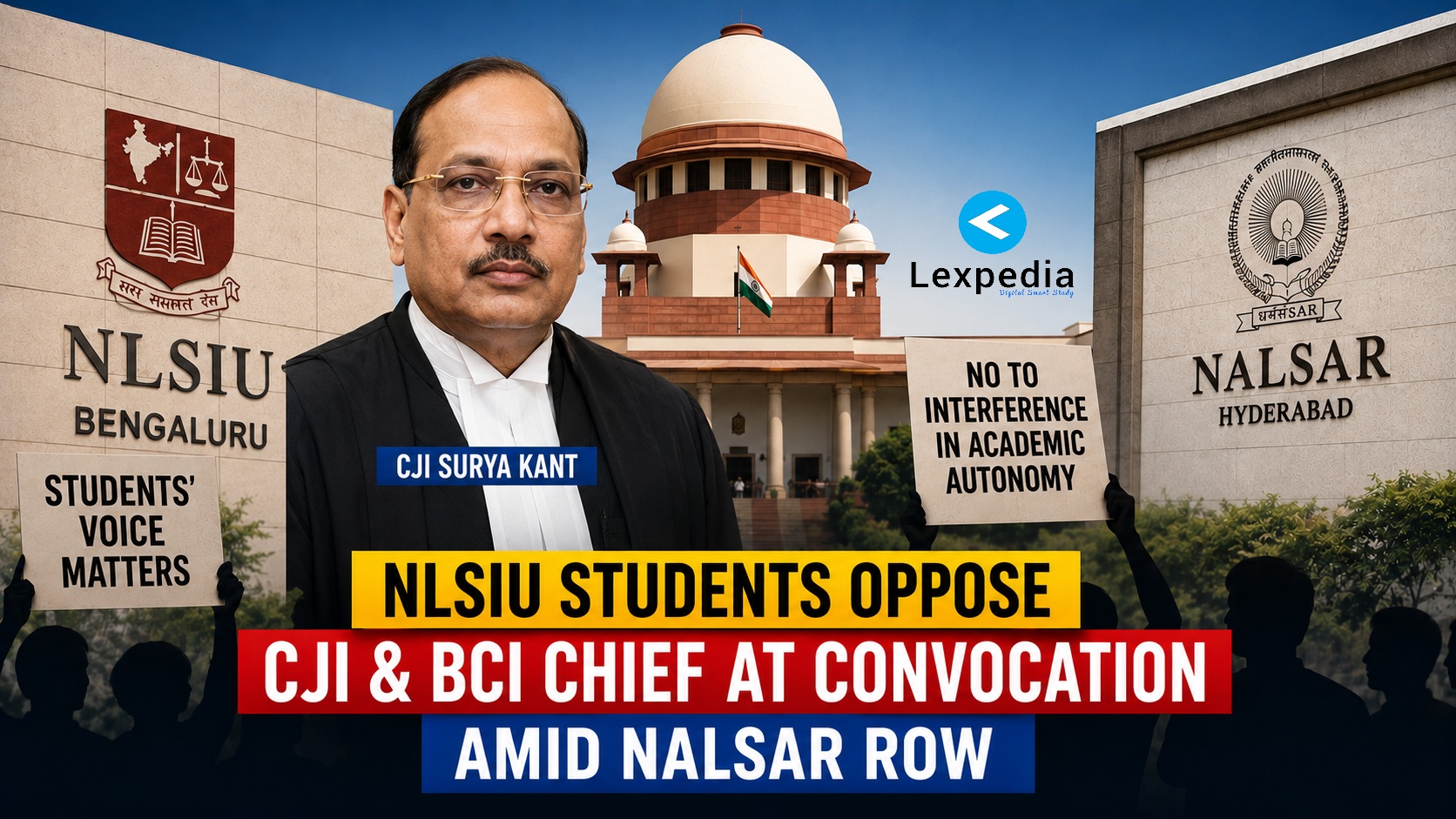
A controversy over the proposed participation of Chief Justice of India Justice Surya Kant in the convocation ceremonies of leading national law universities has now spread from NALSAR University of Law, Hyderabad, to the National Law School of India University (NLSIU), Bengaluru.
Students and alumni of NLSIU have publicly opposed the proposed presence of CJI Surya Kant and Bar Council of India (BCI) Chairman Manan Kumar Mishra at the university's upcoming convocation. The development comes days after a major controversy at NALSAR, where students objected to the reported proposal to have the CJI as chief guest and the BCI subsequently issued, and then withdrew, an extraordinary direction concerning enrolment of NALSAR's 2026 graduating batch.
The controversy has since taken another turn. On August 17, 2026, CJI Surya Kant clarified that he had never accepted the invitation from NALSAR to be chief guest at its convocation and that, consequently, there was no question of his attending the ceremony.
The distinction is important: while the students' objections at NALSAR were directed against the proposed invitation, the CJI has now stated that he had never consented to the invitation in the first place.
NLSIU Students and Alumni Oppose CJI, BCI Chairman's Presence
In Bengaluru, an open statement dated August 15 was signed by 165 students of NLSIU's graduating Class of 2026, 409 current students and 128 alumni.
The signatories expressed solidarity with students and faculty members of NALSAR and criticised the BCI's handling of the controversy. They also objected to the proposed attendance of BCI Chairman Manan Kumar Mishra at the NLSIU convocation.
The statement further called for reconsideration of the choice of CJI Surya Kant as chief guest and said that inviting high constitutional and regulatory office-holders to confer degrees on students in the aftermath of the NALSAR controversy was, in their view, offensive and humiliating.
The students' objection therefore extends beyond the question of the chief guest. It raises broader concerns about student dissent, freedom of expression, institutional autonomy and the relationship between legal education institutions and professional regulators.
Why Did the NALSAR Controversy Begin?
The controversy at NALSAR began after a section of students from the 2026 graduating batch objected to the proposed invitation of CJI Surya Kant as chief guest for the university's convocation.
The students' objections were linked to the CJI's conduct and observations during proceedings concerning protests by students in Delhi. Reports said the students were particularly critical of remarks made during a Supreme Court hearing concerning alleged police action against student protesters.
According to reports, around 450 NALSAR students had earlier written to the university authorities seeking reconsideration of the proposed chief guest. The students said that certain observations attributed to the CJI were inconsistent, in their view, with the constitutional and legal values they were being trained to uphold.
The protest was reportedly not framed as a demand to disrupt the convocation. Reports indicated that students wished to register their objection while maintaining the dignity of the ceremony.
BCI's Extraordinary Enrolment Direction
The controversy escalated sharply on August 13, 2026, when the Bar Council of India issued a communication directing State Bar Councils not to enrol graduates of NALSAR's 2026 batch until further notice.
The action was linked to the campaign by students opposing the proposed participation of the CJI in the convocation.
The BCI also sought information regarding persons allegedly instrumental in initiating, organising or mobilising the campaign. The development triggered widespread criticism because enrolment as an advocate is a crucial professional step for law graduates, and the direction potentially affected an entire graduating batch rather than only individuals alleged to have participated in the campaign.
The direction was subsequently withdrawn amid mounting criticism.
The withdrawal is an important qualification to the controversy: the BCI's initial direction is no longer operative, and it should not be reported as an existing prohibition on NALSAR's 2026 graduates.
Supreme Court Steps In
The controversy subsequently reached the Supreme Court.
On August 14, a three-judge Bench headed by CJI Surya Kant and comprising Justice Joymalya Bagchi and Justice V. Mohana questioned the BCI's intervention.
The CJI reportedly described the BCI's intervention as “absolutely uncalled for”, observing that the issue involved a dialogue between the students and him and questioning the BCI's authority to intervene in the matter.
The Bench also emphasised the students' right to protest. CJI Surya Kant reportedly observed that even assuming students were wrong in their views, they had a right to express those views and protest.
The Court's intervention came even though the BCI had already withdrawn its controversial enrolment direction.
CJI Says Students Have a Right to Protest
The CJI's comments have become a central feature of the controversy.
During the Supreme Court proceedings, Justice Surya Kant reportedly said that the BCI had no business interfering in the dispute between him and the students.
He also referred to his own student days and said that students have the right to participate in student activities and protest.
The comments are significant because the original controversy arose precisely from students exercising their right to express disagreement with the proposed choice of chief guest.
The Supreme Court's response has consequently shifted the focus of the controversy from the propriety of the students' protest to the limits of regulatory intervention against student dissent.
BCI Chairman Later Expresses Regret
Against the backdrop of the controversy, BCI Chairman Manan Kumar Mishra subsequently issued an apology/regret to law students.
In a letter issued around Independence Day, Mishra said that if anything connected with the controversy, including his words or letters, had hurt the feelings of law students, he sincerely regretted and apologised for it.
He also said that expressing regret should not be treated as a matter of prestige or ego and acknowledged that the concerns of students matter.
However, NLSIU students and alumni have continued to demand a more explicit institutional response from the BCI, including an unconditional apology to the NALSAR student and faculty community.
NLSIU Extends Solidarity to NALSAR
The NLSIU statement has effectively brought the controversy into another leading national law school.
The signatories said they stood in “unconditional solidarity” with NALSAR's students and faculty.
They criticised the BCI's action against NALSAR's graduating batch and questioned whether the BCI Chairman could unilaterally take such a decision affecting the professional future of an entire graduating class.
The students also objected to the attendance of BCI Chairman Manan Kumar Mishra at NLSIU's convocation without what they considered adequate accountability for the events at NALSAR.
CJI's Position on the NALSAR Invitation Is Now Clear
One of the most significant developments as of August 18 is the clarification from CJI Surya Kant himself.
Earlier reports had described the CJI as the proposed or expected chief guest at NALSAR's convocation. However, on August 17, the CJI clarified that he had never accepted the invitation.
He therefore stated that there was no question of his attending the NALSAR convocation.
This clarification should be kept distinct from the earlier student protest.
The students were objecting to the reported proposal/invitation of the CJI as chief guest. The CJI's later statement indicates that no final acceptance by him had taken place.
Accordingly, it would be inaccurate to state at present that NALSAR students succeeded in forcing the CJI to withdraw from an accepted invitation. The available reporting instead establishes that the students opposed the proposed invitation, the controversy escalated following the BCI's intervention, and the CJI subsequently stated that he had never accepted the invitation.
NLSIU's Situation Is Different
The NLSIU episode should also not be treated as identical to the NALSAR controversy.
At NALSAR, the initial dispute concerned the proposed selection of CJI Surya Kant as chief guest, followed by the BCI's intervention concerning the 2026 graduates.
At NLSIU, students and alumni have now objected to the proposed presence of both the CJI and BCI Chairman Manan Kumar Mishra at the university's convocation, primarily in solidarity with NALSAR and in response to the BCI's handling of the earlier controversy.
The NLSIU statement therefore represents a new development, rather than merely a continuation of the original NALSAR protest.
Questions Over Institutional Autonomy and Free Speech
The controversy has triggered a wider debate within India's legal education community.
At its core are questions about whether students at law universities should be free to express disagreement with judicial or regulatory authorities, particularly when the disagreement concerns a proposed chief guest at their own convocation.
The episode has also raised questions concerning the respective institutional roles of:
- National law universities, which conduct academic programmes and convocations;
- the Bar Council of India, which regulates the legal profession and legal education under the Advocates Act framework;
- and the Supreme Court, whose Chief Justice is simultaneously the country's highest judicial authority and, in this controversy, the individual whose proposed invitation triggered the student objections.
The BCI's initial decision to affect the enrolment of an entire graduating batch intensified these questions because enrolment determines whether law graduates can enter legal practice.
The subsequent withdrawal of that direction and the Supreme Court's criticism have ensured that the episode remains under close scrutiny.
No Confirmation That NLSIU Has Withdrawn the Invitation
At present, the students' statement should not be confused with an official decision by NLSIU to withdraw or change its convocation invitations.
The publicly reported development is that students and alumni have opposed the attendance of the CJI and BCI Chairman and have demanded reconsideration.
Unless the university itself officially announces a change in its guest list, it would be premature to state that the invitations have been withdrawn.
This distinction is particularly important in view of the rapidly changing developments surrounding the controversy.
A Broader Debate Across Law Universities
The NALSAR-NLSIU controversy follows an earlier incident involving the Tata Institute of Social Sciences (TISS), where its August 2, 2026 convocation was postponed at short notice. The CJI had been scheduled to attend as chief guest, while concerns over possible protests and security arrangements were reported around the event. TISS officially cited “unforeseen circumstances” for the postponement and did not publicly identify the CJI controversy as the reason at that stage.
More recently, reports indicate that TISS has subsequently named a different chief guest and rescheduled its convocation for August 22. This development has added another layer to the wider debate concerning invitations to the CJI amid the ongoing student controversy.
However, the reasons officially stated by institutions should be distinguished from reported or attributed explanations. Possible protest concerns should not be presented as the official reason unless the institution itself confirms them.
What Happens Next?
The immediate focus is now on how NALSAR and NLSIU respond to the students' objections and whether their respective convocation arrangements are altered.
For NALSAR, the position has already changed substantially because the CJI has clarified that he never accepted the invitation.
For NLSIU, the students' open statement places pressure on the university to address the objections concerning both the CJI and the BCI Chairman. Whether the university changes its guest arrangements remains to be officially determined.
The controversy has also placed the Bar Council of India under renewed scrutiny following its withdrawn enrolment direction and subsequent apology, while the Supreme Court's observations have reinforced the significance of students' right to express dissent.
The episode has consequently evolved from a dispute over a convocation chief guest into a larger debate concerning free speech, student protest, institutional autonomy, regulatory authority and the relationship between India's legal education institutions and the legal profession.
Key Developments at a Glance
NALSAR: Students objected to the proposed invitation of CJI Surya Kant as chief guest.
BCI: Initially directed State Bar Councils not to enrol NALSAR's 2026 graduates; the direction was subsequently withdrawn.
Supreme Court: A Bench headed by CJI Surya Kant criticised the BCI's intervention and emphasised students' right to protest.
BCI Chairman: Manan Kumar Mishra later expressed regret and apologised if his words or communications had hurt students.
NLSIU: 165 graduating students, 409 current students and 128 alumni signed a statement opposing the proposed attendance of CJI Surya Kant and BCI Chairman Manan Kumar Mishra and expressing solidarity with NALSAR.
CJI's latest position: On August 17, CJI Surya Kant said he never accepted NALSAR's invitation, meaning there was no question of his attending the NALSAR convocation.
Legal and Editorial Note
The controversy remains fluid. Accordingly, references to CJI Surya Kant being the “chief guest” at NALSAR should presently be qualified as referring to a proposed/reported invitation, not an officially accepted engagement.
Similarly, the BCI's earlier direction against enrolment of the 2026 NALSAR graduates has been withdrawn and should not be described as a continuing prohibition.
For NLSIU, student opposition is established through the joint statement, but any change to the university's official convocation guest list should be reported as final only after official confirmation from NLSIU.
NALSAR विवाद के बीच NLSIU छात्रों ने CJI सूर्यकांत और BCI चेयरमैन के दीक्षांत समारोह में आने का किया विरोध; CJI बोले—NALSAR का निमंत्रण कभी स्वीकार ही नहीं किया
देश के प्रमुख राष्ट्रीय विधि विश्वविद्यालयों के दीक्षांत समारोहों में भारत के मुख्य न्यायाधीश जस्टिस सूर्यकांत की प्रस्तावित भागीदारी को लेकर शुरू हुआ विवाद अब NALSAR University of Law, Hyderabad से National Law School of India University (NLSIU), Bengaluru तक पहुंच गया है।
NLSIU के छात्रों और पूर्व छात्रों ने विश्वविद्यालय के आगामी दीक्षांत समारोह में CJI सूर्यकांत और Bar Council of India (BCI) के चेयरमैन मनन कुमार मिश्रा की प्रस्तावित उपस्थिति का सार्वजनिक रूप से विरोध किया है। यह घटनाक्रम NALSAR में पैदा हुए उस विवाद के कुछ दिनों बाद सामने आया है, जिसमें छात्रों ने दीक्षांत समारोह के लिए CJI को मुख्य अतिथि बनाए जाने के प्रस्ताव पर आपत्ति जताई थी और इसके बाद BCI ने NALSAR के 2026 बैच के स्नातकों के नामांकन को लेकर एक असाधारण निर्देश जारी किया था, जिसे बाद में वापस ले लिया गया।
विवाद ने इसके बाद एक और महत्वपूर्ण मोड़ लिया। 17 अगस्त 2026 को CJI सूर्यकांत ने स्पष्ट किया कि उन्होंने NALSAR की ओर से मुख्य अतिथि बनने का निमंत्रण कभी स्वीकार नहीं किया था और इसलिए उनके वहां किसी कार्यक्रम में शामिल होने का सवाल ही नहीं उठता।
यह अंतर महत्वपूर्ण है। NALSAR के छात्रों की आपत्ति प्रस्तावित निमंत्रण को लेकर थी, जबकि CJI ने अब स्पष्ट किया है कि उन्होंने उस निमंत्रण को स्वीकार ही नहीं किया था।
NLSIU छात्रों और पूर्व छात्रों ने CJI तथा BCI चेयरमैन का विरोध किया
बेंगलुरु में 15 अगस्त की तारीख वाले एक खुले बयान पर NLSIU के 2026 बैच के 165 छात्रों, 409 वर्तमान छात्रों और 128 पूर्व छात्रों ने हस्ताक्षर किए।
हस्ताक्षरकर्ताओं ने NALSAR के छात्रों और शिक्षकों के साथ एकजुटता व्यक्त की और विवाद से निपटने के BCI के तरीके की आलोचना की। उन्होंने NLSIU के दीक्षांत समारोह में BCI चेयरमैन मनन कुमार मिश्रा की प्रस्तावित उपस्थिति पर भी आपत्ति जताई।
बयान में CJI सूर्यकांत को मुख्य अतिथि बनाए जाने के निर्णय पर पुनर्विचार की मांग की गई और कहा गया कि NALSAR विवाद के बाद उच्च संवैधानिक एवं नियामक पदों पर बैठे व्यक्तियों को उन छात्रों को डिग्री प्रदान करने के लिए आमंत्रित करना, जिनके संदर्भ में विवाद उत्पन्न हुआ, छात्रों के लिए अपमानजनक और उनके संघर्ष का मजाक बनाने जैसा है।
इस प्रकार NLSIU छात्रों की आपत्ति केवल मुख्य अतिथि के सवाल तक सीमित नहीं है, बल्कि यह छात्र असहमति, अभिव्यक्ति की स्वतंत्रता, संस्थागत स्वायत्तता तथा विधि शिक्षा संस्थानों और पेशेवर नियामकों के बीच संबंधों से जुड़े व्यापक प्रश्न भी उठाती है।
NALSAR में विवाद की शुरुआत कैसे हुई?
NALSAR में विवाद तब शुरू हुआ जब 2026 बैच के कुछ छात्रों ने विश्वविद्यालय के दीक्षांत समारोह में CJI सूर्यकांत को मुख्य अतिथि बनाए जाने के प्रस्ताव पर आपत्ति जताई।
छात्रों की आपत्ति दिल्ली में छात्रों के विरोध-प्रदर्शन से संबंधित कार्यवाही के दौरान CJI के आचरण और टिप्पणियों से जुड़ी थी।
रिपोर्टों के अनुसार, लगभग 450 NALSAR छात्रों ने पहले विश्वविद्यालय के अधिकारियों को पत्र लिखकर प्रस्तावित मुख्य अतिथि के चयन पर पुनर्विचार करने की मांग की थी। छात्रों का कहना था कि CJI की कुछ टिप्पणियां उनके विचार में उन संवैधानिक और कानूनी मूल्यों के अनुरूप नहीं थीं, जिन्हें वे विधि के विद्यार्थी के रूप में सीखते हैं।
रिपोर्टों के अनुसार, छात्रों का विरोध दीक्षांत समारोह को बाधित करने की मांग के रूप में नहीं था। वे समारोह की गरिमा बनाए रखते हुए अपनी असहमति दर्ज कराना चाहते थे।
BCI का असाधारण नामांकन संबंधी निर्देश
विवाद 13 अगस्त 2026 को उस समय गंभीर हो गया जब Bar Council of India ने State Bar Councils को निर्देश दिया कि वे NALSAR के 2026 बैच के कानून स्नातकों का नामांकन अगली सूचना तक न करें।
यह कार्रवाई उन छात्रों के अभियान से जुड़ी थी, जिन्होंने दीक्षांत समारोह में CJI की प्रस्तावित भागीदारी का विरोध किया था।
BCI ने उन व्यक्तियों के बारे में भी जानकारी मांगी जो कथित तौर पर इस अभियान को शुरू करने, आयोजित करने या छात्रों को संगठित करने में महत्वपूर्ण भूमिका निभा रहे थे। इस कदम की व्यापक आलोचना हुई क्योंकि इससे पूरे graduating batch के पेशेवर भविष्य पर असर पड़ने की संभावना पैदा हो गई थी।
बढ़ते विरोध के बीच BCI ने बाद में यह निर्देश वापस ले लिया।
इस तथ्य को स्पष्ट रूप से रेखांकित करना आवश्यक है कि BCI का प्रारंभिक निर्देश अब लागू नहीं है और NALSAR के 2026 बैच के छात्रों पर वर्तमान में ऐसा कोई जारी प्रतिबंध नहीं बताया जा सकता।
सुप्रीम कोर्ट ने लिया संज्ञान
विवाद के बाद मामला सुप्रीम कोर्ट तक पहुंचा।
14 अगस्त को CJI सूर्यकांत की अध्यक्षता वाली तीन सदस्यीय पीठ, जिसमें न्यायमूर्ति जॉयमाल्या बागची और न्यायमूर्ति वी. मोहना शामिल थे, ने BCI के हस्तक्षेप पर सवाल उठाए।
CJI ने कथित तौर पर BCI के हस्तक्षेप को “absolutely uncalled for” बताया और कहा कि यह मामला छात्रों और उनके बीच संवाद से जुड़ा था। उन्होंने BCI के इस मामले में हस्तक्षेप करने के अधिकार पर भी सवाल उठाया।
पीठ ने छात्रों के विरोध करने के अधिकार पर भी जोर दिया।
CJI सूर्यकांत ने कथित तौर पर कहा कि यदि यह मान भी लिया जाए कि छात्रों की राय गलत थी, तब भी उन्हें अपनी राय व्यक्त करने और विरोध करने का अधिकार है।
CJI ने छात्रों के विरोध के अधिकार का समर्थन किया
CJI की टिप्पणियां विवाद का एक महत्वपूर्ण हिस्सा बन गई हैं।
सुप्रीम कोर्ट की सुनवाई के दौरान जस्टिस सूर्यकांत ने कथित तौर पर कहा कि छात्रों और उनके बीच के मामले में BCI का हस्तक्षेप उचित नहीं था।
उन्होंने अपने छात्र जीवन का भी उल्लेख करते हुए कहा कि छात्रों को छात्र गतिविधियों और विरोध-प्रदर्शन में भाग लेने का अधिकार है।
यह टिप्पणी इसलिए महत्वपूर्ण है क्योंकि पूरा विवाद ही छात्रों द्वारा प्रस्तावित मुख्य अतिथि के चयन के खिलाफ असहमति व्यक्त करने से शुरू हुआ था।
इस प्रकार सुप्रीम कोर्ट की प्रतिक्रिया ने विवाद का केंद्र छात्रों के विरोध से हटाकर छात्र असहमति पर नियामक हस्तक्षेप की सीमा की ओर कर दिया।
BCI चेयरमैन ने बाद में जताया खेद
विवाद के बीच BCI चेयरमैन मनन कुमार मिश्रा ने बाद में कानून के छात्रों से माफी/खेद व्यक्त किया।
स्वतंत्रता दिवस के आसपास जारी एक पत्र में मिश्रा ने कहा कि यदि विवाद से जुड़ी उनकी किसी बात, शब्द या पत्र से कानून के छात्रों की भावनाएं आहत हुई हैं, तो उन्हें इसका ईमानदारी से खेद है और वे माफी मांगते हैं।
उन्होंने यह भी कहा कि खेद व्यक्त करना प्रतिष्ठा या अहंकार का विषय नहीं होना चाहिए और छात्रों की भावनाएं एवं चिंताएं महत्वपूर्ण हैं।
हालांकि, NLSIU के छात्रों और पूर्व छात्रों ने BCI से NALSAR के छात्रों और शिक्षकों के लिए अधिक स्पष्ट तथा बिना शर्त माफी की मांग जारी रखी है।
NLSIU ने NALSAR के छात्रों के साथ एकजुटता जताई
NLSIU का बयान अब इस विवाद को देश के एक अन्य प्रमुख राष्ट्रीय विधि विश्वविद्यालय तक ले आया है।
हस्ताक्षरकर्ताओं ने NALSAR के छात्रों और शिक्षकों के साथ “unconditional solidarity” व्यक्त की।
उन्होंने NALSAR के graduating batch के खिलाफ BCI की कार्रवाई की आलोचना की और सवाल उठाया कि क्या BCI चेयरमैन अकेले पूरे graduating batch के नामांकन को प्रभावित करने वाला ऐसा निर्णय ले सकते थे।
छात्रों ने NLSIU के दीक्षांत समारोह में BCI चेयरमैन मनन कुमार मिश्रा की उपस्थिति पर भी आपत्ति जताई और कहा कि NALSAR में हुई घटनाओं के संदर्भ में पर्याप्त जवाबदेही तय किए बिना उनकी उपस्थिति उचित नहीं होगी।
NALSAR निमंत्रण को लेकर CJI की स्थिति अब स्पष्ट
18 अगस्त की स्थिति में सबसे महत्वपूर्ण घटनाक्रम स्वयं CJI सूर्यकांत की सफाई है।
पहले की रिपोर्टों में CJI को NALSAR के दीक्षांत समारोह का प्रस्तावित या संभावित मुख्य अतिथि बताया गया था। हालांकि, 17 अगस्त को CJI ने स्पष्ट किया कि उन्होंने NALSAR का निमंत्रण कभी स्वीकार नहीं किया था।
इसलिए उन्होंने कहा कि उनके NALSAR दीक्षांत समारोह में शामिल होने का कोई प्रश्न ही नहीं उठता।
यह स्पष्टीकरण NALSAR छात्रों के विरोध से अलग करके समझना जरूरी है।
छात्र प्रस्तावित निमंत्रण का विरोध कर रहे थे। दूसरी ओर, CJI के नवीनतम बयान से स्पष्ट है कि उन्होंने उस निमंत्रण को स्वीकार नहीं किया था।
इसलिए फिलहाल यह कहना सही नहीं होगा कि NALSAR छात्रों ने CJI को स्वीकार किए गए निमंत्रण से पीछे हटने के लिए मजबूर कर दिया। उपलब्ध रिपोर्टों से यह स्पष्ट है कि छात्रों ने प्रस्तावित निमंत्रण का विरोध किया, इसके बाद BCI का हस्तक्षेप हुआ और विवाद बढ़ा, तथा बाद में CJI ने कहा कि उन्होंने निमंत्रण स्वीकार ही नहीं किया था।
NLSIU की स्थिति NALSAR से अलग है
NLSIU की घटना को NALSAR के विवाद के बिल्कुल समान रूप में नहीं देखा जाना चाहिए।
NALSAR में मूल विवाद CJI सूर्यकांत को मुख्य अतिथि बनाए जाने के प्रस्ताव को लेकर था, जिसके बाद BCI ने 2026 बैच के छात्रों के नामांकन को लेकर विवादित निर्देश जारी किया।
वहीं NLSIU में छात्रों और पूर्व छात्रों ने अब CJI सूर्यकांत तथा BCI चेयरमैन मनन कुमार मिश्रा दोनों की प्रस्तावित उपस्थिति का विरोध किया है। यह विरोध मुख्य रूप से NALSAR के छात्रों के साथ एकजुटता और BCI की कार्रवाई के विरोध में है।
इसलिए NLSIU का बयान मूल NALSAR विरोध का केवल विस्तार नहीं, बल्कि विवाद का एक नया चरण है।
संस्थागत स्वायत्तता और अभिव्यक्ति की स्वतंत्रता पर सवाल
इस विवाद ने देश के विधि शिक्षा क्षेत्र में व्यापक बहस को जन्म दिया है।
मुख्य प्रश्न यह है कि क्या राष्ट्रीय विधि विश्वविद्यालयों के छात्र न्यायिक या नियामक अधिकारियों से असहमति व्यक्त करने के लिए स्वतंत्र हैं, खासकर तब जब वह असहमति उनके अपने दीक्षांत समारोह के मुख्य अतिथि के चयन से संबंधित हो।
इस घटनाक्रम ने निम्न संस्थाओं की भूमिकाओं पर भी सवाल उठाए हैं:
- राष्ट्रीय विधि विश्वविद्यालय, जो अकादमिक कार्यक्रम और दीक्षांत समारोह आयोजित करते हैं;
- Bar Council of India, जो Advocates Act के तहत कानूनी पेशे और विधि शिक्षा से संबंधित नियामक भूमिका निभाता है;
- और Supreme Court, जिसके Chief Justice इस विवाद में एक ओर सर्वोच्च न्यायिक पदाधिकारी हैं और दूसरी ओर वही व्यक्ति हैं जिनके प्रस्तावित निमंत्रण को लेकर छात्रों ने आपत्ति जताई।
पूरे graduating batch के नामांकन को प्रभावित करने वाले BCI के शुरुआती निर्णय ने इन सवालों को और गंभीर बना दिया, क्योंकि नामांकन यह निर्धारित करता है कि कानून के स्नातक पेशेवर रूप से वकालत में प्रवेश कर सकते हैं या नहीं।
बाद में BCI द्वारा निर्देश वापस लिए जाने और सुप्रीम कोर्ट की टिप्पणियों के कारण यह विवाद अभी भी महत्वपूर्ण बना हुआ है।
NLSIU ने निमंत्रण वापस लिया है—ऐसी कोई आधिकारिक पुष्टि नहीं
फिलहाल छात्रों के बयान को NLSIU द्वारा आधिकारिक रूप से निमंत्रण वापस लेने या अतिथि सूची बदलने के निर्णय के रूप में प्रस्तुत नहीं किया जाना चाहिए।
सार्वजनिक रूप से उपलब्ध जानकारी यह बताती है कि छात्रों और पूर्व छात्रों ने CJI तथा BCI चेयरमैन की उपस्थिति का विरोध किया है और पुनर्विचार की मांग की है।
जब तक विश्वविद्यालय स्वयं अपनी आधिकारिक अतिथि सूची में बदलाव की घोषणा नहीं करता, तब तक यह कहना जल्दबाजी होगी कि निमंत्रण वापस ले लिए गए हैं।
यह अंतर विशेष रूप से महत्वपूर्ण है क्योंकि इस पूरे विवाद में घटनाक्रम बहुत तेजी से बदल रहे हैं।
अन्य विधि एवं उच्च शिक्षा संस्थानों तक पहुंचा विवाद
NALSAR और NLSIU विवाद से पहले Tata Institute of Social Sciences (TISS) से संबंधित एक घटनाक्रम भी सामने आया था। TISS ने 2 अगस्त 2026 को होने वाले अपने 86वें दीक्षांत समारोह को अंतिम समय में स्थगित कर दिया था। उस समारोह में CJI सूर्यकांत के मुख्य अतिथि के रूप में शामिल होने की संभावना/योजना बताई गई थी। TISS ने आधिकारिक तौर पर समारोह स्थगित करने के लिए “unforeseen circumstances” का उल्लेख किया था।
बाद की रिपोर्टों के अनुसार, TISS ने अब नए मुख्य अतिथि का नाम घोषित किया है और दीक्षांत समारोह को 22 अगस्त के लिए पुनर्निर्धारित किया है। इस घटनाक्रम ने CJI को लेकर चल रहे व्यापक विवाद को और चर्चा में ला दिया है।
हालांकि, संस्थानों द्वारा आधिकारिक रूप से बताए गए कारणों और मीडिया में रिपोर्ट किए गए संभावित कारणों के बीच अंतर बनाए रखना आवश्यक है। संभावित विरोध या सुरक्षा संबंधी चिंताओं को तब तक आधिकारिक कारण नहीं कहा जाना चाहिए जब तक संबंधित संस्थान स्वयं इसकी पुष्टि न करे।
अब आगे क्या होगा?
अब निगाहें NALSAR और NLSIU के अगले कदम पर हैं।
NALSAR के मामले में स्थिति पहले ही काफी बदल चुकी है क्योंकि CJI सूर्यकांत ने स्पष्ट कर दिया है कि उन्होंने निमंत्रण स्वीकार नहीं किया था।
NLSIU में छात्रों के खुले बयान के बाद विश्वविद्यालय के सामने यह प्रश्न है कि वह CJI और BCI चेयरमैन की प्रस्तावित उपस्थिति को लेकर उठाई गई आपत्तियों पर क्या प्रतिक्रिया देता है। क्या विश्वविद्यालय अपनी अतिथि सूची में कोई बदलाव करेगा, यह अभी आधिकारिक रूप से तय होना बाकी है।
वहीं, BCI अपने वापस लिए गए नामांकन निर्देश और बाद में जारी माफी/खेद के कारण पहले ही व्यापक सार्वजनिक और कानूनी scrutiny के दायरे में आ चुका है। सुप्रीम कोर्ट की टिप्पणियों ने छात्रों के असहमति व्यक्त करने के अधिकार को भी विवाद के केंद्र में ला दिया है।
इस प्रकार जो विवाद शुरुआत में केवल दीक्षांत समारोह के मुख्य अतिथि के चयन से जुड़ा था, वह अब अभिव्यक्ति की स्वतंत्रता, छात्र विरोध, संस्थागत स्वायत्तता, नियामक अधिकार और भारत के विधि शिक्षा संस्थानों तथा कानूनी पेशे के बीच संबंध से जुड़ी बड़ी बहस में बदल गया है।
पूरे घटनाक्रम के प्रमुख बिंदु
NALSAR: छात्रों ने CJI सूर्यकांत को मुख्य अतिथि बनाए जाने के प्रस्ताव पर आपत्ति जताई।
BCI: शुरुआत में State Bar Councils को NALSAR के 2026 बैच के छात्रों का नामांकन नहीं करने का निर्देश दिया गया; बाद में यह निर्देश वापस ले लिया गया।
Supreme Court: CJI सूर्यकांत की अध्यक्षता वाली पीठ ने BCI के हस्तक्षेप पर सवाल उठाए और छात्रों के विरोध के अधिकार पर जोर दिया।
BCI चेयरमैन: मनन कुमार मिश्रा ने बाद में छात्रों की भावनाएं आहत होने की स्थिति में खेद और माफी व्यक्त की।
NLSIU: 2026 graduating class के 165 छात्रों, 409 वर्तमान छात्रों और 128 पूर्व छात्रों ने CJI सूर्यकांत और BCI चेयरमैन मनन कुमार मिश्रा की प्रस्तावित उपस्थिति का विरोध किया और NALSAR के साथ एकजुटता व्यक्त की।
CJI की नवीनतम स्थिति: 17 अगस्त को CJI सूर्यकांत ने कहा कि उन्होंने NALSAR का निमंत्रण कभी स्वीकार नहीं किया, इसलिए उनके NALSAR दीक्षांत समारोह में शामिल होने का प्रश्न नहीं उठता।
कानूनी एवं संपादकीय टिप्पणी
यह विवाद अभी भी तेजी से बदल रहा है। इसलिए CJI सूर्यकांत को NALSAR का “मुख्य अतिथि” बताते समय वर्तमान स्थिति में इसे प्रस्तावित/रिपोर्ट किया गया निमंत्रण कहना अधिक सटीक होगा, न कि स्वीकार किया गया आधिकारिक निमंत्रण।
इसी प्रकार, NALSAR के 2026 स्नातकों के नामांकन के खिलाफ BCI का प्रारंभिक निर्देश वापस लिया जा चुका है और इसे वर्तमान में लागू प्रतिबंध के रूप में प्रस्तुत नहीं किया जाना चाहिए।
NLSIU के संबंध में छात्रों का विरोध स्पष्ट रूप से दर्ज है, लेकिन विश्वविद्यालय की आधिकारिक अतिथि सूची में बदलाव हुआ है या नहीं, इसे केवल NLSIU की आधिकारिक पुष्टि के बाद ही अंतिम तथ्य के रूप में प्रकाशित किया जाना चाहिए।