
Kalyan Health Care Products Pharmaceuticals Co-Operative Society Limited v. State of U.P. and 4 Others., 2026
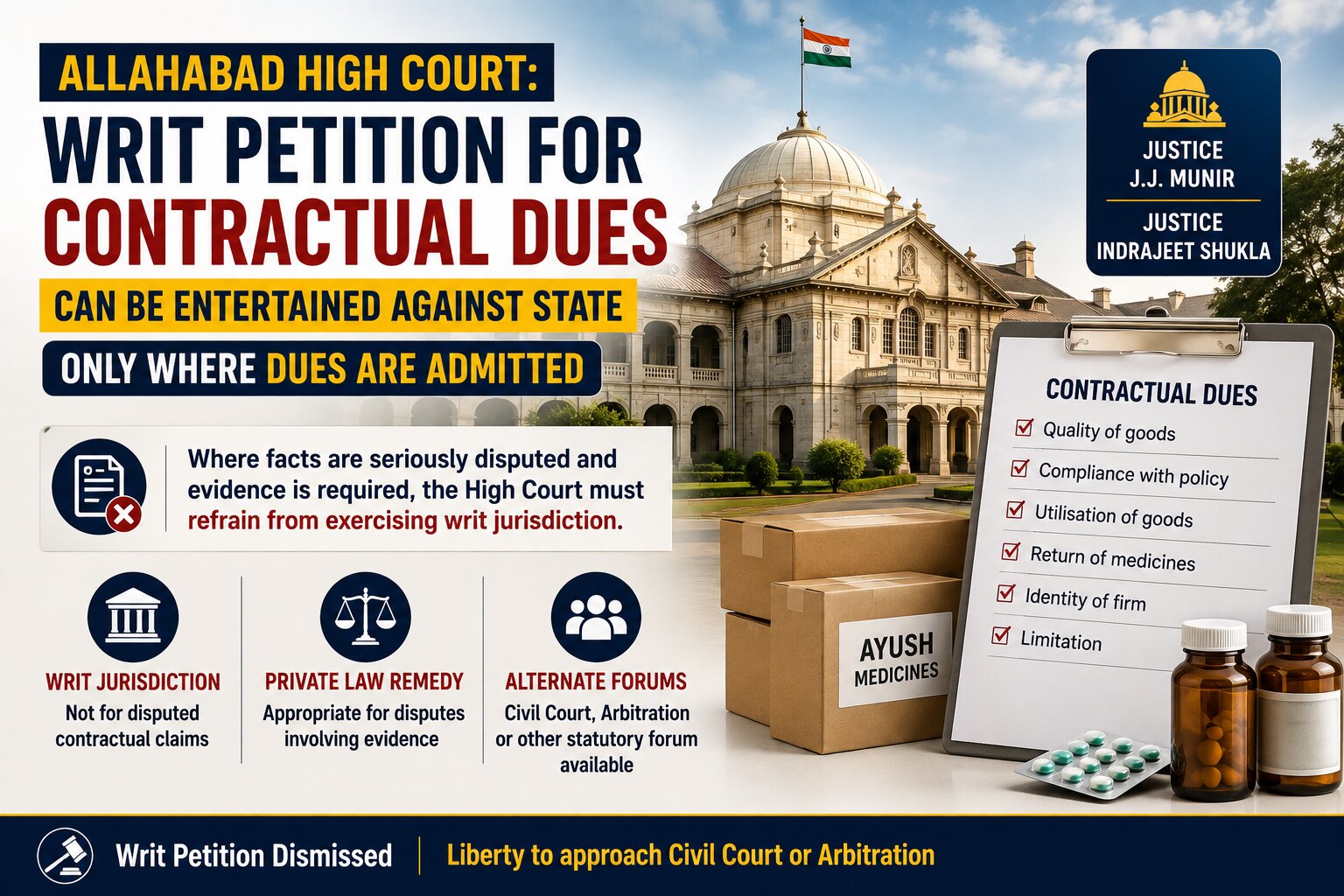
The Court held that a writ petition for recovery of contractual dues against the State is maintainable in appropriate cases where the liability is admitted and no factual inquiry is necessary.
Judgement Details
Court
Allahabad High Court
Date of Decision
18 August 2026
Judges
Justice J.J. Munir and Justice Indrajeet Shukla
Citation
Acts / Provisions
Facts of the Case
- The petitioner was a cooperative society registered under the Cooperative Societies Act, 1965.
-
The society was licensed to manufacture AYUSH medicines.
-
The office of the Chief Medical Officer, Allahabad issued a supply order to the petitioner for medicines.
-
The petitioner claimed that it supplied the medicines in accordance with the supply order.
-
The petitioner asserted that it had also paid approximately ₹2 lakh towards GST.
-
According to the petitioner, there was no fault or deficiency in the medicines supplied.
-
The petitioner's bills allegedly remained unpaid.
-
The petitioner approached the High Court earlier seeking consideration of its grievance.
-
The High Court directed the Chief Medical Officer to decide the petitioner's pending representation within eight weeks.
-
The Chief Medical Officer subsequently passed an order dated 8 October 2018, refusing to pass the petitioner's bills.
-
The petitioner challenged that order before the High Court.
-
The petitioner sought a mandamus directing the State authorities to make payment of the outstanding amount along with 18% interest.
-
The State disputed the petitioner's entitlement to payment.
-
The dispute involved questions concerning compliance with procurement policy, quality of medicines, utilisation of the supplied medicines, return of medicines, identity of the supplying firm and limitation.
-
The petitioner relied upon an alleged certification by the Chief Pharmacist concerning the supplied medicines.
-
However, the Court found that the alleged certification had not been placed on record.
-
The Court also noted that even if such certification existed, the competence of the Chief Pharmacist to certify the quantity and quality of the medicines would itself require examination.
-
The petitioner argued that the registration of other empanelled manufacturers had expired while its own registration remained valid.
-
The Court held that this circumstance by itself did not create a right in favour of the petitioner to receive payment.
-
The Court concluded that the disputed factual questions could not properly be determined through writ proceedings based only on affidavits.
Issues
-
Whether a writ petition under Article 226 of the Constitution seeking payment of contractual dues can be maintained against the State where the alleged liability is disputed?
-
Whether the High Court can exercise writ jurisdiction to determine contractual claims involving disputed questions concerning the quality, quantity and utilisation of supplied goods?
-
Whether a contractual claim for payment can be adjudicated under Article 226 when determination of the claim requires oral and documentary evidence and cross-examination of witnesses?
-
Whether the petitioner's claim for payment could be treated as an admitted contractual liability of the State warranting issuance of a writ of mandamus?
-
Whether the petitioner's alleged certification by the Chief Pharmacist was sufficient to establish the quantity and quality of the medicines supplied?
-
Whether the alleged continuation of the petitioner's registration, despite expiry of the registration of other empanelled manufacturers, created an enforceable right to payment?
-
Whether the petitioner should be relegated to the Civil Court, arbitration or another appropriate statutory forum for determination of its disputed contractual claim?
Judgement
-
The Allahabad High Court dismissed the writ petition.
-
The Court held that a writ petition seeking contractual dues can be entertained against the State in appropriate circumstances, particularly where the amount payable is admitted and no detailed factual inquiry is required.
-
However, the Court held that disputed contractual claims requiring evidence cannot ordinarily be adjudicated under Article 226.
-
The State had disputed several material aspects of the petitioner's claim.
-
These disputes concerned the quality and deficiency of medicines, compliance with procurement requirements, utilisation of the goods, return of medicines, identity of the firm and limitation.
-
The Court held that these issues could not properly be resolved merely on the basis of affidavits.
-
The disputed facts would require oral and documentary evidence, including the possibility of cross-examination.
-
The Court observed that disputes concerning the quality or deficiency of goods supplied arise from contractual rights and obligations.
-
Such disputes are more appropriately determined through private-law remedies.
-
The Court found that the alleged Chief Pharmacist's certification could not establish the petitioner's entitlement because the document itself had not been produced.
-
The Court further observed that the authority of the Chief Pharmacist to certify the relevant matters would itself require examination.
-
The Court rejected the argument concerning the continuing registration of the petitioner as insufficient to establish an automatic right to payment.
-
The Court relied upon its earlier decision in M/s Alaska Tech through its Partner Sanjeet Singh and another v. State of U.P. through Principal Secretary Urban Development and others.
-
The Court also relied upon the Supreme Court's decision in Hindustan Petroleum Corporation Limited and another v. Dolly Das.
-
Applying these principles, the Court declined to exercise its extraordinary writ jurisdiction.
-
The Court clarified that dismissal of the writ petition would not prevent the petitioner from approaching the Civil Court or another appropriate statutory forum, including arbitration.
Held
-
Where the contractual liability is seriously disputed, Article 226 should ordinarily not be used to determine the claim.
-
Questions involving quality, quantity, compliance, utilisation, return of goods and limitation may require evidence and cross-examination.
-
Such disputed contractual matters are more appropriately decided through private-law remedies.
-
The petitioner failed to establish an admitted liability requiring the High Court to issue a writ of mandamus.
-
The writ petition was therefore dismissed.
-
The petitioner remained free to pursue its claim before the Civil Court, arbitration or another competent statutory forum.
Analysis
-
Limits of Article 226: The judgment reinforces that writ jurisdiction is extraordinary and discretionary. It is not intended to function as an ordinary mechanism for recovering disputed contractual debts.
-
Admitted dues versus disputed dues: The key distinction is whether the State's liability is admitted. If the amount is admitted and no factual investigation is necessary, a writ may be considered. If liability itself is disputed, ordinary legal remedies are generally more appropriate.
-
Evidence cannot ordinarily be tested in writ proceedings: Where competing versions require documents, oral testimony and cross-examination, the High Court should ordinarily avoid conducting a full-fledged factual trial under Article 226.
-
Private-law remedy: The Court emphasised that disputes concerning contractual performance, including the quality and adequacy of goods supplied, are primarily matters of contractual rights and obligations.
-
Mandamus requires an enforceable right: A writ of mandamus cannot ordinarily be issued merely because a party claims that money is due under a contract. The claimant must establish an appropriate public-law or otherwise legally enforceable basis for the relief.
-
Quality of supplied goods: Whether medicines complied with contractual specifications is a factual question. It may require examination of the goods, procurement conditions, records and witness testimony.
-
Chief Pharmacist's certification: The Court did not automatically accept the alleged certification because the document was not on record and the competence of the issuing officer was itself potentially disputed.
-
Registration argument: The petitioner's continuing registration did not by itself establish that the State was legally obligated to make payment for the disputed supplies.
-
Alaska Tech principle: The Court reinforced the principle that a claim for money under a non-statutory contract for supply of goods may essentially amount to a claim for a money decree, which is ordinarily unsuitable for determination under Article 226 when substantial factual disputes exist.
-
Hindustan Petroleum principle: The judgment also reflects the Supreme Court's position that, in the absence of an appropriate constitutional or statutory right, Article 226 cannot ordinarily be invoked merely to recover money arising from breach of contract.
-
Alternative remedy preserved: Importantly, dismissal of the writ petition did not mean that the petitioner had no remedy. The Court expressly preserved the possibility of approaching the Civil Court, arbitration or another competent forum.
-
Broader significance: The decision maintains the boundary between public-law remedies and private contractual disputes, preventing writ jurisdiction from becoming a substitute for a civil trial in cases involving seriously disputed facts.