
The Branch Manager, National Insurance Company Limited v. Hasmukh Pannalal Punamiya & Others, 2026
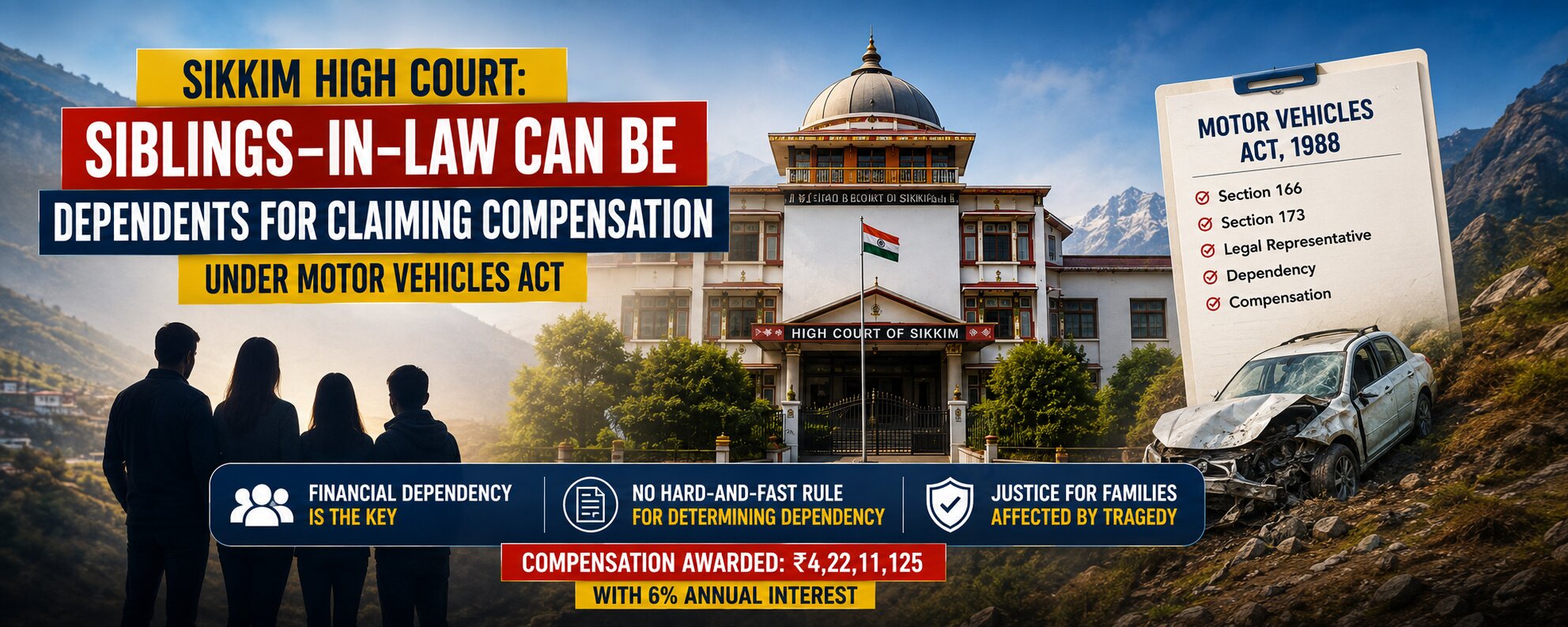
The Court held that legal representative does not necessarily mean legal heir under Section 166 of the Motor Vehicles Act.
Judgement Details
Court
High Court of Sikkim
Date of Decision
18 August 2026
Judges
Justice Meenakshi Madan Rai
Citation
Acts / Provisions
Facts of the Case
-
The case arose from a fatal motor vehicle accident in Sikkim.
-
The accident occurred on the intervening night of 28–29 May 2022 at Khedum along the Chungthang–Lachung Road in Mangan District.
-
The deceased was travelling with his wife and two minor children, who also died in the accident.
-
The claimants were the siblings of the deceased.
-
They claimed that they were members of a joint family and were financially dependent upon the deceased.
-
The deceased was claimed to be the principal source of income for the family.
-
The claimants relied upon the deceased's income records and Income Tax Returns to establish his earnings.
-
The Motor Accident Claims Tribunal awarded compensation of approximately ₹4.22 crore to the claimants.
-
The insurance company challenged the award before the High Court.
-
The insurer argued that the claimants were adult persons and financially independent, and therefore could not be treated as dependants.
-
The insurer also argued that because the deceased's wife and children had died in the same accident, the deceased should be treated as a bachelor for calculating personal expenses.
-
The High Court rejected this argument.
-
The Court found that the claimants had sufficiently established their financial dependency through evidence.
-
The insurer had not effectively disproved the claim of dependency through cross-examination or independent evidence.
-
The High Court therefore considered whether the claimants, although siblings, could qualify as legal representatives and dependants for compensation under the Motor Vehicles Act.
Issues
-
Whether the siblings of the deceased can qualify as legal representatives under Section 166 of the Motor Vehicles Act, 1988?
-
Whether adult siblings of the deceased can claim compensation for loss of dependency when their financial dependency upon the deceased is established through evidence?
-
Whether there is a fixed or hard-and-fast rule for determining whether a claimant is dependent upon a deceased person?
-
Whether the claimants established through pleadings and evidence that they were financially dependent upon the deceased's income?
-
Whether the deceased should be treated as a bachelor for calculating personal and living expenses merely because his wife and children also died in the same accident?
-
Whether the one-third deduction towards the deceased's personal and living expenses was appropriate in the circumstances of the case?
-
Whether the compensation awarded by the Motor Accident Claims Tribunal required interference on the ground that the claimants were not dependants of the deceased?
Judgement
-
The High Court dismissed the insurer's appeal and substantially upheld the compensation awarded by the Tribunal.
-
The Court held that the expression “legal representative” under Section 166 of the Motor Vehicles Act has a wider meaning and is not restricted only to conventional legal heirs.
-
The Court accepted that the deceased's siblings could fall within the expression “legal representatives”.
-
The Court held that there is no hard-and-fast rule for determining dependency.
-
Dependency must be decided according to the facts and evidence of each individual case.
-
The claimants had specifically pleaded financial dependency on the deceased.
-
Their evidence and the deceased's financial records supported their claim of dependency.
-
The insurer failed to effectively establish that the claimants had independent sources of income sufficient to disprove dependency.
-
The Court rejected the argument that the deceased should be treated as a bachelor merely because his wife and children also died in the accident.
-
The Court therefore upheld the one-third deduction towards personal and living expenses.
-
The Court applied the relevant principles concerning future prospects, multiplier and conventional heads of compensation.
-
The final compensation was fixed at approximately ₹4.22 crore, with 6% annual interest.
-
The Court directed payment of the compensation to the claimants in accordance with its directions.
Held
-
The Court held that siblings may qualify as legal representatives for the purpose of pursuing a motor accident compensation claim.
-
The Court held that dependency is a question of fact and must be established through evidence.
-
The Court held that there is no rigid formula for determining whether a person is dependent upon the deceased.
-
The claimants successfully established their financial dependency on the deceased.
-
The Court rejected the argument that the deceased should be considered a bachelor because his wife and children died in the same accident.
-
The Court upheld the applicable one-third deduction towards personal expenses.
-
The compensation awarded to the claimants was substantially upheld.
Analysis
-
Wider meaning of legal representative: The judgment makes clear that a person does not necessarily have to be a direct legal heir to qualify as a legal representative under the Motor Vehicles Act.
-
Dependency is evidence-based: The Court rejected a rigid approach and held that dependency must be determined from the actual facts and evidence of each case.
-
Adult siblings can be dependants: Merely being an adult does not automatically mean that a sibling is financially independent.
-
Proof remains necessary: Although the definition of legal representative is broad, a claimant seeking compensation for loss of dependency must establish actual dependency.
-
Importance of evidence: Income-tax records and evidence concerning the family's financial circumstances played an important role in establishing the deceased's contribution to the family.
-
Insurer's failure to rebut: The Court took note of the insurer's failure to effectively challenge the claimants' evidence or establish that they had independent sources of income.
-
Marital status issue: The Court rejected the argument that the deceased should be treated as a bachelor simply because his wife and children died in the same accident.
-
Application of established principles: The Court applied established principles concerning future prospects, personal expenses, multiplier and conventional compensation.
-
Beneficial nature of motor accident law: The decision reflects the broader objective of motor accident compensation law to provide meaningful compensation to persons who actually suffered financial loss because of the death.
-
Broader significance: The ruling is important for claims involving siblings and other non-traditional dependants, as it establishes that the relationship alone does not determine dependency.
-
A person may qualify as a legal representative, but entitlement to compensation for loss of dependency depends upon proof of actual financial dependency.