
Chintherla Padmavathi v. State of A.P. & Ors., 2026
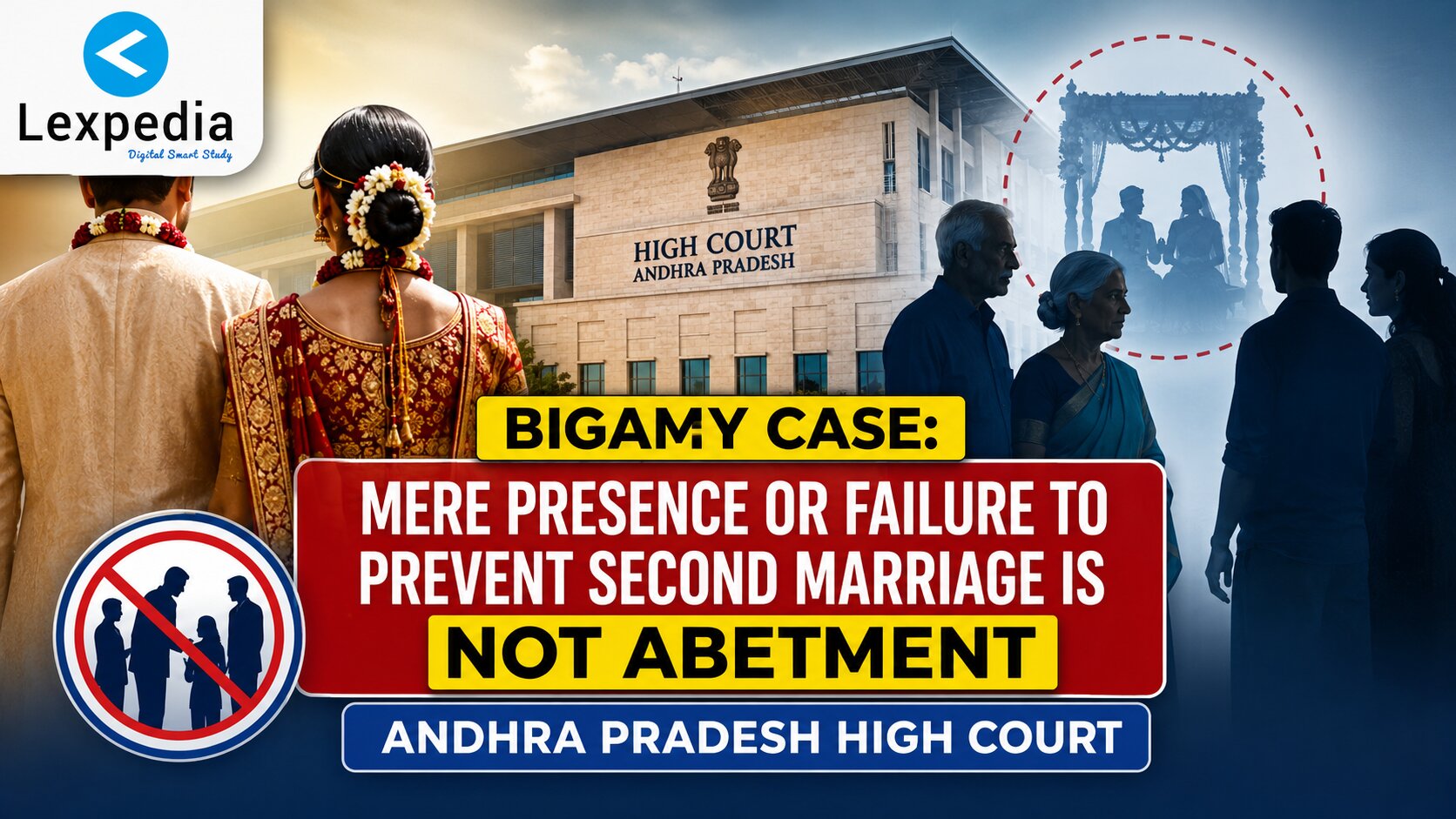
Mere presence at a bigamous marriage ceremony does not amount to abetment or instigation.
Judgement Details
Court
Andhra Pradesh High Court
Date of Decision
30 May 2026
Judges
Justice Subhendu Samanta
Citation
Acts / Provisions
Facts of the Case
-
The complainant married A1 (her husband) in 1975, and a daughter was born from the marriage.
-
During the subsistence of the first marriage, A1 allegedly developed an illicit relationship with A2.
-
It was alleged that A1 subsequently contracted a second marriage with A2 while his first marriage with the complainant remained legally valid.
-
The complainant alleged that several relatives and family elders either encouraged the second marriage or failed to prevent it despite having knowledge of the existing marriage.
-
It was further alleged that these relatives later pressured the complainant to accept A2 into the matrimonial home.
-
The trial court convicted A1 and A2 for offences under Sections 498-A and 494 IPC.
-
Certain relatives were also prosecuted under Sections 498-A and 494 read with Section 34 IPC.
-
The appellate court acquitted those relatives on the ground that there was insufficient evidence showing instigation, common intention, or active participation in the second marriage.
-
The complainant filed revision petitions before the High Court challenging the acquittal of the relatives.
Issues
-
Whether the relatives of A1 had instigated or abetted the commission of the alleged bigamous marriage between A1 and A2?
-
Whether the mere presence of family elders and relatives at the second marriage ceremony was sufficient to establish liability under Section 494 read with Section 34 IPC?
-
Whether the refusal or failure of the relatives to prevent the second marriage constituted evidence of common intention or abetment?
-
Whether the prosecution had proved that the relatives exercised influence, control, or authority over A1 and A2 so as to establish their participation in the commission of the offence?
-
Whether the acquittal of the relatives by the appellate court warranted interference in revision?
Judgement
-
The High Court examined whether the relatives had actively instigated, encouraged, or shared a common intention in relation to the second marriage.
-
The Court relied on the principles laid down in S. Nitheen v. State of Kerala, emphasizing that mere presence of an accused is insufficient and that an overt act, omission, or active participation must be established.
-
The Court observed that A1 and A2 were adults who had entered into the second marriage of their own free will.
-
The Court held that mere attendance at the marriage ceremony or consent to the marriage does not automatically amount to instigation or abetment.
-
The Court noted that the prosecution failed to prove that the relatives possessed such influence or authority over A1 and A2 that the marriage could not have taken place without their approval or encouragement.
-
The Court further held that even if the complainant and her family requested the relatives to stop the marriage, their failure or inability to prevent it did not establish criminal liability.
-
The Court emphasized that to prove common intention, the prosecution must establish not only knowledge of the act but also deliberate participation or wilful encouragement.
-
Finding no evidence of active involvement, instigation, or shared intention, the Court upheld the acquittal granted by the appellate court.
Held
-
Mere presence at a bigamous marriage ceremony does not amount to abetment or instigation.
-
Mere consent, knowledge, or failure to prevent a second marriage is insufficient to attract liability under Section 494 read with Section 34 IPC.
-
Criminal liability of relatives requires proof of intentional participation, instigation, abetment, or common intention.
-
The prosecution failed to establish the necessary mens rea and active involvement of the acquitted relatives.
-
The acquittal of the relatives was affirmed.
-
The criminal revision petitions were dismissed.
Analysis
-
The judgment reinforces the principle that criminal liability cannot be imposed merely on the basis of family relationship or association with the principal offenders.
-
The Court correctly distinguished between passive presence and active participation, ensuring that criminal law targets only those who intentionally contribute to the commission of an offence.
-
The decision emphasizes the importance of proving mens rea (guilty intention) in cases involving abetment and common intention.
-
By requiring proof of influence, authority, control, or active encouragement, the Court prevented the expansion of criminal liability to persons who merely witnessed or knew about the conduct.
-
The ruling aligns with established principles governing Sections 34 and 494 IPC, which require a clear nexus between the accused person's conduct and the commission of the offence.
-
The judgment strengthens safeguards against the misuse of criminal proceedings against extended family members in matrimonial disputes.
-
Reliance on S. Nitheen v. State of Kerala reflects the judiciary's insistence on concrete evidence of participation rather than assumptions arising from familial relationships.
-
The decision contributes to the jurisprudence on bigamy by clarifying the evidentiary threshold required to implicate relatives and family elders.