
Arjun Dass v. State of Andhra Pradesh, 2026
Religious & Secular Roles Can't Be Separated.
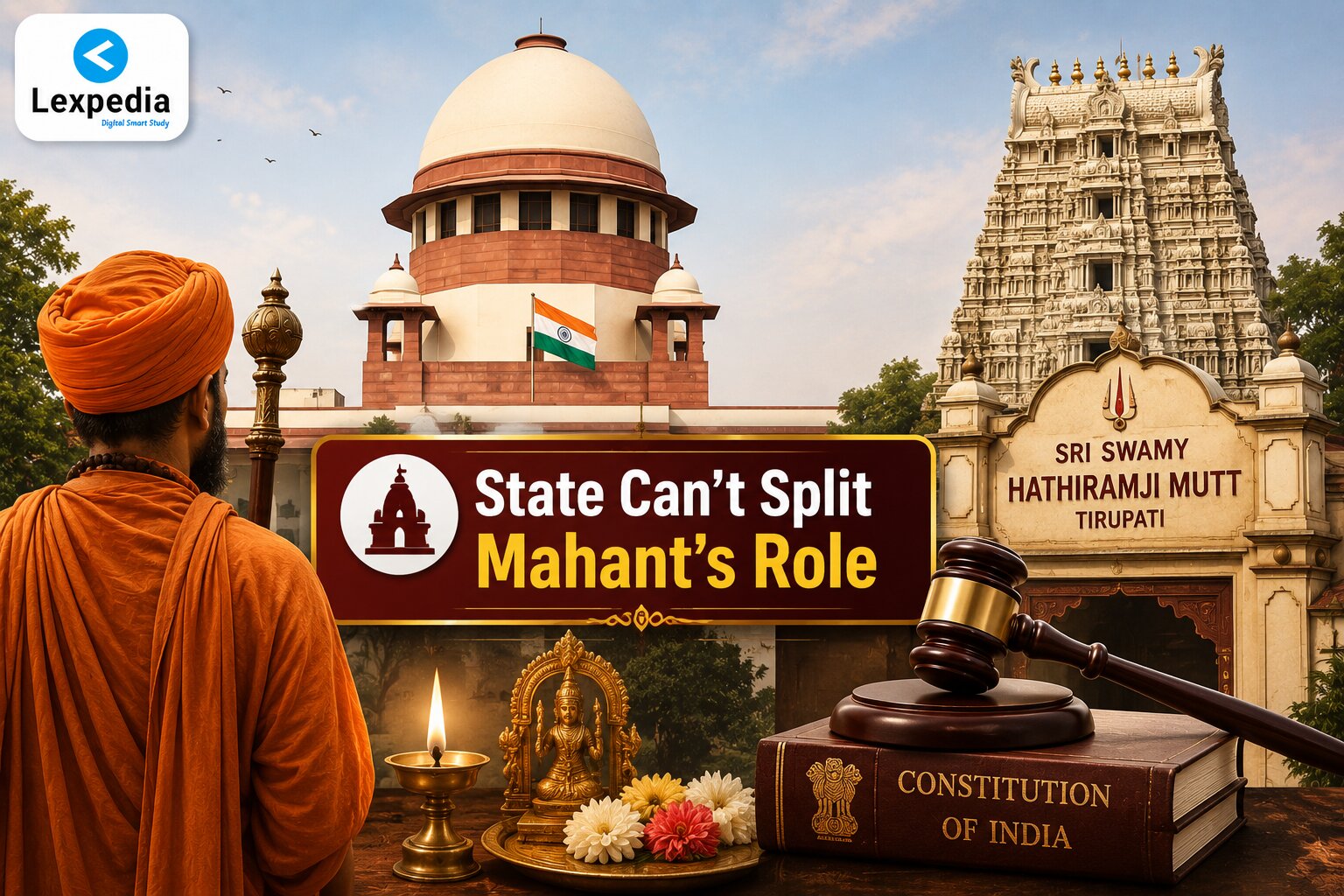
Judgement Details
Court
Supreme Court of India
Date of Decision
30 May 2026
Judges
Justice J.K. Maheshwari and Justice Atul S. Chandurkar
Citation
Acts / Provisions
Facts of the Case
-
Arjun Dass was recognized as the 21st Mahant (Mathadhipati) of the historic Sri Swamy Hathiramji Mutt, Tirupati.
-
He had been associated with the Mutt since 1970 and was formally recognized as Mahant in 2000.
-
His tenure witnessed several disputes with the Andhra Pradesh Endowments Department regarding control over the Mutt's administration and properties.
-
In 2017, newspaper reports alleged irregularities in the administration of the Mutt.
-
Based on these allegations, the Andhra Pradesh Dharmika Parishad initiated disciplinary proceedings.
-
On 8 June 2023, the Parishad framed 16 charges, suspended Arjun Dass from office, and appointed a Fit Person to administer the Mutt.
-
The charges included allegations of:
-
Misappropriation of funds.
-
Unauthorized dealings with Mutt properties.
-
Acquisition of personal assets.
-
Nepotistic appointments.
-
Failure to protect Mutt properties.
-
Administrative irregularities.
-
-
A three-member enquiry committee found all charges proved.
-
In November 2023, the Parishad removed Arjun Dass from office.
-
The State Government subsequently confirmed the removal.
-
The Andhra Pradesh High Court largely upheld the removal order.
-
Aggrieved, Arjun Dass approached the Supreme Court.
Issues
-
Whether the removal proceedings against the Mathadhipati were conducted in violation of the principles of natural justice?
-
Whether the appointment of a Fit Person and removal of the Mahant resulted in an impermissible separation of the spiritual and secular functions of a Mathadhipati?
-
Whether members of the Dharmika Parishad could participate in the enquiry after having initiated disciplinary proceedings against the appellant?
-
Whether the enquiry suffered from institutional bias and procedural unfairness?
-
Whether the State could indefinitely vest administrative powers of the Mutt in a government-appointed administrator while the lawful Mathadhipati remained in office?
-
Whether intervention under Article 142 was necessary to ensure complete justice?
Judgement
-
The Supreme Court held that the removal proceedings were fundamentally flawed and violated the principles of natural justice.
-
The Court found that the charge memo and supporting documents exceeding 600 pages were never properly supplied to the appellant.
-
It rejected the State's argument that service was effected by affixing notices on the Mutt premises after the authorities themselves had taken possession of those premises.
-
The Court described the State's stand as a "legal absurdity."
-
It observed that the enquiry was conducted ex parte, despite repeated requests for documents and adequate opportunity to defend.
-
The Court held that members of the Dharmika Parishad who initiated proceedings could not subsequently sit in judgment over the same proceedings.
-
It found that the enquiry violated the rule against bias and the principle that no one should be a judge in his own cause.
-
The Bench emphasized that the concept of Mahantship integrates both spiritual and administrative functions.
-
Relying on the Shirur Mutt judgment, the Court held that these functions cannot be permanently separated.
-
The Court ruled that any arrangement permanently vesting administrative powers in a Fit Person while leaving only spiritual functions to the Mahant would undermine the constitutional concept of Mahantship.
-
The Court set aside the removal order and the appointment of the Fit Person.
Held
-
The removal proceedings against Arjun Dass were vitiated by violations of natural justice.
-
The appointment of a Fit Person to indefinitely administer the Mutt was unconstitutional.
-
Spiritual and secular functions of a Mathadhipati cannot be permanently separated.
-
The orders removing Arjun Dass and appointing a Fit Person were quashed.
-
Arjun Dass was restored to office as Mathadhipati.
-
A fresh independent enquiry was directed.
Analysis
-
The judgment is a significant reaffirmation of religious autonomy under Article 26.
-
The Court reinforced the constitutional protection available to religious denominations against excessive State interference.
-
By relying on Shirur Mutt, the Court reaffirmed the traditional legal understanding of Mahantship as a composite institution involving both spiritual and temporal authority.
-
The ruling draws an important distinction between regulation and takeover of religious institutions.
-
While the State may regulate administration to prevent mismanagement, it cannot effectively strip a Mathadhipati of administrative authority while permitting him to retain only ceremonial functions.
-
The decision strengthens procedural safeguards by insisting upon strict compliance with natural justice before removing religious office-bearers.
-
The Court's discussion on institutional bias is particularly important because it reiterates that disciplinary bodies must remain independent and impartial.
-
The judgment serves as a precedent limiting arbitrary governmental control over religious institutions.
-
By invoking Article 142, the Court ensured a balanced solution that protects both institutional integrity and accountability.