
Zainab Gowhar Th. Her Mother v. Gowhar Rasool Bhat, 2026
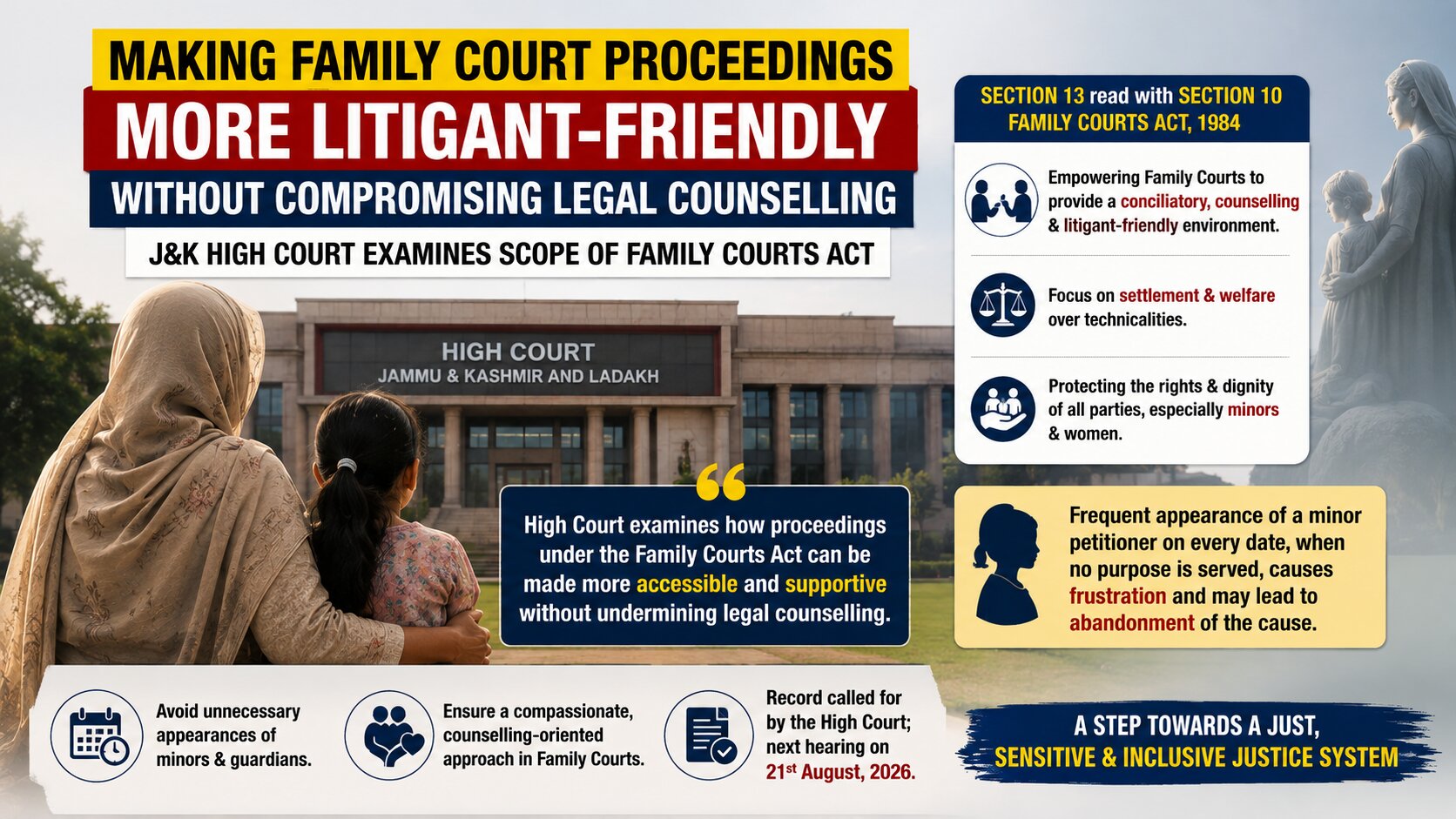
A minor litigant should not ordinarily be subjected to unnecessary or repetitive personal appearances when such attendance serves no effective judicial purpose.
Judgement Details
Court
High Court of Jammu & Kashmir and Ladakh
Date of Decision
25 August 2026
Judges
Justice Rahul Bharti
Citation
Acts / Provisions
Facts of the Case
-
The proceedings arose from a maintenance claim filed by a minor daughter against her father.
-
The minor petitioner approached the Family Court through her mother, who acted as her guardian.
-
The petitioner invoked Section 144 of the BNSS, 2023, seeking maintenance from her father.
-
The proceedings were pending before the Additional Judge Family Court, 4th Additional District Judge, Srinagar.
-
The petitioner raised a grievance regarding the manner in which proceedings were being conducted before the Family Court.
-
According to the petitioner, she was being required to appear personally along with her guardian mother on every date of hearing, even on dates when her personal presence served no effective purpose.
-
The petitioner contended that such repeated appearances imposed an unnecessary burden upon a minor and her guardian.
-
It was argued that a mechanical insistence upon personal appearance could cause frustration and hardship and could ultimately compel a litigant to abandon a legitimate legal claim simply to avoid repeated attendance before the court.
-
The grievance led the High Court to examine whether Family Court proceedings could be conducted in a more litigant-friendly manner while preserving the important functions of legal consultation and counselling.
-
The High Court considered the scope of Sections 10 and 13 of the Family Courts Act, 1984 in this context.
-
The Court referred to judgments of the Karnataka High Court, including High Court of Karnataka v. State of Karnataka and Mrs. Komal S. Padaukone v. Principal Judge, Family Court at Bangalore City & Anr., reported in AIR 1999 Karnataka 427.
-
Rather than immediately deciding the underlying maintenance entitlement, the High Court sought the relevant record from the Family Court so that it could properly examine the procedural grievance.
-
The Registrar Judicial, Srinagar, was directed to obtain the scanned record of the relevant file before the next hearing.
Issues
-
Whether requiring a minor petitioner and her guardian to appear personally on every date of hearing before a Family Court, even when their presence serves no effective purpose, is consistent with the litigant-friendly objectives of the Family Courts Act, 1984?
-
Whether Sections 10 and 13 of the Family Courts Act, 1984 permit Family Courts to adopt a flexible and less burdensome procedure so as to reduce unnecessary appearances by minor litigants?
-
Whether the procedure adopted by a Family Court should balance the need for legal consultation and counselling with the requirement of ensuring accessibility, convenience and fairness to litigants?
-
Whether repeated personal appearance of a minor petitioner and her guardian, when not required for effective adjudication, can frustrate access to justice and potentially discourage the continuation of a legitimate maintenance proceeding?
-
Whether Family Courts, while exercising their procedural powers, are required to adopt an approach that is sensitive to the particular circumstances of minors and other vulnerable litigants?
-
Whether the High Court should call for the Family Court record to examine whether the procedure followed in the proceedings was consistent with the objectives of the Family Courts Act, 1984?
Judgement
-
The High Court took up the procedural issue for examination concerning the manner in which Family Court proceedings should be conducted.
-
The Court recognized that the insistence upon repeated personal appearances by a minor, particularly when no effective purpose is served by such attendance, can create unnecessary hardship.
-
The Court considered the grievance that such a mechanical approach may create frustration for the minor petitioner and her guardian.
-
The Court stated that the proceedings under the Family Courts Act should be examined from the perspective of making them more litigant-friendly.
-
At the same time, the Court emphasized that greater procedural flexibility must not compromise the role of legal consultation and counselling, which forms an important part of the Family Court system.
-
The High Court examined Sections 13 and 10 of the Family Courts Act in light of the Karnataka High Court decisions referred to in the order.
-
The Court did not finally determine the minor's substantive entitlement to maintenance in the order described.
-
Instead, the Court directed the Registrar Judicial, Srinagar, to call for the scanned record of the Family Court proceedings.
-
The Registrar Judicial was directed to ensure that the requisitioned record was received before the next date of hearing.
Held
-
Family Court proceedings should be conducted in a manner that is litigant-friendly and sensitive to the circumstances of the parties.
-
Procedural requirements before Family Courts should be balanced against the need to ensure accessibility, convenience and effective participation of litigants.
-
The objective of making proceedings less burdensome does not mean eliminating the important functions of legal consultation and counselling.
-
The High Court considered the matter sufficiently important to examine the operation of Sections 10 and 13 of the Family Courts Act, 1984.
-
The High Court called for the Family Court record to properly examine the grievance raised by the minor petitioner.
-
The order was essentially procedural and exploratory; it did not finally adjudicate the underlying maintenance claim.
Analysis
-
Court’s reasoning: The Court's central concern was the practical accessibility of Family Courts. A legal remedy may exist on paper, but excessive procedural burdens can make that remedy difficult to pursue in practice.
-
Minor-centric approach: The case is particularly significant because the petitioner was a minor. Requiring a child and her guardian to attend every hearing can create financial, logistical and emotional burdens, particularly where the child's presence is unnecessary.
-
Litigant-friendly proceedings: The High Court's approach reflects the special character of Family Courts. Family Court proceedings are intended to be less adversarial and more conducive to reconciliation, counselling and meaningful resolution of family disputes.
-
Sections 10 and 13: The Court's examination of these provisions indicates that procedural rules before Family Courts cannot necessarily be viewed through the same rigid lens as ordinary civil litigation. The Court sought to understand how the statutory framework can facilitate effective and humane proceedings.
-
Balance with legal consultation: The Court did not suggest that procedural informality should eliminate professional legal assistance. Instead, the concern was to find an appropriate balance between legal consultation and a procedure that does not unnecessarily burden vulnerable litigants.
-
Access to justice: The order illustrates an important principle of access to justice: procedural convenience is not merely administrative when excessive requirements can discourage or prevent a person from pursuing a legal remedy.
-
Protection of minors: The Court's observations are particularly relevant to maintenance proceedings involving children. The child's welfare and ability to effectively pursue the proceeding should be considered when determining whether personal attendance is actually necessary.
-
Judicial efficiency: Requiring parties to appear when nothing substantive is to be done can also consume judicial and litigant resources. A more carefully managed hearing process can reduce unnecessary appearances without compromising adjudication.
-
Importance of the record: Instead of deciding the grievance solely on the basis of oral submissions, the High Court directed that the Family Court record be called for. This reflects a cautious judicial approach: the Court sought to examine how the proceedings were actually being conducted before determining the appropriate procedural response.
-
Nature of the order: It is important not to overstate the decision as a final declaration that minors can never be required to appear before Family Courts. The order instead raises and examines the circumstances in which personal appearance is genuinely necessary.
-
Broader significance: The case could contribute to the development of more child-sensitive and litigant-oriented Family Court procedures, particularly where repeated attendance serves no meaningful judicial purpose.
-
Practical impact: If the Court ultimately formulates procedural guidance, it could encourage Family Courts to distinguish between hearings requiring personal participation and routine dates where representation through a guardian or counsel may be sufficient.
-
Overall significance: The order emphasizes that Family Court procedure should facilitate the pursuit of justice rather than become an additional source of hardship for the very persons the statutory framework is intended to assist.