
Yellamma & Others v. Ramappa & Others, 2026
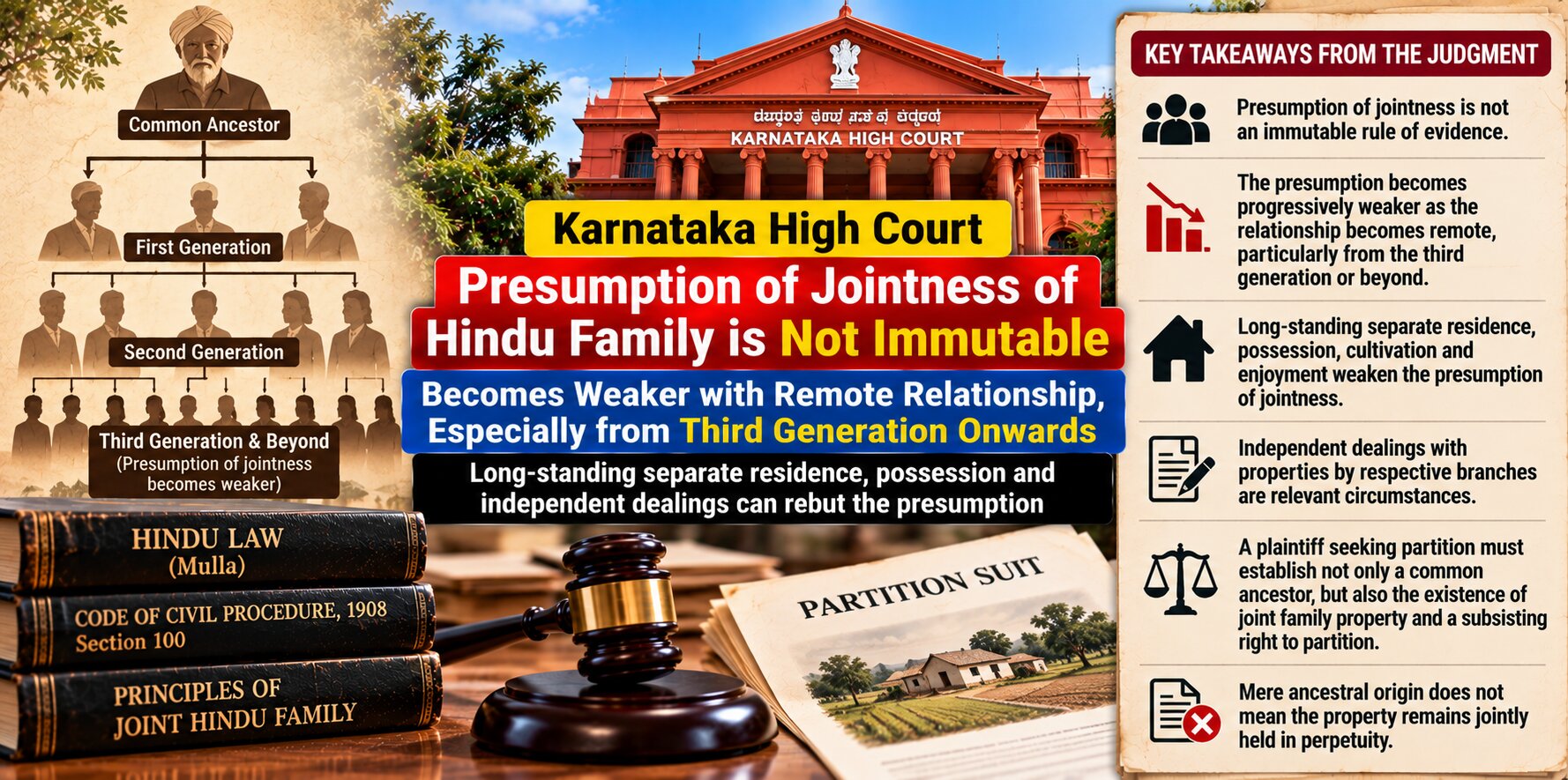
The presumption of jointness in a Hindu family is not an immutable rule of evidence.
Judgement Details
Court
High Court of Karnataka
Date of Decision
24 September 2026
Judges
Justice Sachin Shankar Magadum
Citation
Acts / Provisions
Facts of the Case
-
The dispute concerned a claim for partition of properties which the plaintiffs asserted were ancestral joint family properties.
-
The plaintiffs represented one branch descended from Bharmappa @ Bheema, while the defendants represented another branch descended from Sanna Bheemappa.
-
The plaintiffs claimed that both branches continued to constitute an undivided Hindu joint family.
-
They asserted that the suit schedule properties were joint family properties and claimed one-half share in those properties.
-
The Trial Court dismissed the plaintiffs' suit.
-
The plaintiffs challenged the dismissal before the First Appellate Court.
-
The First Appellate Court affirmed the Trial Court's decision.
-
The plaintiffs thereafter approached the Karnataka High Court by way of a regular second appeal under Section 100 CPC.
-
A significant issue before the High Court was whether the plaintiffs could rely upon the general presumption that a Hindu family is joint merely because the parties could trace their relationship to a common ancestor.
-
The evidence showed that the parties had been residing separately and cultivating their respective lands separately for more than 70 years.
-
Documentary material also indicated that the respective branches had independently dealt with the properties.
-
The Court noted a transaction dating back to 19 March 1946, when the properties had been sold by the fathers of certain defendants, followed by their repurchase in 1948.
-
The High Court considered these independent dealings together with the long-standing separate residence, possession, cultivation and enjoyment of the properties.
-
The Court also noted that the parties were not immediate descendants of the common ancestor; the dispute involved descendants extending into the third generation.
-
The High Court therefore examined whether the initial presumption of jointness remained sufficiently strong in light of the long period of separation and independent dealings.
-
The Court also distinguished between the initial presumption of jointness and the ultimate burden on a plaintiff seeking partition to establish a subsisting right in identifiable joint family property.
Issues
-
Whether the presumption that a Hindu family is joint continues with the same strength when the disputing parties are descendants belonging to the third generation or beyond?
-
Whether prolonged separate residence, separate possession, separate cultivation and independent dealings with property can weaken the presumption of continuing jointness?
-
Whether merely tracing the parties to a common ancestor is sufficient to establish that the disputed properties continued to be joint family properties?
-
Whether a plaintiff seeking partition is required to establish both the existence of joint family property and a subsisting right to partition in that property?
-
Whether the long-standing separate possession and independent transactions concerning the properties constituted sufficient circumstances to rebut the presumption of jointness?
-
Whether the concurrent findings of the Trial Court and First Appellate Court suffered from perversity or involved a substantial question of law warranting interference under Section 100 CPC?
Judgement
-
The Karnataka High Court dismissed the regular second appeal and upheld the concurrent findings of the Trial Court and First Appellate Court.
-
Justice Sachin Shankar Magadum held that the presumption of jointness of a Hindu family is not an immutable rule of evidence.
-
The Court explained that the presumption arises from the normal condition of a Hindu family but its strength depends upon the surrounding circumstances.
-
The further the members are removed from their common ancestor, and the longer they have lived and dealt with property separately, the weaker the presumption becomes.
-
The Court particularly emphasised that the presumption becomes progressively weaker where the dispute concerns members belonging to the third generation or beyond and the evidence demonstrates prolonged separation in residence, possession and enjoyment.
-
The Court rejected the proposition that a Hindu family should be treated as jointly held merely because its members can trace their ancestry to a common ancestor.
-
It observed that such an approach could effectively result in treating a family as joint in perpetuity despite generations of separate residence, cultivation, possession and independent property transactions.
-
The Court placed significant reliance on the admission of PW1 that the two branches had been residing separately and cultivating their respective lands for approximately seven decades.
-
The Court also considered documentary evidence demonstrating independent dealings with the properties.
-
The 1946 sale and subsequent 1948 repurchase were treated as relevant circumstances indicating that the respective branches had dealt with the properties independently.
-
The Court clarified that separate residence or separate cultivation in isolation may not necessarily establish partition because such arrangements can sometimes arise within a joint family.
-
However, when separate residence, possession, cultivation and enjoyment continue uninterruptedly for several decades and are accompanied by independent dealings with the properties, those circumstances become significant in determining whether jointness continues.
-
The Court distinguished the initial presumption of jointness from the ultimate burden resting on a plaintiff seeking partition.
-
A plaintiff cannot succeed merely by establishing that the parties share a common ancestor.
-
The plaintiff must establish that the property claimed is still joint family property and that a subsisting right to partition exists.
-
The Court held that the plaintiffs failed to establish that the two branches continued to constitute an undivided Hindu joint family.
-
The plaintiffs also failed to establish that the schedule properties continued to possess the character of joint family property available for partition.
-
The High Court found that the findings of the courts below were neither perverse nor contrary to settled principles of Hindu law.
-
The Court consequently found no substantial question of law requiring interference under Section 100 CPC.
-
The second appeal was dismissed.
Held
-
The strength of the presumption depends upon the relationship between the parties and the surrounding circumstances.
-
The presumption becomes progressively weaker as family members become more remote from the common ancestor.
-
The presumption is particularly weakened where the dispute concerns descendants in the third generation or beyond and there is evidence of prolonged separation.
-
Decades of separate residence, possession, cultivation and enjoyment are relevant circumstances against the continued existence of a joint family.
-
Independent dealings with the property by different branches can further weaken the presumption of continuing jointness.
-
A common ancestor alone does not establish a subsisting right to partition.
-
A plaintiff seeking partition must establish that the property continued to be joint family property at the relevant time and that the plaintiff had a subsisting interest in it.
-
An ancestral origin of property does not automatically mean that the property continues indefinitely as joint family property.
-
Long-standing separate possession and independent enjoyment can constitute compelling circumstances against a claim of continuing jointness when supported by other evidence.
-
The concurrent findings of the Trial Court and First Appellate Court were not shown to be perverse.
-
No substantial question of law was made out under Section 100 CPC.
-
The second appeal was therefore dismissed.
Analysis
-
Presumption versus proof: The judgment makes an important distinction between the traditional presumption that a Hindu family is joint and the actual burden of proving a present, enforceable right to partition. The presumption is a starting point; it is not conclusive proof of continuing jointness.
-
Remoteness of relationship matters: The Court's reasoning recognises that the evidentiary strength of jointness cannot remain identical across several generations. Where parties are separated by multiple generations, the surrounding conduct of the branches becomes increasingly important.
-
Seven decades of separation: The admission regarding separate residence and cultivation for approximately 70 years was particularly significant. The Court treated such a prolonged period as materially different from a temporary arrangement between members of an otherwise joint family.
-
Separate possession and cultivation: The Court did not treat separate residence alone as conclusive proof of partition. Rather, it considered residence together with separate possession, cultivation, enjoyment and independent dealings with the property.
-
Independent property transactions: The historical transactions involving the disputed properties were important because they demonstrated conduct consistent with the branches treating the properties independently. Such conduct weakened the plaintiffs' assertion that the property remained jointly held.
-
Ancestral does not necessarily mean presently joint: One of the important principles emerging from the judgment is that a property may have an ancestral origin without necessarily continuing to possess the character of joint family property indefinitely. The relevant inquiry is whether the property remained jointly held and whether a subsisting right to partition existed when the suit was instituted.
-
Burden on partition plaintiff: A person seeking partition cannot rely solely upon genealogy. The claimant must establish the legal and factual basis for the claimed share, including the existence of joint family property and a subsisting interest capable of partition.
-
Effect of alleged prior severance: Where defendants plead prior separation or severance and produce evidence of long-standing separate possession and enjoyment, the plaintiff must address that evidence rather than relying exclusively on the general presumption of jointness.
-
Section 100 CPC: Because this was a second appeal, the High Court's jurisdiction was restricted to substantial questions of law. The Court found that the lower courts had properly assessed the evidence and that their findings were not perverse. Therefore, another possible interpretation of the evidence was insufficient to justify interference.
-
Ordinary human experience: The Court also relied upon practical considerations. Treating every family as perpetually joint solely because its members can trace descent to a common ancestor would disregard generations of actual conduct showing separate residence, possession and independent dealings.
-
No automatic rule of severance: The judgment should not be read to mean that separate residence or cultivation automatically proves partition in every Hindu family. The Court's reasoning was based on the cumulative effect of prolonged separation and independent possession, enjoyment and transactions.
-
Practical significance: The decision is important in partition litigation where plaintiffs rely on the ancestral nature of property and genealogical relationship while defendants rely on decades of separate possession and enjoyment.
-
Overall significance: The ruling reinforces that the question in a partition suit is not simply whether the parties once descended from a common ancestor, but whether, on the evidence, a joint family and a subsisting joint-family property interest continued to exist when the partition claim was brought.