
XXX v. YYY, 2026
The availability of relief under Section 25 of the Hindu Marriage Act does not bar a claim under Section 24 during the pendency of the appeal.
Judgement Details
Court
Delhi High Court
Date of Decision
14 July 2026
Judges
Justice Vivek Chaudhary and Justice Renu Bhatnagar
Citation
Acts / Provisions
Facts of the Case
-
The parties were married in December 2012.
-
The husband, a serving officer in the Indian Army, instituted divorce proceedings under Sections 13(1)(ia) and 13(1)(ib) of the Hindu Marriage Act, 1955, alleging cruelty and desertion.
-
During the pendency of the matrimonial proceedings, the Family Court directed the husband's employer to deduct 30% of his gross salary, after statutory deductions, and pay it to the wife as interim maintenance with effect from 18 May 2022.
-
The interim maintenance order was subsequently affirmed by the Delhi High Court.
-
In July 2025, the Family Court granted a decree of divorce in favour of the husband.
-
Aggrieved by the decree, the wife filed an appeal before the Delhi High Court challenging the dissolution of the marriage.
-
She also sought continuation of the interim maintenance already granted under Section 24 of the Hindu Marriage Act during the pendency of the appeal.
-
The husband opposed the application, contending that Section 24 operates only till the conclusion of the proceedings before the Family Court and that the wife should instead seek relief under Section 25 of the Hindu Marriage Act.
-
The husband further argued that the wife, being an MBA graduate with previous employment experience, was capable of maintaining herself.
-
The High Court was therefore called upon to determine whether interim maintenance under Section 24 continues during the pendency of an appeal against a divorce decree.
Issues
-
Whether interim maintenance granted under Section 24 of the Hindu Marriage Act, 1955 continues during the pendency of an appeal against a decree of divorce?
-
Whether an appeal under Section 19 of the Family Courts Act constitutes a continuation of the original matrimonial proceedings for the purposes of Section 24 of the Hindu Marriage Act?
-
Whether the availability of a remedy under Section 25 of the Hindu Marriage Act bars continuation of interim maintenance under Section 24 during appellate proceedings?
-
Whether the wife's educational qualifications and earning capacity alone are sufficient to deny her interim maintenance?
Judgement
-
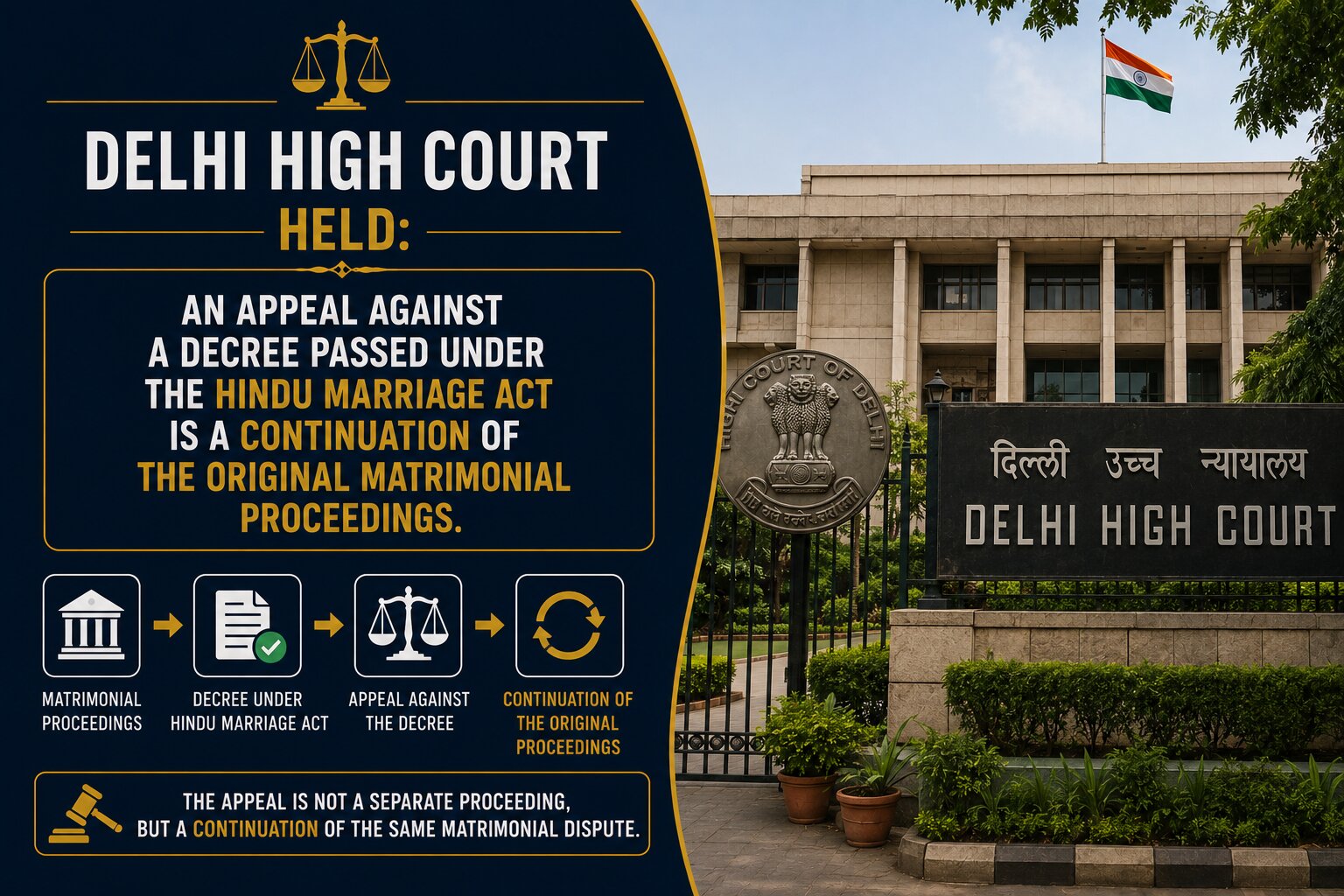
The Delhi High Court held that an appeal against a decree passed under the Hindu Marriage Act is a continuation of the original matrimonial proceedings.
-
The Court observed that proceedings do not attain finality merely because the Trial Court has delivered its judgment, as they continue until all appellate remedies are exhausted.
-
The Court held that the expression "during the proceeding" occurring in Section 24 of the Hindu Marriage Act includes the appellate stage.
-
The Court rejected the husband's contention that Section 24 ceases to operate after the Family Court grants a decree of divorce.
-
The Court clarified that Section 24 and Section 25 of the Hindu Marriage Act operate in different fields, with Section 24 governing interim maintenance during pending proceedings and Section 25 providing for permanent alimony after the decree.
-
The Court held that the existence of a pending application under Section 25 does not extinguish the wife's entitlement to interim maintenance under Section 24 during the pendency of the appeal.
-
Referring to Shailja v. Khobbanna, the Court reiterated that mere educational qualifications or earning capacity do not disentitle a spouse from maintenance unless it is shown that the spouse is actually earning sufficient income.
-
The Court distinguished the Supreme Court's decision in Sukhdev Singh v. Sukhbir Kaur, observing that it did not address the question of continuation of Section 24 maintenance during appellate proceedings.
-
Accordingly, the Court directed the husband to continue paying 30% of his gross salary, after statutory deductions, as interim maintenance to the wife until disposal of the appeal or until further orders.
Held
-
Proceedings under the Hindu Marriage Act continue during the pendency of an appeal.
-
Interim maintenance under Section 24 of the Hindu Marriage Act continues during appellate proceedings.
-
Mere capability or qualification to earn is not a valid ground to deny maintenance where the spouse is not actually earning.
-
The husband was directed to continue paying 30% of his gross salary, after statutory deductions, as interim maintenance.
Analysis
-
The judgment provides an important clarification regarding the scope of Section 24 of the Hindu Marriage Act, confirming that interim maintenance remains available throughout appellate proceedings.
-
By treating an appeal as a continuation of the original matrimonial proceedings, the Court adopted a purposive interpretation that furthers the welfare objective underlying Section 24.
-
The decision prevents a financially dependent spouse from being left without support merely because a decree has been passed by the Trial Court while an appeal remains pending.
-
The Court correctly distinguished Section 24 from Section 25, emphasizing that the two provisions serve different purposes and operate at different stages of matrimonial litigation.
-
The reliance on Shailja v. Khobbanna reinforces the settled principle that earning capacity is distinct from actual earning, and maintenance cannot be refused merely because a spouse possesses educational qualifications or employment potential.
-
The ruling strengthens access to justice by ensuring that financial hardship does not discourage an aggrieved spouse from exercising the statutory right of appeal.
-
Overall, the judgment advances the protective object of matrimonial maintenance provisions by ensuring continuity of financial support until matrimonial proceedings attain finality.