
Latest JudgementIndian Penal Code, 1860Special Marriage Act, 1954Code of Criminal Procedure, 1973
R v. State of Rajasthan & Another, 2026
Quashes FIR Against Husband Over Delayed Black Magic and Rape Allegations
Rajasthan High Court·6 August 2026
Judgement Details
Court
Rajasthan High Court
Date of Decision
6 August 2026
Judges
Justice Anoop Kumar Dhand
Citation
Acts / Provisions
Section 375, Indian Penal Code, 1860,
Exception 2 to Section 375, IPC,
Section 376, Indian Penal Code, 1860,
Special Marriage Act, 1954,
Rajasthan Prevention of Witch Hunting Act, 2015,
Section 482, Code of Criminal Procedure, 1973
Facts of the Case
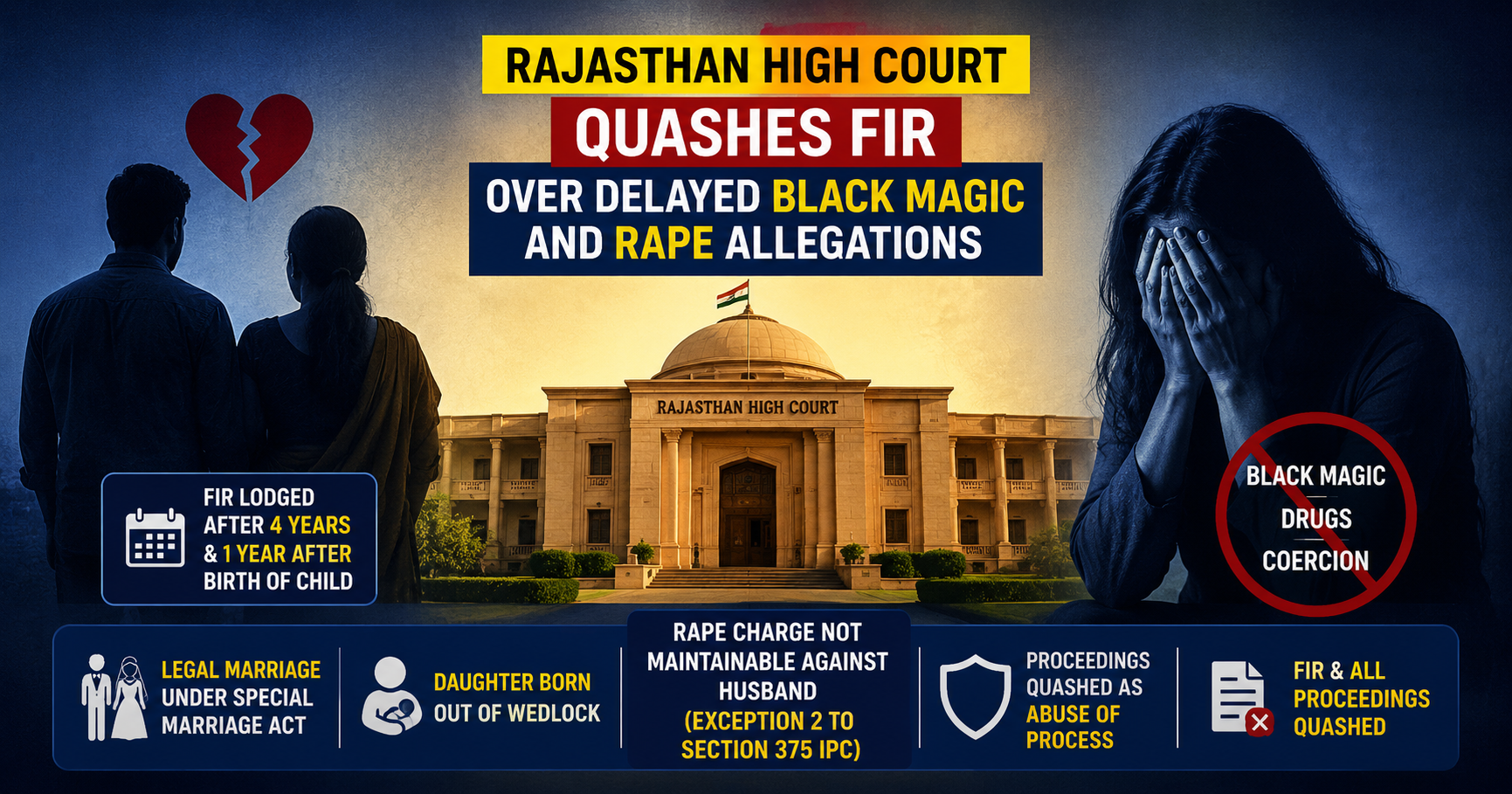
- The respondent-wife, a divorced woman, entered into an inter-faith marriage with the petitioner under the Special Marriage Act, 1954. Soon after the marriage, the couple sought police protection due to threats from others. During the subsistence of the marriage, they lived together as husband and wife, and a daughter was born from the marriage.
- Nearly four years after the marriage, and about one year after the birth of the child, the wife lodged an FIR alleging that the petitioner had induced her into marriage through drugs, medicines, and black magic. She further alleged that he had committed rape upon her.
- The husband approached the Rajasthan High Court seeking quashing of the FIR, contending that the allegations were fabricated and that the offence of rape was legally unsustainable since he was the complainant's legally wedded husband.
Issues
- Whether the offence of rape under Section 376 IPC could be invoked against a legally wedded husband in view of Exception 2 to Section 375 IPC.
- Whether the allegations of black magic, drugs, and coercion disclosed a prima facie criminal offence.
- Whether the FIR lodged nearly four years after marriage and after the birth of a child constituted an abuse of the process of law.
- Whether the High Court should exercise its inherent jurisdiction to quash the criminal proceedings.
Judgement
- The Rajasthan High Court allowed the petition and quashed the FIR along with all consequential criminal proceedings.
- The Court held that the allegation of rape was legally untenable because the petitioner was the complainant's legally wedded husband, attracting Exception 2 to Section 375 IPC. It further found that the remaining allegations relating to black magic, drugs, and coercion were vague and unsupported by prima facie material.
- The Court observed that the FIR had been lodged after an unexplained delay of almost four years following the marriage and one year after the birth of their daughter, indicating that the criminal proceedings lacked bona fides.
Held
- The offence under Section 376 IPC was not made out because the petitioner was the complainant's legally wedded husband and was covered by Exception 2 to Section 375 IPC.
- The allegations regarding drugs, medicines, and black magic were vague and insufficient to constitute the alleged offences.
- The delayed FIR and surrounding circumstances demonstrated misuse of the criminal justice process.
- The High Court exercised its inherent powers to quash the FIR and all consequential proceedings as an abuse of the process of law.
Analysis
- The Court reaffirmed the legal position prevailing under the Indian Penal Code at the relevant time that Exception 2 to Section 375 IPC excludes sexual intercourse by a husband with his wife from the offence of rape (subject to statutory exceptions). Consequently, the charge under Section 376 IPC could not survive against the petitioner solely because he was the legally wedded husband.
- The Court emphasized that criminal law cannot be invoked on the basis of vague, speculative, or inherently improbable allegations. The unexplained delay of approximately four years in lodging the FIR, despite the parties living together and having a child, substantially weakened the prosecution's case.
- The Court held that allegations involving black magic, drugs, and coercion must be supported by credible material before criminal prosecution can proceed. Mere assertions without supporting evidence are insufficient to justify a criminal trial.
- The judgment illustrates the High Court's power to prevent misuse of criminal proceedings. Where allegations do not disclose the commission of an offence or continuation of prosecution would amount to harassment, the High Court may quash the proceedings to secure the ends of justice.
- Reinforces the principles governing the exercise of the High Court's inherent jurisdiction in quashing FIRs.
- Emphasizes that delayed and unsupported allegations require careful judicial scrutiny.
- Reiterates the legal effect of Exception 2 to Section 375 IPC, as applicable to offences governed by the IPC at the relevant time.
- Highlights that criminal law should not be used as a tool of personal vendetta or matrimonial retaliation where no prima facie offence is disclosed.