
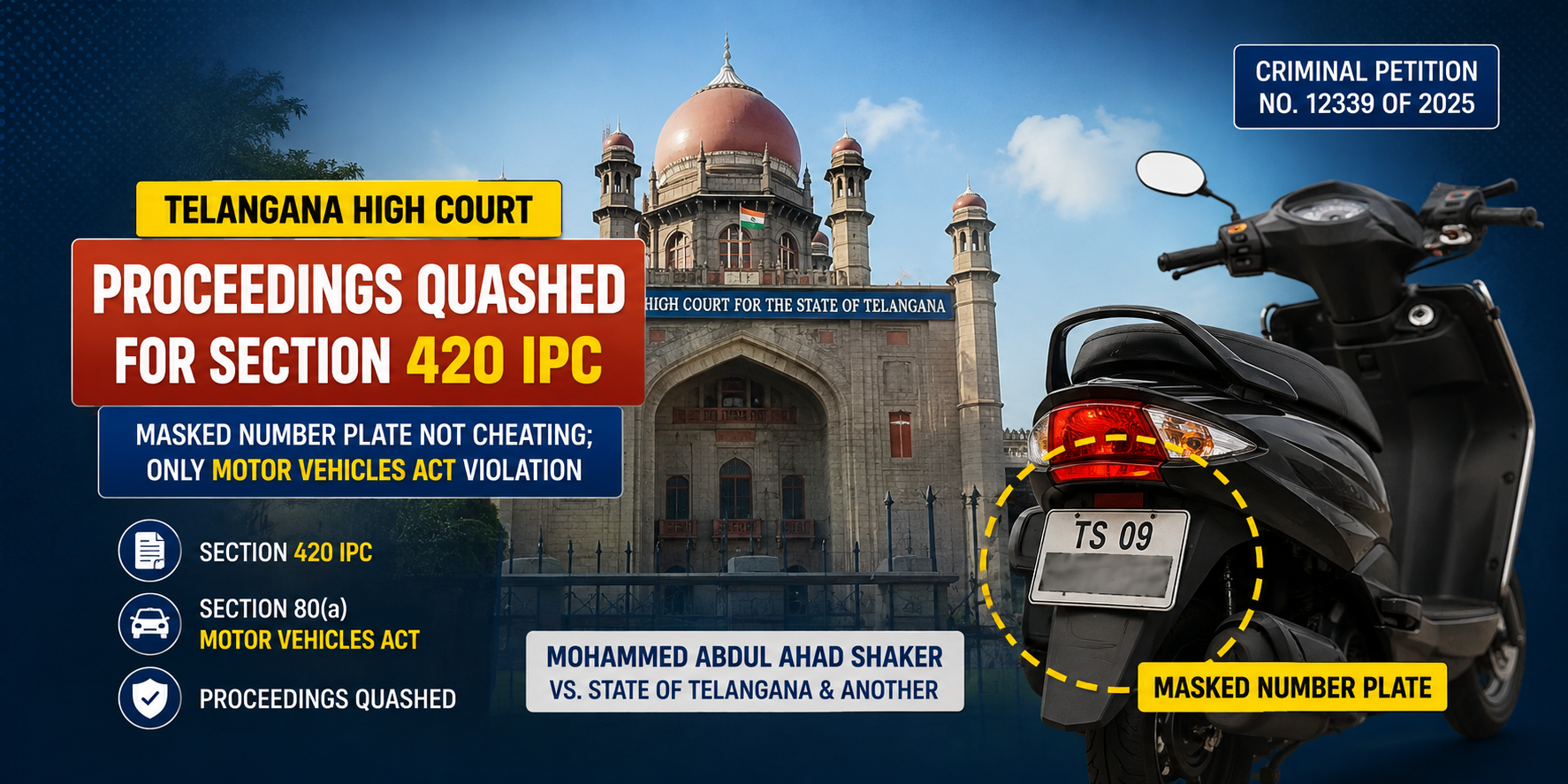
Mohammed Abdul Ahad Shaker v. State of Telangana and Another, 2026
Masked Number Plate Does Not Constitute Cheating.
Judgement Details
Court
Telangana High Court
Date of Decision
1 August 2026
Judges
Justice Tirumala Devi Eada
Citation
Acts / Provisions
Facts of the Case
-
The petitioner sought quashing of criminal proceedings pending in C.C. No. 7840 of 2020 before the VII Additional Chief Metropolitan Magistrate, Nampally, Hyderabad.
-
The prosecution alleged that the petitioner drove a Honda Activa with its registration number plate masked/obscured.
-
Based on this allegation, the police filed a charge sheet for offences under Section 420 IPC and Section 80(a) of the Motor Vehicles Act.
-
The petitioner argued that he never intended to deceive or cheat anyone and that the allegations, even if accepted, did not satisfy the essential ingredients of cheating under Section 420 IPC.
-
He therefore invoked the High Court's inherent jurisdiction under Section 528 BNSS seeking quashing of the proceedings.
Issues
-
Whether masking or obscuring a vehicle's registration number plate constitutes the offence of cheating under Section 420 IPC.
-
Whether the allegations disclosed the essential ingredients of dishonest intention required under Section 420 IPC.
-
Whether continuation of criminal proceedings for Section 420 IPC would amount to an abuse of the process of law.
-
Whether the High Court should exercise its inherent jurisdiction under Section 528 BNSS to quash the proceedings.
Judgement
The High Court observed that:
-
For an offence under Section 420 IPC, the prosecution must establish dishonest or fraudulent intention from the very beginning of the transaction.
-
The allegations against the petitioner merely indicated that the vehicle's registration number was allegedly masked.
-
There was no allegation that the petitioner induced any person to deliver property or caused wrongful loss through deception.
-
The essential ingredients constituting the offence of cheating were therefore absent.
-
Consequently, prosecution under Section 420 IPC could not be sustained merely because the registration plate was obscured.
Held
The High Court held that:
-
Section 420 IPC was not attracted on the facts alleged.
-
The allegations primarily related to a possible violation under the Motor Vehicles Act, but they did not constitute the offence of cheating.
-
Accordingly, the Court exercised its powers under Section 528 BNSS and quashed the criminal proceedings insofar as they related to the offence under Section 420 IPC.
Analysis
-
Deception of a person.
-
Dishonest or fraudulent intention at the inception.
-
Inducement leading to delivery of property or alteration of a valuable security.
-
Resulting wrongful loss or wrongful gain.
-
Absent these elements, a prosecution for cheating cannot be sustained.
-
The Court distinguished a traffic or regulatory violation from the serious offence of cheating.
-
Masking a registration plate may violate provisions of the Motor Vehicles Act, but such conduct does not automatically amount to cheating unless the statutory ingredients of Section 420 IPC are independently established.
-
The judgment reflects the principle that criminal law should not be invoked by mechanically adding serious penal provisions where factual allegations disclose only a minor statutory violation.
-
The High Court exercised its inherent jurisdiction under Section 528 BNSS to prevent abuse of the judicial process where the allegations, even if accepted in entirety, did not disclose the commission of the alleged offence.